Adjustable Rope Bridge

An adjustable bridge is great. But my personal take on the rope grab is that it is pushing directly on the bridge paw. On the TM saddle I would worry about it metal on metal contact always pushing and rubbing on that paw. You could just clip a biner on it and use a short lanyard that way you would just be pulling on it or something. I am not trying to start a debate but for me the roll'n lock would have to be on the inside of the bridge.
Ted
Not 100% sure if the movement is significant or even notable enough for mention, between the rollnlock and the TM's rigging plate. If the rollnlock has nowhere to go except up against the rigging place then contact becomes more passive, and when under weight it's all tucked in. All you really need is a small beaner to hold the rollnlock on the rope-bridge, from outside of the plate and tension does the rest.
 
Does anyone know where I can buy new or used TM bridge rings? Got some bridge tests I want to do and using the exact rings would be helpful.
I'll be doing some on the Rollnlock too.

Look forward to the results Richard, I've been using the roll n lock a long time now & haven't had any problems, I change the globe rope bridge regularly also ..


Sent from my iPhone using Tapatalk
 
I connected my RollNLock to my tM bridge-plate using a zip-tie. It's been working great on several climbs, with no slippage and no excess friction. Using a 5' bite of Yale Kernmaster Safari for a bridge-cord with stopper knots on both sides seems to be a perfect length when fully extenuated. When cranked in tight during ascents, it keeps everything nice and compact. So far, I've not noticed any excess wear and tear on either the bridge-cord or the bridge-plate.
 
I wonder what happens when the climber has the bridge shortened up and leans left. The bridge ring would slide over and hit the top of the hitch and cause it to slip...right???

I do like the tether from the ZZ up!

I used to run some 5mm Maxim cord as a rope bridge adjuster and never had an issue with a ring/swivel causing the hitch to slip. Probably a year of climbing on it till I switched to CT roll n lock.

The cordage had enough bite that you needed to unweight your bridge before adjusting. However, in the right situation, it might still slip. Like Jeff said, I think if you do use cordage to make an adjustable bridge, it would be important to not have a huge amount of bridge length in case of a slip. Or just avoid it all together.

Correction: It was 6mm Oceans
 
Last edited:
I used to run some 5mm Maxim cord as a rope bridge adjuster and never had an issue with a ring/swivel causing the hitch to slip. Probably a year of climbing on it till I switched to CT roll n lock.

The cordage had enough bite that you needed to unweight your bridge before adjusting. However, in the right situation, it might still slip. Like Jeff said, I think if you do use cordage to make an adjustable bridge, it would be important to not have a huge amount of bridge length in case of a slip. Or just avoid it all together.
100% agree and in fact I've never really thought that huge amount of rope bridge length was the point. It only takes about 8" to get what I'm after. (Please, no, "that's what she said jokes"!
 
Oh man killjoy, that was perfect for an 8 incher joke.

But in the video, hard to tell where the hitch is actually attached. It appears to be a shackle from a DMM swivel attached to a non-load bearing point of the TM - it should go to the ring or at least the webbing correct? Maybe it is and I just couldn't see it. Great concept though.
 
I wonder what happens when the climber has the bridge shortened up and leans left. The bridge ring would slide over and hit the top of the hitch and cause it to slip...right???

Yes I see the same disadvantage and agree.

I do like the tether from the ZZ up!

Me too, but we have seen here similar ideas in the past. Glad that I could find it:
http://www.treebuzz.com/forum/threads/zigzag-and-rw-tether-my-avatar.31075/#post-441280
 
I like how the hitch is 'woven' through the D, that could make that half of the hitch act as a sort of stopper knot so as to relieve some of the strain on the loop he has the shackle connected to. I don't really know if that's the case, but maybe.

I like the CT Mumford n Lock system better! However, this guys solution is really nice and clean.

Thanks again @yoyoman Richard for that innovation!
 
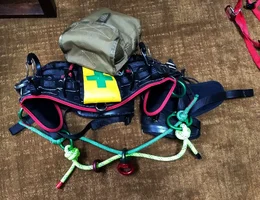
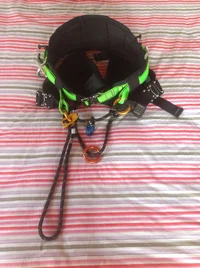
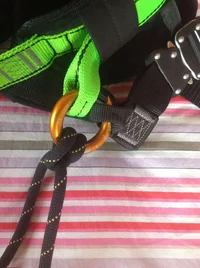
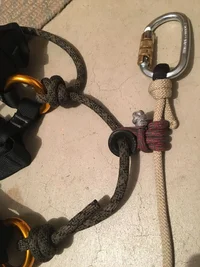
Adjustable bridge, double bridge... Why not have an adjustable one + a fixed one?

After I had replaced my standard bridge with a Petzl adjustable one, I did not like the amount of extra rope I never used, but had to deal with.
I was thinking about cutting a piece of this long bridge but realized that this extra length could become a second bridge. That's what I did: See pictures

Note: This has probably been done before, but I could not find anything similar yet.
 

Attachments

  • Modif deux ponts dont un réglable - 1.webp
    Modif deux ponts dont un réglable - 1.webp
    472.1 KB · Views: 74
  • Modif deux ponts dont un réglable - 2.webp
    Modif deux ponts dont un réglable - 2.webp
    486.4 KB · Views: 75
  • Modif deux ponts dont un réglable - 3.webp
    Modif deux ponts dont un réglable - 3.webp
    429.5 KB · Views: 75
  • Modif deux ponts dont un réglable - 4 .webp
    Modif deux ponts dont un réglable - 4 .webp
    449.1 KB · Views: 74
I use a petzl adjust with velocity for a 2nd adjustable bridge on my tm. I connect the adjust to one side of the lower d's with the recommended petzl spirit biner and girth hitch a loop to the other lower d. Now I don't always use it but if i do i have it connected like this so I can easily take it off and send it back down if I don't want it anymore, or sometimes use it as a lanyard, friction saver or redirect.
 
I use a petzl adjust with velocity for a 2nd adjustable bridge on my tm. I connect the adjust to one side of the lower d's with the recommended petzl spirit biner and girth hitch a loop to the other lower d. Now I don't always use it but if i do i have it connected like this so I can easily take it off and send it back down if I don't want it anymore, or sometimes use it as a lanyard, friction saver or redirect.

I like your solution which allows you to easily take it off when not needed. I suppose that because of the length of the biner, you use this additional 'bridge' especially when you need one longer than the original.
 

New threads New posts

Back
Top Bottom