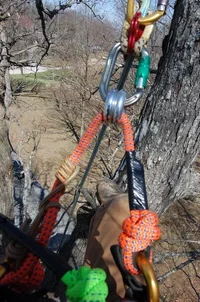
adjustable bridge

Cycles to failure is not directly related to breaking strength. CTF in metals is generally a function of fatigue.

For myself, I just like soft rope grabs a lot better and I definitely trust them more.

I've shock loaded my harness before, dropped about 4' when a tulip branch I was standing on snapped. I was at the top of the tree on DdRT so no rope out to stretch at all... next day I felt like I'd been in a car wreck.
 
Tom, do you use a bolt with the MG in that configuration. I know it is required with lanyards. Seems to me there would be more risk at the bridge of something catching it.
 
The only venue where replacing the spring pin with a bolt is required is in comps.

I've used that micro in various SRT configurations for over 15 years and have never had a spring pin move.

Has anyone ever even heard of an incident where a spring pin has come out?

If my memory is right when the issue came up as a rule for comps I asked the same question. The answer was 'Because it might come out.'

'...might...' ???

I've tried to simulate the configuration necessary to have a spring pin come out. There are so many dual-actions that have to happen simultaneously that I haven't been able to cause the pin to come out. When even the small load is on the pin it doesn't slide out.

There has never been a compelling story or reason for me to not trust the spring pins. I'm always open for change though.
 
[ QUOTE ]
The only venue where replacing the spring pin with a bolt is required is in comps.

I've used that micro in various SRT configurations for over 15 years and have never had a spring pin move.

Has anyone ever even heard of an incident where a spring pin has come out?

If my memory is right when the issue came up as a rule for comps I asked the same question. The answer was 'Because it might come out.'

'...might...' ???

I've tried to simulate the configuration necessary to have a spring pin come out. There are so many dual-actions that have to happen simultaneously that I haven't been able to cause the pin to come out. When even the small load is on the pin it doesn't slide out.

There has never been a compelling story or reason for me to not trust the spring pins. I'm always open for change though.

[/ QUOTE ]

Thanks just questioning. I know it isnt requiredfor the dual ascender either.
 
those look cool. really looking for a hitch set up. thinking of using a small dyneema sling prusic. I have seen this before but am wondering if the rings slide the prussic when swinging to that side of the bridge.
 
I remember from another thread that someone mentioned the prusic adjusted bridge would slide when the ring hits that side of the bridge. I seem to remember that someone had the adjustable bridge run straight thru the shackle/ring and then connect to a prusic that originated from the side D or thereabouts. It would be adjusted from back there. sounds interesting. could clog things up.
 
i used to run a helical hitch on my treemotion that enabled my bridge to lengthen, the extra hanging off the side when it was short though became a right pain. the ring never opened it up though. i put pics up on arbtalk a while ago if it helps...
 
[ QUOTE ]
I've tried to simulate the configuration necessary to have a spring pin come out. There are so many dual-actions that have to happen simultaneously that I haven't been able to cause the pin to come out. When even the small load is on the pin it doesn't slide out.

[/ QUOTE ]

Ditto, that's my experience. Try doing a switchover from SRT ascent to descent on a Microcender or similar device away from the tree (no lanyard tie-in) and you'll wish the pin would come out much easier. First you have to unload the Microcender which means one hand holds you up on the rope, you only have one hand free to take the pin out, not so easy even unloaded. No way it comes out loaded.

I suspect it was just a simplification, reduced machining/manufacturing/parts cost, since climbers don't need to install a rope grab on or off a lanyard while climbing why not just make it a clean and simple fixed bolt for that use?
-AJ
 
[ QUOTE ]

Ditto, that's my experience. Try doing a switchover from SRT ascent to descent on a Microcender or similar device away from the tree (no lanyard tie-in) and you'll wish the pin would come out much easier. First you have to unload the Microcender which means one hand holds you up on the rope, you only have one hand free to take the pin out, not so easy even unloaded. No way it comes out loaded.


[/ QUOTE ]

This is sort of a non sequitur, but why would you resort to a changeover method that required the use of only one hand? What ascent method and descender combination would require you to do this?
 
I'm working at making an adjustable bridge for my sequoia but have a question concerning the cordage I'm going to be using for my bridge. Are there any concerns about using 8mm beeline in this application? I'm not worried about the strength of the cordage, just the materials/construction/application equation. I don't think there will be a problem using beeline for the bridge but any feedback would be a big help. Thanks.
 
on the tm has does anyone have a problem an adjustable bridge with a slip knot with a micro krab clipped into the bight as a midline stopper/line adjuster and a double overhand on the very end as a stopper knot
 
bump.

I've been trying this setup on my Sequoia:
5 ft. of Tachyon attached with a dbl fisherman's on the right gold ring
3 ft. of NE Tech Cord tied in a 4:1 Distel and tied to left gold ring with triple fisherman's

The tail of the Tachyon runs through the left gold ring, and tends the slack on the hitch. I'd probably be fine with just a stopper knot in the tail of the Tachyon, but I attached it to the left gold ring with a dbl fishermann's.

If I pivot my hips all the way to the right, my bridge rings release the Distel, but only a little, like an inch or two max. There seems to be a point where I can't twist any further to make the rings release the hitch. And at that point, the bridge is still short enough to keep my hitch in reach.

My reasons for trying this out is to put my hitch farther out in front of me so my hands are beneath it when returning from a limbwalk or moving upwards through the crown. I climb DdRT, by the way.

I'm still trying it out to see how practical it is. Only real complaint so far is that the loop of slack hanging down on my left side grabs my left knee sometimes when I'm footlocking.

Any criticisms and concerns are most welcome -
icon14.gif


271957-DSC_0046.jpg
 

Attachments

  • 271957-DSC_0046.webp
    271957-DSC_0046.webp
    92.4 KB · Views: 52
I had an adjustable bridge setup very similar to yours but I never got used to the bulk and the extra line hanging down all the time. I also thought about how often I was actually extending the bridge and it turned out it wasn't often enough to justify the bulk and inconvenience.
What I switched to (but still don't use very often) is a spliced eye to eye that tethers between from the middle HC hole to my SRT loop (or your bridge)that can be deployed by unclipping your termination biner (bottom HC hole biner)from your bridge. There's no need to lanyard in on the change over since you're always connected.
For a better idea of the system you should look up Noel Boyers aerial rescue vid from the NATCC 2011.
 

New threads New posts

Back
Top Bottom