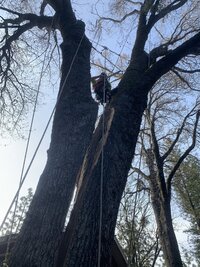
A good day to stay alive

You saw it in the video. The client said that when the wind blows the crack would open up so that you could see through the tree. That's a not a great look at the decay in the video, but given the age of the decay, and height of the decay, and the fact that it went straight through the center of the tree, would you climb it? Would Chisholm climb it? Anybody else here?
I’m not arguing it should be a tree that should or shouldn’t be climbed, but advocating the fallacy of the logic of yarding on a top with a truck. More so when deemed unsafe to climb by the expert onsite.
Never mind truck pulling a stem that has a crack opening and closing in the wind.
Never mind having a nearly fatal close call by executing said plan.
Needless to say sharing it on a professional forum.
In which you then argue when judgement/cognitive errors are questionable are brought up.
 
I misjudged the amount of push back from the top, but if I had a re-do, I would not hesitate to pull the tree back out of the crossing limbs with a pull line, tied to a truck or any other pulling system. Again, the pull line was set below the topping cut and pulling back against the lean of the tree. When I called for the pull, I called for one foot at a time. And I was listening for any cracking or popping sounds.

And we had three straps on the tree by the time I got up in the bucket.

I just can't say how much tension was on the line, because I never got a feel of it. I was above the line the entire time. I must have asked for another foot 5 times. In retrospect, it may have been a mistake to make the cut. It might have been better to walk and let them bring in a crane. But not a climber... not this tree.
 
Last edited:
From my buddy's latest substack... think it applies here for those that see no value in these argumentative threads:

In the earnest and sincere pursuit of knowledge and progress toward understanding, the value of opposing viewpoints cannot be overstated. It is through the clash of ideas, the confrontation of differing perspectives, and the robust exchange of opinions that society is able to grow and evolve.

Diversity of thought is recognized as a fundamental driver of innovation and critical thinking. By engaging with viewpoints that challenge our own, we are compelled to question our assumptions, reevaluate our beliefs, and strengthen our arguments. The presence of dissenting voices fosters intellectual rigor, encourages broader perspectives, and ultimately leads to more informed decision-making. Throughout history, Greek and Roman philosophers have emphasized the importance of open discourse and the practice of disagreement, recognizing that it is through the crucible of debate that the best-backed position can emerge.

The utility of debate was particularly cherished in the ancient Roman Senate, where the practice of argument for the sake of argument thrived. Prominent Greek and Roman writers such as Cicero, a renowned Roman statesman and philosopher, and Plato, the influential Greek philosopher, were advocates of this approach. Cicero, in his work "De Oratore," emphasized the value of differing viewpoints, arguing that through discussion and contention, the most accurate and persuasive arguments could be discerned. Plato, in his renowned dialogue "The Republic," portrayed Socrates engaging in rigorous debates to arrive at the truth, emphasizing that open discourse allows for the discovery of superior ideas. The Roman Senate, inspired by such teachings, embraced the culture of debate, welcoming dissenting voices and encouraging senators to present contrasting opinions in pursuit of the best course of action. This tradition of intellectual clash and dialogue in the Senate not only fortified the decision-making process but also exemplified the importance of respectful disagreement in a democratic society, where diverse perspectives are valued, and the strength of ideas is tested through rigorous debate.

 
Glad to have gotten to see the footage. Had you considered climbing out of an adjacent tree? If I were approaching this I would see if I could get a nice high TIP nearby (or two, to triangulate) and spike up this tree.
Yes I have done this many times. Sometimes even climbed above my tie in. Sometimes the risk of a big swing is better than taking too big of top I am not comfortable with. Not sure if possible here. Cant really see the angles and hieght of the other trees.
 
Yes I have done this many times. Sometimes even climbed above my tie in. Sometimes the risk of a big swing is better than taking too big of top I am not comfortable with. Not sure if possible here. Cant really see the angles and hieght of the other trees.
Yep. As I sit here drinking my morning cup and armchair quarterbacking it looks likes getting a decent TIP in a nearby tree was an option. I would have also done what was needed to get a couple guy-lines set. Then I might have been comfortable climbing this thing and worrying it down?
 
Yep. As I sit here drinking my morning cup and armchair quarterbacking it looks likes getting a decent TIP in a nearby tree was an option. I would have also done what was needed to get a couple guy-lines set. Then I might have been comfortable climbing this thing and worrying it down?
Erik, how many discussions have we had here about someone making a cut from a maxed out bucket and getting lucky. Only to be told how much skill and calculation was involved and that you dont improve if you dont push the limits.
 
One thing nobody is discussing is the fact that the tagline was set below his topping cut. As I sit here trying to recall 40+ years of blowin' tops I can't remember ever doing this. Obviously, this scenario is gonna play out very differently than a typical tagline set above the topping cut, where slack gently falls back into the system as the top falls into the undercut, and one where the inevitable pushback stage is allowed to happen. Me thinks having the overloaded tagline below the topping cut was a very big deal...
 
Erik, how many discussions have we had here about someone making a cut from a maxed out bucket and getting lucky. Only to be told how much skill and calculation was involved and that you dont improve if you dont push the limits.
You just need to "THINK OUTSIDE THE BOX" bro!
 
One thing nobody is discussing is the fact that the tagline was set below his topping cut. As I sit here trying to recall 40+ years of blowin' tops I can't remember ever doing this. Obviously, this scenario is gonna play out very differently than a typical tagline set above the topping cut, where slack gently falls back into the system as the top falls into the undercut, and one where the inevitable pushback stage is allowed to happen. Me thinks having the overloaded tagline below the topping cut was a very big deal...
Yeah asking for trouble. Tallish tree lots of tension, better think it through.
 
Nuff trees bout there to set up a highline. But Daddio was never a strong climber. Hence maxxed out bucket hail marys. Man tensions a tree under his cut, to stand up the top, to clear it out neighbouring tree. Then proceeds to send it. When that top popped his eyeballs must of cranked in pure fear.
 
Dan is spinning out, again.
Many different ways to skin a cat.
#1 climb the tree with the locked inter fearing limb, remove the limb.
#2 cut the limb just out of reach from the bucket with a pole tool.
#3 set a tag ABOVE the cut with a throwline from the bucket if needed even.
#4 use the truck as an anchor but pull by hand with a MA
#5 climb the neighboring tree, piece out the rotten one from there
#6 set a highline
#7 get a bigger bucket
#7.5 Rent a crane to suspend the climber
#8 walk from the job
#9 Sub the job to someone more capable

Lots of options, but obviously none of us were onsite to look.... I too have worked on crews where we had it so dialed in we even used a small yarder to perfectly time the pull. With pulling back leaners the goal was to keep the wire tight until the tree was on the ground. A strong hard, consistent, fast pull.. yet those days have passed, and haven't worked with someone that has clicked like that.
 
One thing nobody is discussing is the fact that the tagline was set below his topping cut. As I sit here trying to recall 40+ years of blowin' tops I can't remember ever doing this. Obviously, this scenario is gonna play out very differently than a typical tagline set above the topping cut, where slack gently falls back into the system as the top falls into the undercut, and one where the inevitable pushback stage is allowed to happen. Me thinks having the overloaded tagline below the topping cut was a very big deal...
Something to think about... I'm pretty sure I've used the strategy before but don't remember the specifics. Don't make the assumption that the tagline was overloaded though... I just don't know what it took to get that tree to move because I didn't hand check the line for tautness. On the other hand I did make the decision that I wasn't going to put any more force on it before I made the cut and then a little breeze came along and parted the branches. So just from watching how the tree moved I was thinking "no more on this tree".

Is overloaded even a proper term in this context. How do you define "overloaded"... Overloaded for what the tree can safely handle? Or overloaded from the safe working load of the line? is that 10 or 20 percent? And how do we ever really know what the force is being put on a line or how much a tree can handle. It's all a judgment call.

If you want to have an intelligent conversation about tree work, then we need to define our terms. So please define overloaded. If you're looking for slander then terms like overloaded and mediocre will do just fine....

And for your perusal, I just found and posted this video circa 2009...
 
Overloaded: pulling with a force that is dangerous. Either by surpassing mechanical strengths, or otherwise pulling with enough force to create a hazardous situation. IE loosing control by applying to much force.
 
Overloaded: pulling with a force that is dangerous. Either by surpassing mechanical strengths, or otherwise pulling with enough force to create a hazardous situation. IE loosing control by applying to much force.
Does anyone think that tagline was overloaded? I was pulling nearly directly against the lean... If anything this provided more stability to the tree. Did it add or subtract from the pushback movement as the top began it's fall? I think it subtracted, but I could be wrong. There are a lot of counter-intuitive aspects to tree rigging. We'll have more information when the I get a closer look at the video of the top going. My buddy took it on his phone from the ground. POV would have been the best here. It's tough to tell what's going on at that distance and through the canopy.
 

New threads New posts

Kask Stihl NORTHEASTERN Arborists Wesspur TreeStuff.com Teufelberger Westminster X-Rigging Teufelberger
Back
Top Bottom