Tips and Tricks

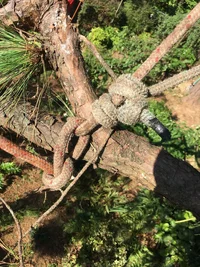
Loading the eye more than both legs of the long axis can give problems
Ideally eye is isolating weak part of line or less loaded that the 2 real mains
Can get away some breaking the rule(we all kinda do with Zrig) but if real hard impact load eye or 1 leg to eye the weakness can show , jam knot etc.
Sometimes smooth pin thru B'Fly long axis is used to prevent jam; remove pin to give more play and remove knot.
 
I like that! Quickie and butterfly is my #1 anchor. Working down a spar in long sections you can just tie another butterfly for the quickie instead of taking all the slack out
That's clever. I will try to remember it when the time comes.

@TheTreeSpyder
What issues happen when you load the eye more than the legs? I've been using almost nothing but butterfly cinches ever since I learned the knot.
Got an infographic?
The one showing where the loads in a bowline are was great.
 
I think the point is to tie another midline-alpine butterfly, leaving a long tail on the working end, rather than moving your hitch to the top of the working end to choke the spar again.

If you lower down after taking a top off, dropping 20' for a 20' log, you can pull your choked AB down, and rather than moving 20' through the hitch, you tie your second AB 25' from the end. This will let you have fall-arrest if on a spar with a flipline (180 degree wrap) and spurs, if you set a second TIP before retrieving your first TIP.
 
I think the point is to tie another midline-alpine butterfly, leaving a long tail on the working end, rather than moving your hitch to the top of the working end to choke the spar again.

If you lower down after taking a top off, dropping 20' for a 20' log, you can pull your choked AB down, and rather than moving 20' through the hitch, you tie your second AB 25' from the end. This will let you have fall-arrest if on a spar with a flipline (180 degree wrap) and spurs, if you set a second TIP before retrieving your first TIP.
That sounds pretty decent, and it gets your hitch closer to the end of the line so you can just pop it off the end when you hit the ground.
 
I think the point is to tie another midline-alpine butterfly, leaving a long tail on the working end, rather than moving your hitch to the top of the working end to choke the spar again.

If you lower down after taking a top off, dropping 20' for a 20' log, you can pull your choked AB down, and rather than moving 20' through the hitch, you tie your second AB 25' from the end. This will let you have fall-arrest if on a spar with a flipline (180 degree wrap) and spurs, if you set a second TIP before retrieving your first TIP.
That sounds pretty decent, and it gets your hitch closer to the end of the line so you can just pop it off the end when you hit the ground.
 
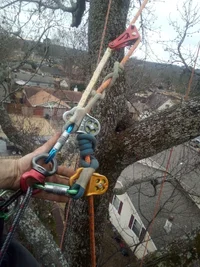
Homemade friction saver. 2' strap, tri-lock carabiner, figure 8 all attached with girth hitches. All together about half the cost of a Buckingham model, and made from parts you may already have! And I haven't found a need for a retrieval ball with this. An eye splice will slide through the biner, but get caught on the small hole of the figure 8 every time.
effb7044b0452b7222fcbadba1501913.jpg
e90359bc7b779c979eb36f37a6cdcf99.jpg


Sent from my SM-G950U using Tapatalk
 
When rigging from two separate points, you can tie a Blake’s hitch with one line to the other. This way you only have to tie one leg each time, and the ground crew only unties one. Slide the Blake’s to gain enough tail to tie with, then slide it back down to the knot. I’ve used this with a grcs on the Blake’s side and no slipping.

Something I’ve not tried, but that came to me while sharing this- to get one rope in a different place on the piece for better manipulation but still avoiding a lot of tying and untying, incorporating a sling and biner could work by choking the sling where you want the load, and clip the desired leg into the biner. A little more gear, but still a lot less tying. If I don’t get to it first, someone try this and let me know. In this scenario, I would tie the Blake’s to pull downward toward the knot, so that loading would pull it toward the knot rather than away. Normally, I tie it so the tying tail is exiting the top of the hitch, but I’m not sure how things might change, if at all, with the deflection of the sling and biner.
 
Homemade friction saver. 2' strap, tri-lock carabiner, figure 8 all attached with girth hitches. All together about half the cost of a Buckingham model, and made from parts you may already have!

When the ring/ring FC debuted many years ago I cut apart an F8 rings then spliced them into 3 strand Safety Blue. Cost...zero. I had the F8 collecting dust. A friend suggested using a whole F8 like in your configuration. The concern was that since the F8 was forged I might be stressing the rings in some way that might weaken them. Easy enough. I spliced up another and still have my original!

Using a sling is even easier.

A suggestion for slings...any sewing machine would be strong enough to run a row of stitches along the edges of the webbing after choking onto the 8 and making the eye for the biner. This takes away the loop that could get snagged when its retrieved. The stitching isn't meant as life support, just housekeeping. A couple of back and forth passes can sew a tight eye for the biner too.

Use a high stitch count/inch for the work

Of course, bands of electrical tape works too hahahha
 
When rigging from two separate points, you can tie a Blake’s hitch with one line to the other. This way you only have to tie one leg each time, and the ground crew only unties one. Slide the Blake’s to gain enough tail to tie with, then slide it back down to the knot. I’ve used this with a grcs on the Blake’s side and no slipping.

Something I’ve not tried, but that came to me while sharing this- to get one rope in a different place on the piece for better manipulation but still avoiding a lot of tying and untying, incorporating a sling and biner could work by choking the sling where you want the load, and clip the desired leg into the biner. A little more gear, but still a lot less tying. If I don’t get to it first, someone try this and let me know. In this scenario, I would tie the Blake’s to pull downward toward the knot, so that loading would pull it toward the knot rather than away. Normally, I tie it so the tying tail is exiting the top of the hitch, but I’m not sure how things might change, if at all, with the deflection of the sling and biner.
I've done that before and it didn't really work the way you expected. The biner and sling slides down or up the rope depending on how the balance on the piece is and behaves much more like a running bowline with a half hitch above it, than like a spider leg.

A midline Alpine or a figure 8 on a bight that the biner is clipped into makes it behave like a spider leg.

Off topic to that, the shizll spider slings or a diy alternative with a rigging plate and prussik and a pair of steel biners on the balancing legs makes a very easy, very quick balancer setup
 
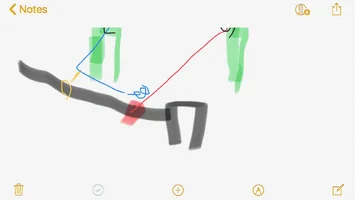
I’m wondering if we’re describing the same thing. My goal is not to spider leg. The initial idea, which was pictured, just puts two ropes on a piece when using two rigging points, whether it be a rigging point in another tree with a brake line in the tree you’re climbing, or rigging a “y” to it a drop zone between stems.

The second idea (which may be the one you’re referencing?) was to redirect one of the lines down a branch, so that one is simulating a tip tie in addition to the butt tie. I’m not attempting a spider leg. In general, they tend to be more work and too involved when smaller pieces works just fine (my opinion).

Here’s a quick attempt at illustrating my thought to see if we’re talking about the same thing.
 

Attachments

  • 42AA134C-187C-4043-9DD9-2FA7375C20C9.webp
    42AA134C-187C-4043-9DD9-2FA7375C20C9.webp
    45 KB · Views: 91
I’m wondering if we’re describing the same thing. My goal is not to spider leg. The initial idea, which was pictured, just puts two ropes on a piece when using two rigging points, whether it be a rigging point in another tree with a brake line in the tree you’re climbing, or rigging a “y” to it a drop zone between stems.

The second idea (which may be the one you’re referencing?) was to redirect one of the lines down a branch, so that one is simulating a tip tie in addition to the butt tie. I’m not attempting a spider leg. In general, they tend to be more work and too involved when smaller pieces works just fine (my opinion).

Here’s a quick attempt at illustrating my thought to see if we’re talking about the same thing.
Different things, yours should work as you drew it. I was assuming only 1 line.
 
I think I know what you’re referring to now. What if you tried opposing munter hitched on the biners? There’s still a chance they would just slide, but less chance (I think).

I’m considering more sling use in rigging. I’ve toyed with knotless rigging setups before, but haven’t stuck to them to see their efficiency in varied situations. Since buying a rapid rig and seeing its value, I’m more open to trying more things like the backbone mini and other sling-happy systems.
 

New threads New posts

Kask Stihl NORTHEASTERN Arborists Wesspur TreeStuff.com Teufelberger Westminster X-Rigging Teufelberger
Back
Top Bottom