Question about felling technique

samsquatch

Participating member
Location
SE MN
Hey gang.
Question about a felling technique, I'd like to know if it's considered safe or not.

I like to cut humboldt notches, just because I guess.. ( should I also use open face notches?) but my real question is: I find it much more comfortable to make my bottom angled cut upwards with the top of the bar. This way the saw is not upside down and I can see better to match the two cuts for less chance of a dutchman. But I quickly realized two concerns for safety:
1. The chain is pushing me back away from the stem, and with my 661 it's pushing back pretty hard.
2. I'm pulling up with my left arm.

Combine those two, and it seems to me like it's a recipe for disaster; like if I temporarily adjust my footing and the bar comes out of the cut, my pulling left arm means the bar & chain are going to come up at my face..

Anyone else out there make their notch cuts with the top side of the bar? any concerns?

Cheers
 
It should not cause a safety concern, however I prefer to cut with the saw facing the opposite way to allow the dogs on the saw to bite in and help with the cut. A couple of quick points, when cutting with a 660 I always had a 25" bar or (and more often than not) a 36" bar. In order for a bar of that length to slip out of a cut you will have to have a pretty major movement, the best way to prevent that is to make sure you have good footing and clear the area of tripping hazards. My second thought is, is that you should not have to pull up hard enough on the saw for it to cut, that the energy you are expending would send the saw up at your face. Just make sure the saw is sharp and let it do the work.

Since you do prefer the action of cutting up into the apex of your cut, you could plunge into the bottom cut and inch or two below the apex. Cut up until your cuts match as you normally would, and then finish your cut cutting down. Letting the weight of the saw, and the dogs work for you allowing you to use less energy to make the cut. As far as which notch to use, I use a combination of open, conventional, and humboldt notches depending on what I want the tree to do.
 
In order for a bar of that length to slip out of a cut you will have to have a pretty major movement

Since you do prefer the action of cutting up into the apex of your cut, you could plunge into the bottom cut and inch or two below the apex. Cut up until your cuts match as you normally would, and then finish your cut cutting down. Letting the weight of the saw, and the dogs work for you allowing you to use less energy to make the cut. As far as which notch to use, I use a combination of open, conventional, and humboldt notches depending on what I want the tree to do.

Agreed on the bar length helping out, most 661 felling I do is with a 114DL. I don't keep the right side dog on, because it gets in the way a lot when bucking. I do like the idea of plunge cutting to make the the notch "crotch" and then cutting down, aided by gravity & the left side dog. Great idea!

Curious: in what situations would you use the three different notches? Are they only dependent on when you want the hinge to separate or do you find other uses for each notch?
Cheers
 
I will often use an open notch if I want to keep the trunk up on the stump to preserve anything on the ground. If you keep it open enough that it does not close then the fibers will often remain intact.
I find myself often using the conventional notch for most of my felling and the Humboldt if I want to have the trunk come off of the stump a little sooner. Such as tip tying a lead and lifting it to the anchor point.

I don't always have a certain reason for a particular notch that I use, they are all viable options and I utilize them all to keep my options open for when I need to use a particular one.
 
For an alternative approach, I prefer to use an open notch most of the time, making my first cut diagonal cutting from high to low. The advantage is that I can now sight down through the diagonal kerf as I make the horizontal cut and when I see the chain emerge into the kerf, I can stop without bypassing my hinge.
 
For an alternative approach, I prefer to use an open notch most of the time, making my first cut diagonal cutting from high to low. The advantage is that I can now sight down through the diagonal kerf as I make the horizontal cut and when I see the chain emerge into the kerf, I can stop without bypassing my hinge.
I've heard this trick before - but the true benefit of sighting down the kerf like you're saying only works on one plane. Your chain could be behind the kerf and you would never see it pass..
Cheers
 
The simple answer is that you are making things hard on yourself, and if you did experience some kickback while doing this, it could get sketchy. Why not just learn how to properly make a Humboldt, then put it into practice. Problem solved.
Always make your horizontal cut first, setting your lay, then pivot off your dawgs, pull your bar out and flow right into the angled portion of your undercut. When done properly it is a fluid thing of beauty. Watch some vids of pro fallers on YouTube to see how it’s done.
 
Last edited:
I've heard this trick before - but the true benefit of sighting down the kerf like you're saying only works on one plane. Your chain could be behind the kerf and you would never see it pass..
Cheers
Yep, if you look down into the kerf and see bar, you should have looked sooner. If you're paying attention, one plane is all you need.
 
For an alternative approach, I prefer to use an open notch most of the time, making my first cut diagonal cutting from high to low. The advantage is that I can now sight down through the diagonal kerf as I make the horizontal cut and when I see the chain emerge into the kerf, I can stop without bypassing my hinge.


This is also my preferred method.
 
The simple answer is that you are making things hard on yourself, and if you did experience some kickback while doing this, it could get sketchy. Why not just learn how to properly make a Humboldt, then put it into practice. Problem solved.
Always make your horizontal cut first, setting your lay, then pivot off your dawgs, pull your bar out and flow right into the angled portion of your undercut. When done properly it is a fluid thing of beauty. Watch some vids of pro fallers on YouTube to see how it’s done.

This.

Put your outside dawg back in OP.
 
Hey go ahead and learn to cut a proper humboldt if you think you'll need it...


AND Liking anything "just because " doesn't make it into my toolbox...

Yes.. it is cool to watch these west coast fallers hit top cut everytime like they were born with a saw in their hands...

35+ years and I still question everything until I UNDERSTAND... Every move I make is intentional. And I AM going to take the fastest, safest, easiest way to get the tree on the ground. I cut a perfect open face 100% with skill that would make a good west coast faller cringe!

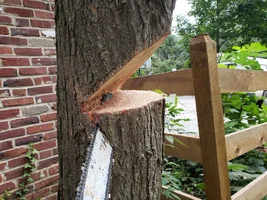
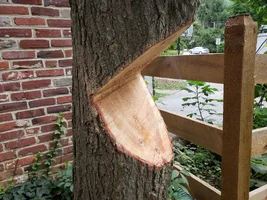
the humboldt has its uses in residential work, but unless you;re getting paid for the lumber, or working on steep ground, the open face is almost always better suited to our needs. It's simple, easy to get right every time without the skills of a west coast faller and has several other advantages over the humboldt...

here's a cheat I use to make the bottom cut when I need 90 degrees or more... Hemlock we cut last week
 

Attachments

  • lazy open face 1.webp
    lazy open face 1.webp
    919.8 KB · Views: 63
  • lazy open face 2.webp
    lazy open face 2.webp
    902.4 KB · Views: 62
Asshole alert!!!
I’m sure there are plenty of “cringing” west coast fallers, after seeing that picture of your open face undercut?
 
Last edited:
I am far from a west coast faller, however I must question the depth of the face cut. I was previously told roughly 30% and more recently 80% of the diameter...I always used 80% of the direction of fall...that seems to be 80% on the back side. This is only my ovservation from your picture and I don't know how much wood/weight is above your notch but from where I stand I wouldn't want a gust of wind or a strong fart to come
 
Count me in as a fan of the asshole...I understand the concept of undermining the Center of Gravity as that is the fundamental principal of any directional tree cutting. I also understand that a deep notch is a tool to have in the tool box. I was always taught when felling from the ground it is safer to try and move the COG by lifting or using mechanical advantage. Again as stated earlier we only see the face notch so we don't know the whole picture
 
  • Like
Reactions: evo
I am a west coast faller and I don’t need to cringe. I say if it works for you then use it, daniel’s got a pretty good track record so more power to him. I take back the cringe part, you know what makes me cringe? Watching videos of tree guys with saws that are oh so dull grinding away on some poor tree. That’s cringe worthy, creative face cuts? Not so much.
 

New threads New posts

Back
Top Bottom