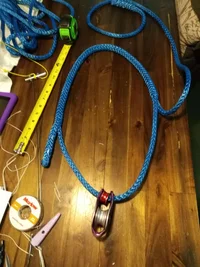
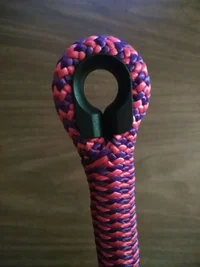
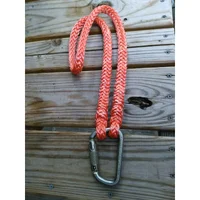
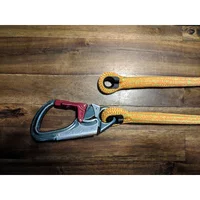
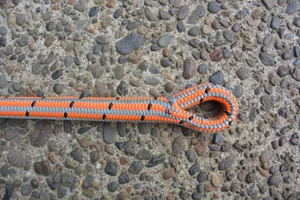
Show off them splices

If you're using a bolt, another way would be to do the locked brummel tightly on the bolt, take the bolt out, and then do the locked brummel on the becket. The first eye will pass through the rope, with a little work, to form the second Brummel. If a toggle, with larger ends than the middle, the method you described would be better. Whipping/seizing will make the eye tight to the dogbone.

Right on.. Right on.. that is a good way.

Hey.. side note/question here...
That 9mm Rit - at Sterling's site, they don't list it as any stronger than the 8mm Rit, in fact, they list the same mbs.... is it of different construction properties that just happen to have the same MBS as the 8mm? Or are they only testing it to a certain Cert & walking away without going to actual MBS.. that would just seem funny, right..?
 
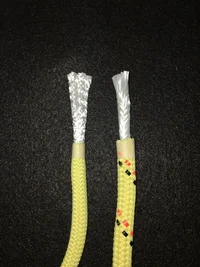
They are made differently. The cores look to be about the same size, but look to be made differently. The cover of the 9mm has single strands and is thicker than the double strand of the 8mm. Sterling's accessory cords have a similar quirk, the break strength increases as the diameter does, until the 9mm, when the cover construction changes, and the strength drops below the 8mm.

Most rock climbing textile products are only tested to 22kN, not their true break strength.
 
I just got a piece of Marlow Vega yesterday and decided to try to splice it with the Marlowbraid method. It took me two tries but I finally got it. This is not easy stuff to splice, despite what some of the online websites claim. I also took it out and climbed on it with my Roperunner. My initial impression is that this is perfect rope for SRS. It has less stretch and better hand than HTP and is very smooth with the Roperunner. The outer cover is tough and this stuff is really strong (8,272 lbs). I noticed a bit of flattening on rappel, but no worse than HTP. I think I may have found a new favorite for SRS.


Vega_eye1.webp
 
Nice smooth taper, Arlo. The top part of the eye, coming out of the throat, looks to be bigger than the bottom half. I zoomed in close and measured the top at 1 3/4" and the bottom was 1 1/2". If you used the directions that have you empty the eye cover, and then refill it, the taper point might be in the middle of the eye, instead of all the way around back to the throat. Comparing the eye to a section of rope not spliced will let you know if one is not right.
 
Nice smooth taper, Arlo. The top part of the eye, coming out of the throat, looks to be bigger than the bottom half. I zoomed in close and measured the top at 1 3/4" and the bottom was 1 1/2". If you used the directions that have you empty the eye cover, and then refill it, the taper point might be in the middle of the eye, instead of all the way around back to the throat. Comparing the eye to a section of rope not spliced will let you know if one is not right.

I am pretty sure the taper point is inside the throat as I seated it inside the throat before I buried the cover. I used the method that is on the video on the Marlow website where you extract and bury the core and then taper and bury the cover over the top of the core. It sounds to me like you are talking about a slightly different method? Is there a different way to splice Vega?
 
Last edited:
Yes, Marlow has specific instructions for Vega, very similar to the Marlowbraid. You might to do the comparison test, as the eye should have a consistent diameter.
 
Yes, Marlow has specific instructions for Vega, very similar to the Marlowbraid. You might to do the comparison test, as the eye should have a consistent diameter.
Ahh crap, I missed that. Do you have the link? It does not come up when I search.
 
Thanks for posting the link. The Vega splice has the core being tapered by cutting out half of the strands. Different from the Marlowbraid that reduces each strand by half, a little more work, but I like the idea that all the strands are involved, through out the splice.
The illustrations for this splice don't make sense to me, the core bury appears to exit on the top. If the needle is inserted on the top and goes through the eye, it will have to pass through itself, brummel like, at the throat. This would be similar to the NER heavy duty kernmantle splice, but they don't mention anything about this happening. It would seem that the core needs to exit from the bottom and the cover from the top.
 
And, is it just me or did the yellow and green dots trade places between panels 8 and 9? Or did they - Oh never mind . . . . sign me confused too! Sorta like trying to follow the Samson splicing illustrations when you first start out fooling around with linear fabric strands?
 
Another confusion is there are no recommendations for bury length based on rope diameter, except for the Vega. Also, Marlowe has put out a few variations of this splice in the past.
 
Comment above notwithstanding, I do like Samson ropes - they have made a stab at good splicing instructions, I have managed to get splices in used ropes (this was my quest one Saturday . . ) and I really like Tangent/ Voyager - for me they hit the nail on the head.

Having worked in big company's most of my career, we found in project engineering that you had to check and check and have version control in place with signoffs. I wish other manufacturing sectors would adopt some of process industry's document control/ review procedures. Just a thought. Multiple reviewers/ sign offs really can make documents better.
 
Thanks for posting the link. The Vega splice has the core being tapered by cutting out half of the strands. Different from the Marlowbraid that reduces each strand by half, a little more work, but I like the idea that all the strands are involved, through out the splice.
.

When I did it I removed half the strands by removing either 1 or 2 of the 3 strands in each of the 8 core strands. That way all 8 of the tapered strands run completely through the splice. It is a bit more work than just cutting off 4 of the 8 strands, but I like the idea of all 8 strands running completely through the splice. I am not sure if this makes any difference in strength of the splice, but I doubt it. These splices are so different from anything I have done before that I am still very curious about how they effect rope strength. Guess it would be smart to do a few and have them tested.
 
Very nice dude.. no way those are your first tries..! If they are i am envious!! Haha! Very clean! My first ones would come out filthy looking cuz i had to mess with them to the point my dirty hands ended up just wearing off on the rope.. I swear my hands looked like i was from a leper colony..
They are made differently. The cores look to be about the same size, but look to be made differently. The cover of the 9mm has single strands and is thicker than the double strand of the 8mm. Sterling's accessory cords have a similar quirk, the break strength increases as the diameter does, until the 9mm, when the cover construction changes, and the strength drops below the 8mm.

Most rock climbing textile products are only tested to 22kN, not their true break strength.
Oh no kidding.. i was not aware of that Brock... I never looked close enough, just knew there were some tracers in the 9m. I just assumed that the 8&9 were the same & Sterling originally designed both to go together in some fire/rescue kit & that the tracers were for differentiating between the two when those guys are all geared up in a emergency situation.. you get what i mean.. scenarios with alot of mental pressure, where there's no time to examine what is what.
Looking closer, the 8mm core seems to be biggerView attachment 53407
Yes.. you right.. they do look completely different... Someone once told me that RIT stuff for Right In Trees.. is that true or is that something someone just made up? I've always thought most Sterling stuff was designed either for Rock, High Access, Fire, Rescue, Tactical & any textile that's Arb related just came from those other sectors & just happen to work well for Tree Applications..

Or does Sterling actual design dedicated Textiles for Arb?

Sent from my Pixel 2 XL using Tapatalk
 
Just a heads up on the rig-n-wrench, the commercially sold tether is only about 4" long. Not that it can't be longer, but I'm sure a test somewhere showed that a short stiff tether was more reliable.

If you want to make your own tether, probably the easiest way would be to use one of these https://www.treestuff.com/store/catalog.asp?category_id=21&item=1860 with a girth on each end. Then stiffen it with tape or shrink tubing.
How strong does the tether need to be on these RNW's.. is there any reasonable scenario where you can rig heavy enough with the thing to even have worry about how strong the tether is or isnt..

Or is it that scenario where you want it to be the weak link?

Sent from my Pixel 2 XL using Tapatalk
 
How strong does the tether need to be on these RNW's.. is there any reasonable scenario where you can rig heavy enough with the thing to even have worry about how strong the tether is or isnt..

Or is it that scenario where you want it to be the weak link?

Sent from my Pixel 2 XL using Tapatalk
The rig-n-wrench Is not rated to be used with a basal friction device, so that being said I do not think one person could hold enough weight to ever break the wrench tether. Just remember that it is a light duty rigging tool and it will do just fine. I mostly prefer mine when working over utility lines or other obstacles, because it excels in lifting away from targets.

In answer to your other question I would certainly not want the tether to be a weak point. Should it break while lowering the ground guy will have to control all of the weight without any friction.
 

New threads New posts

Kask Stihl NORTHEASTERN Arborists Wesspur TreeStuff.com Teufelberger Westminster X-Rigging Teufelberger
Back
Top Bottom