Your personal SRT work setup

I’m trying to get a mental image of what an SRT setup for work would actually look like. Here and there, I’ve seen some pictures of SRT setups, but don’t know if they’re well suited for a work environment, or should just be limited to recreational climbing. I’m looking for something that is not hardware intensive and to be used in 50-60 foot climbs; not like a typical RADS system, which might be good for very long ascents.

I know some use the rocker, but how do you configure it into your setup? I was looking at a picture of one setup, and it suddenly occurred to me that there wasn’t any hitch to be seen.Who uses a hitch? Who doesn’t? How about some kind of a mechanical replacement for the hitch? For those that use the rocker, what do you use for backup and where/how do you attach it to your climbing line?

At present, I’m using a Knut hitch, but tomorrow I’m going to try the Icicle (as recommended by TheTreeSpyder). In addition, I use a microcender (which I push ahead above my hands like a prusik) attached to my saddle as a fall-arrest backup device. I don’t like this configuration because the ‘cender doesn’t always move easily up the line. I find myself holding on with one hand so I can push the ‘cender up my line with the other.

This is my plan. The fall-arrest device would be attached to my saddle via a web strap (midway between my saddle and my normal arm extension, about chest level). To this device (rocker/microcender) I would attach a light cord. The cord, in turn, would be attached to my wrist or over my hand. The thought being that, as I extend my arms to climb, the fall-arrest device would be pulled up the line, ready to stop a fall within a matter of inches instead of feet. Also, with the device at about chest level, I should be able to easily to put weight on it and have the device hold me on the line, rather than my hitch.

I’m pretty sure the microcender plus a hitch would be safe to use in this scenario, but, since the rocker doesn’t grab like the ‘cender does, would substituting the rocker for the microcender still provide a safe setup for SRT? I’ve read the rocker grabs better on soft, rather than stiff, lines. I use KM III Max, which is fairly stiff.

If you do use an SRT setup for work, could you post a picture of what it actually looks like when you ready to start your climb and what devices/hitch you use? Or at least a description which a inexperienced guy like me could understand?

Thanks, I appreciate all your help.
Jim
 
Jim,

I'm always excited to hear that there is another SRT accolyte!

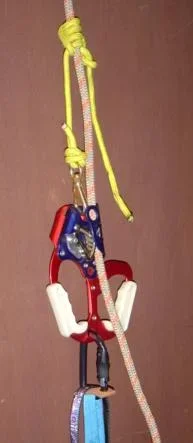
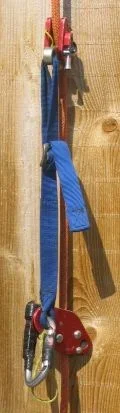
I've posted pics of my SRT ascent system in one of the threads. The rocker is clipped to my front d-ring and the Microcender is attached to a blue webbing sling which is also clipped to my front dee. The MC is adjusted to be jus a bit above head height. If I were to fall I don't want to get slapped in my soft noggin with anymore hardware than necessary.

I use KMIII for SRT line. There hasn't been an opportunity to test how well the Rocker grabs in an emergency situation.
 
Jim;

For a straight climb I use the Pantin and Kong handled ascender in conjunction with a distel hitch for a back up.

[ QUOTE ]
The cord, in turn, would be attached to my wrist or over my hand.

[/ QUOTE ]
You might want to rethink this one, if something fails you don't want your wrist arresting a fall.
 
Thanks, Tom. I've seem pictures of both you old and current setup. It seems like you don't use a hitch. Am I correct? Is so, what do you do once you're up in the tree? Do you remove the rocker and 'cender and then use a hitch? Or is your SRT line just for entry?

Since I use a hitch, the rocker attached to my saddle will keep the hitch from grabbing if attached to my line above the hitch. If below the hitch, it acts like a pulley to tend the hitch, which is okay. I'm just not sure what would happen if I let go, though. Would it grab properly or would my hitch somehow interfere with its action?

I'm trying to limit any fall during ascent to inches. I think, in the scenario above, I would fall several feet before either one of them grabbed because as I advance up the line the hitch and rocker would be below my waist by about7-8 inches and laying against me as I raise my legs up. There could also be some additional slack introduced if I'm pulling on my line to increase the advance.

What's your opinion of my idea about attaching the rocker about chest height to my climbing line and using a web strap from the rocker to my saddle. Then, with a thin shoelace style cord from the rocker to my wrist, the rocker would be advanced up my line every time I extend my arms to climb.

Jim
 
Kevin, thanks. I use a pantin also, to which I've attached a strap and snap to help keep my line in the device. The original problem (see Pantin post) was that my line started slipping off the Pantin. Because I was in the middle of raising my legs to thrust, my hitch wasn't set.

Could you explain a little more? I don't understand how my wrist could be involved in arresting a fall. The cord would be attached loosely and only function to pull the rocker up my climbing line, keeping it at chest level as I ascend.

The rocker, itself, would be attached to my saddle via a web strap. The idea of keep the rocker at chest level is so that, in the event of a fall, my center of gravity is already below the rocker, and my body doesn't have to catch up with, and pass, it to enable it to begin to grab.

I may have to go with a handled ascender, but I was hoping to use the rocker, but at a distance above the saddle.

Thanks again,
Jim
 
I don't think that your idea of a wrist sling is a good idea. If you fall, it could get tangled or cut you.

Two possibilities that I can think of to keep the Rocker "tended"

Wear a chest harness and add a bungee cord to the outboard eye of the Rocker. As you move up the rope the bungee will keep the Rocker up.

The other would be to just use a loop of cord around your neck/shoulder like a sash. Attach the bungee to that.

Take a look at some of the SRT setups in the Sherrill catalog or On Rope 1. Cavers have perfected SRT and arbos can learn a lot from the "masters"

When it's time to work the tree I'll switch over to a closed friction hitch of some kind. Lately, I've been using a Knut using HRC cord. You have to work through the hitch and cord material that works for you. Adding wraps and twists to the various hitches will lead you to the best combo for your body weight and climbing style. No matter what you do, the HRC cord is the best that I've, and others, have found.

Look in the "Booty haul from Long Beach" thread for a write-up on the Uni-cender.
 
Thanks, Tom. I agree with you about the HRC and the Knut. I've been using that combination for about 2 months and like them both a lot; works well with my KM III Max.

I wanted to try the Icicle today, but I think I may have had too many wraps. When I tested its movement before clipping on to my saddle, it wouldn't slide up my line easily at all so I went back to the Knut.

I like your current setup, so I may give that a try. I just need to get a buckle. I believe I saw some at onrope1, but I'll have to check. Actually, in the meantime, I wonder if I could use a Double Fisherman's knot to adjust the sling length. What do you think?

Thanks for the help,
Jim
 
Here is a description of my srt system. It has been evolving for 14 years now and I think it is a nice balance of simple, light on gear, quick to get on and off, and efficient in climbing.

For a picture I will start with this one, which is similar to a system shown in many books and catalogs...

store%5Cimages%5Cproducts%5Cthumbnail_431.jpg


Now let me say that I think this system is all wrong! Here is how I have changed it...

The top ascender should be on a tether long enough to be tight just before full arm extension.

The lower leg ascender should be on a tether long enough so that when the ascenders are in this position...

ASC-CMI.jpg


... your leg is up about 14 inches to take a step. The reason for the lengths is that your arms are both in the same position for pulling. In the first picture, one hand would always be around your nads. Keep in mind that we are not doing chin ups in SRT, your arms are only used to pull yourself into the rope so you don't tip back. Your feet should be under your butt. I use one foot loop but it is big enough to put both feet in if I desired. I n ormally use the other leg for balance and pushing off of the tree as I climb.

Another important change is there should be a webbing tether from the leg ascender to the harness. It should be long enough to allow full motion without interfering. This acts as a safety so that if one ascender should fail, the other is still attached to you. It also allows you to just drop the ascenders while switching over without worry they will fall to the ground.

My last hint is to girth the webbing to the upper ascender and to the biner at your harness. This will keep everything in its place and prevent that heart murmer when the gate gets cross loaded by the webbing and pops off while you are hanging from it. (No matter how many times it happens, it still scares the crap out of me).


One of the disadvantages I have found with SRT systems that have an ascender or rocker, or hitch right at your waist, is that there is slop unless you use a chest harness. There can easily be 3 inchs of loss when you sit down in the harness each time unless you fiddle with it by hand or use a bungee cord to the top ascender (tangle!) On a 50 ft climb, taking 14 inch steps, thats quite a bit of extra climbing!


Good luck!

Dave

PS. I started out as a rock climber and a caver, so thanks for the compliment Tom /forum/images/graemlins/grin.gif
 
Tom. thanks, I'll try it it with three wraps.

Dave, thanks, very nice. It's good to hear the 'why' behind the 'what' to help with the understanding.

I definitely learned some good things today.

Thanks again,
Jim
 
This is what I'm using now.
One runner goes to my belt from the Kong and the other goes to the foot without the pantin.
I also use a distel hitch for life support below the Kong.
If something goes wrong I can kick off the pantin, easily detach from the Kong and bail out on the distel.
Same when you get to the top, everything gets removed easily and you can continue on with what you want.
 

Attachments

  • 26935-Image2.webp
    26935-Image2.webp
    8.9 KB · Views: 394
Kevin, nice setup; mimimum amount of hardware. Thanks for the picture. Why the Distel above the Kong? Have you had any problems with the Kong coming off your line?

I hope more people can post a picture of their setup. For me, this is very educational. I would think it would be beneficial to many to see what/how others accomplish the same task. For example, I notice that you use corner traps to minimize crossloading. Tom Dunlap, in his setup, uses some sort of a sleeve or tube to prevent crossloading. There's so much creativity on this site, I sometimes feel like a kid in a candy store.

Thanks,
Jim
 
Jim;
That's a Blakes above the Kong but it only serves as a back up in the event the Kong should fail.
With my Distel hitch(life support) below the Kong and having the Kong fail it could slam down on the top of the Distel taking me to the ground.
I've never had a problem with the Kong but it is a mechanical ascender and there's always a possibility of failure.
 
Kevin,

In your picture it looks like you have a brass snap going from the ascenders to the upper hitch. Is that so? Can't be... :)Couldn't you use a screw link instead?

Maybe you're just using that as an example picture.

If a hitch is used above the ascenders there should be a very short bridge. In the case of the ascenders slipping the climber would fall the distance of the bridge. This would put a heck of a load on the rest of the kit.

When I look at back-up systems I consider the connection chain. Are there parallel or series backups? To me, the best backup system attaches to the point of connection. On an ascent system, both would attach to the saddle. In your system I'd rather see the upper hitch attach below the ascender, with the rest. That way, both operate in parallel and either could fail independently and you would still be secure. When I was getting dressed this morning there was a talk about failure statistics. They brought in the case of the o-rings on the shuttle. The original design used a second o-ring in the same configuration as a backup. A better system, which they changed to, was the two original and another one that will stand alone. I guess it might be looked at as back-up or redundancy. Parallels seem to be a safer system. But at some time this can get clumsy which could make the whole works more dangerous.
 
Tom;
The bridge can be made shorter, the fall must be arrested within 1.2 meters.
My distel self tends so any free fall would be considerably less than one meter.
The snap is rated at 500lbs., not my first choice but it fits, quick to use and isn't for life support.
The screw link would be stronger and I might try to find one that fits the Kong.
Good observation.
 
Kevin,

If you fell 6 inches, which looks reasonable with your setup, you could easily put more than 500 lbs of force on your snap. If you dont believe me just bounce on your bathroom scale and watch it bottom out, then picture a 6 inch fall.

Backups need to be treated as life support, otherwise it's not much of a backup.

Dave
 
[ QUOTE ]
The rocker is clipped to my front d-ring and the Microcender is attached to a blue webbing sling which is also clipped to my front dee.

[/ QUOTE ]

Tom, are you using a different setup than in the picture I've attached? By what you wrote it seems that the rocker and the webbing sling are attached independently, not to the same carabiner.

I tried a version of your setup yesterday, but I used a piece of KM III Max for a cord instead of a webbing strap. As you suggested, I used a 3-wrap Fisherman's knot on the upper device, the microcender, and that worked out pretty well. The knot's a little bulky, but I liked that I didn't have to worry about cross-loading. The rocker and the other end of the cord were attached to a single carabiner and then to my saddle. I didn't use a hitch.

The rocker was a problem: it kept sliding down the side of my carabiner as I climbed. If I stick with the rocker, I'll definitely have to address that problem.

I'm still leaning toward using a hitch, maybe with a knot tender (small carabiner) running from the cord the microcender is attached to, then around my climbing line just under my hitch. As I move the microcender up, the hitch should slide up the line also and be in a better position to grab then if it were trailing down my line.

Thanks,
Jim
 

Attachments

  • 27063-TomDunlap-WebbingAscentSetup(CURRENT).webp
    27063-TomDunlap-WebbingAscentSetup(CURRENT).webp
    12.5 KB · Views: 251

New threads New posts

Back
Top Bottom