X-Rigging THT

I don't think you would. The double should be fine. So maybe a long double or what I was thinking was if you had a sling with a medium and a beast ring then at the other end just a beast ring you could use it in multiple configs. The thing I like about the ring to ring is that you don't have to tie s crazy hitch in the tree every time. More often than not I just drape it through a crotch. The long sling with the 3 rings would let you dump it in a crotch or just timber hitch the single ring end when you have to work a narrow spar. You could hitch it and the use the double ring end. I'm looking for a somewhat one tool for the job thing. Versatility and less time used in the tree tieing and untieing

I miss understood. The basket rr fs with lg and xl is my most often used xrr sling I love it no tying knots, basket is strong retrieve from the ground. I personally don't see why you would bother with a medium ring when a lg ring does more and any rope fits, my preference.
 
if i were a contract climber i would use the THT almost all the time, and use a ring as the base rigging point where the ground man operates from. now you as the climber have control of the friction you put on the piece

A THT with an large ring on a prussic on the same sling, and now you have an all in one piece as your in the tree. You could run thru two rings for med. weights, then thread the line thru the 3 holes for the top and the logs as your work the spar down.

Say, you work how i do, and work with a two man crew. you hang a top and your ground guy is trying to lay it down. as the climber / bucket op, since you have the friction device right at your rigging point (where you are) you can take control of the line as your ground man lays the piece down.

say you hang a piece over something and have another line on it so you can pull it away from whatever its hanging over as you lower it (imagine a spot where you would like to do a speedline, but for whatever reason you cant). if you have something to anchor the THT to, you can haul the piece over the area you need it to lay in, and use the THT as a progress capture.

...and so on and so on and so on and so on......
 
Last edited:
the only other thing that is the same idea is the buckingham Oxblock and thats like $400 or $500 and isnt good for the same weights, and not made with aborists in mind (if im not mistaken)
 
David,

I commented on your article, but this may be a better place to answer. Is bend radius not an issue with the THT as the terminal rigging point as it is with one x ring?

Thanks.
 
David,

I commented on your article, but this may be a better place to answer. Is bend radius not an issue with the THT as the terminal rigging point as it is with one x ring?

Thanks.

I think he said if it goes through 2 or 3 of the rings fiber elongation takes the bend radius in to count but I'm not 100% on that and I wonder if 2 holes is equal to 2 beasts and 3 is equal to 3 or how that ratio works out.
 
rescuedick-and-chris-g-diagram-jpg.30277

I'm still just a bit confused. I grabbed this picture from Chisholm's article, where does the tht go?

I've got a lot of catching up to do.
I did read this first page over the weekend while on my phone, but didn't respond because it's a pain on my phone and I wanted to draw it. Let me answer Kevin's excellent question first. (next post).

I'll really try to read all the other pages and answer any questions or concerns as well. Put in a long day yesterday, used the THT once again and filmed some more. I LOVE that thing. Yeah, I could be biased, but I'm not. Wait till other smart riggers get ahold of this thing, it's so different. It changes things more than you would think. I still can't get over it and even after using them for over a year now, I'm still learning the benefits and uses.
 
Kevin.;

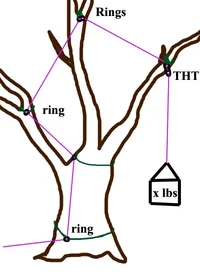
Since you asked about Chisholms diagram. IF it was THOSE angles, the final rigging point on the right actually tends to LIFT UP when weight is put on it.
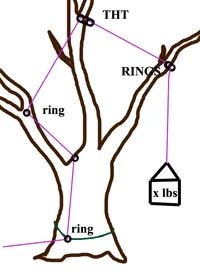
Even though it would likely be okay to have that rigging point as the THT, I would rather that point be a little more fluid (so it does lift upward). Thus, put the THT at the high rigging point. Both should be okay, but diagram TWO here is likely a bit better if I had to pick one as "better".

Diagram one is fine:
THT where.webp

diagram two below is a bit better IMO:
THT where BETTER.webp
 
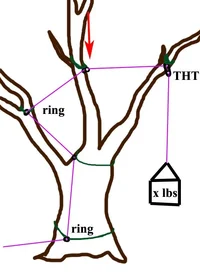
however, if the top rigging point was lower; like this, then I'd rather the THT be at the end.

I've actually done a lot of experimenting with the rings and rigging since 2011. Most of it on video. Haven't edited and posted much of it, but someday I'll have time maybe or have the money to pay someone to edit it. BUT, it gives me piece of mind and knowledge.

I don't know if I've run the THT at the top and a ring afterwards; I'll have to think back on jobs for a while, but I feel quite confident in what I'm showing here in these diagrams.

Anyway, last one for now; IF the top rigging point was lower, like THIS shown below, I'd rather the THT be at the end.

THT where top lower.webp
 
,,

Kevin, the video shows its uses pretty well.

"Last in the system" as in replacing the port-a-wrap? I don't think that was X's intention. It is used to increase friction and control up in the tree as a rigging point, or for negative rigging. I mean, that's what I'm gathering.

Looks cool. I'd like to try it out.

Mike, for light and up to moderate weights (say around 500 lbs) a THT in the system and say one redirect with ring(s) and one ring at the ground to channel the force down the tree and no other lowering device is needed. Did a decent size scarlet oak yesterday with exactly that. Lowered limbs and small log diameters from leaders (10 inch diameter and about 14 feet long).

If larger weights had to be added I would have continued to use the same system I set up, but just added the hobbs lowering device to the base of the tree.

I was able to flop the trunk logs on this particular job. (so, no lowering of the main trunk logs necessary).
 
I think no matter what, if your using the THT, you want to be cutting somewhere relatively close to it. I can't imagine it being a good choice as a primary rigging point on one central lead, if your out climbing/rigging on another lead (that is quite far away). But I could be wrong, I never used it. Just seems like the climber is going to want to manually feed the rope through it (especially if using all three holes)
Good speculation. I would have thought this way as well. I am amazed how easy it is for the groundperson to pull up the rigging line.
yesterday I was easily 40 feet away from the THT working on one of the lowest limbs. Now, I was lifting the tail of the rigging line and the groundman was pulling rigging line through the system. Each time we did this I asked him, "is it difficult?". "No, it's fine, not bad at all"; he kept replying.

What I think happens is that under no real weight pressure, the rope does not contact the entire surface area of the THT, but rather floats around it.

Let me draw real quick yesterdays set up. I'm paying more attention to details lately, the more and more questions I get.
 

New threads New posts

Back
Top Bottom