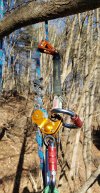
When does a foot ascender or knee ascender become self-tending?

I plan on keeping the ZZ as the highest device on the rope. Anything with teeth will be used as climbing aids only.

The foot ascender will be the easiest to try, so I'll start with that. I may add the knee ascender for climbing in the clear away from the trunk.

So far my arms and shoulders have had no problem with what I've been doing. Three 60'+ climbs in one day will make me tired, but nothing hurts.
 
I plan on keeping the ZZ as the highest device on the rope. Anything with teeth will be used as climbing aids only.

The foot ascender will be the easiest to try, so I'll start with that. I may add the knee ascender for climbing in the clear away from the trunk.

So far my arms and shoulders have had no problem with what I've been doing. Three 60'+ climbs in one day will make me tired, but nothing hurts.
Three 120' climbs in a day use to not hurt... now nearing two decades, climbing a fruit tree hurts...
 
This is the old zig zag so not exactly meant for srt but yea I hear what you’re saying.

I’ve climbed DdRT my whole career mainly.
People use to drive their whole career without power steering, power brakes or seatbelts. No Thanks.

woke up hungry in the night and am not sleepy, but am not up to Oxford editing ATM, so sorry for any disjointedness in the post. I had written most of it previously, but wanted to get a video up.


Entirely changed the game for me. Same as not doing treework without a material handling machine, I'll never go back to DdRT for most all of my work. My body would be ruined (pushing 49yo).

Different trees, different places, I know.


@DSMc Dave from Montana is one of the oldest production climbers I know of. He's been SRT (sounds like almost always, if not always) for the longest time, having input on the HH prototypes, and very knowledgeable.

SRT can be expensive and complicated AF (especially if you're a gearhead). I use it very simply most of the time on all different size and shape of trees. Occasional non-natural redirects. Very, very little bling.


I have only been in one tree that I couldn't SRT to the ground in one quick shot in an Emergency, a 250' doug-fir, working for a gov't agency, with a 120' rope (obviously not my choice of ropes, and before I started getting the agency out of the dark ages, gov't choices you see).

Once, I came down and changed ropes to go over 120' in a 160' grand fir, cleaned up, went back up, limbed and topped it. (more run of the mill, solo work). The next dead grand fir of that size, I used a longer rope and carried my 2511t and 200t. 2.5-3.5 hours up and down, always ready to get to the ground in about 10 seconds or less, even with smashed hands (hopefully something that never happens to people. I can imagine breaking a DrRT hitch would be difficult with your forearms.

I find great peace of mind in getting to the ground fast even if the rope is snagged on a limb or held down to the ground by debris.

Hitchhikers do not bend ropes. You can use them on a stationary, tensioned rope. Once, I had a 40-50' tall unstable snag with only one good, tall, strong tree nearby. I set my line in the tree, tensioned it and anchored it to a ground anchor, and ascended up the slanted climb line, popped the top, descended and flopped the spar. Can't do that with anything other than a HH that I know of.


SRT opens up lots that DdRT can't do. You don't have to stop DdRT, unless you realize you want to.

I haven't really used a friction saver in years, and rarely need any isolation.

 
I plan on keeping the ZZ as the highest device on the rope. Anything with teeth will be used as climbing aids only.

The foot ascender will be the easiest to try, so I'll start with that. I may add the knee ascender for climbing in the clear away from the trunk.

So far my arms and shoulders have had no problem with what I've been doing. Three 60'+ climbs in one day will make me tired, but nothing hurts.
You might find it more enjoyable if less tiring.

We would be happy to help you improve your system, @Winchman. I think I speak for many, much respect for you treeing it up at your place in life, and we hope we can be doing it, too, if we reach similar maturity.

Pictures are soooo valuable compared to words.

Ask us for any pictures you need us to take of our set-ups.
 
People use to drive their whole career without power steering, power brakes or seatbelts. No Thanks.

woke up hungry in the night and am not sleepy, but am not up to Oxford editing ATM, so sorry for any disjointedness in the post. I had written most of it previously, but wanted to get a video up.


Entirely changed the game for me. Same as not doing treework without a material handling machine, I'll never go back to DdRT for most all of my work. My body would be ruined (pushing 49yo).

Different trees, different places, I know.


@DSMc Dave from Montana is one of the oldest production climbers I know of. He's been SRT (sounds like almost always, if not always) for the longest time, having input on the HH prototypes, and very knowledgeable.

SRT can be expensive and complicated AF (especially if you're a gearhead). I use it very simply most of the time on all different size and shape of trees. Occasional non-natural redirects. Very, very little bling.


I have only been in one tree that I couldn't SRT to the ground in one quick shot in an Emergency, a 250' doug-fir, working for a gov't agency, with a 120' rope (obviously not my choice of ropes, and before I started getting the agency out of the dark ages, gov't choices you see).

Once, I came down and changed ropes to go over 120' in a 160' grand fir, cleaned up, went back up, limbed and topped it. (more run of the mill, solo work). The next dead grand fir of that size, I used a longer rope and carried my 2511t and 200t. 2.5-3.5 hours up and down, always ready to get to the ground in about 10 seconds or less, even with smashed hands (hopefully something that never happens to people. I can imagine breaking a DrRT hitch would be difficult with your forearms.

I find great peace of mind in getting to the ground fast even if the rope is snagged on a limb or held down to the ground by debris.

Hitchhikers do not bend ropes. You can use them on a stationary, tensioned rope. Once, I had a 40-50' tall unstable snag with only one good, tall, strong tree nearby. I set my line in the tree, tensioned it and anchored it to a ground anchor, and ascended up the slanted climb line, popped the top, descended and flopped the spar. Can't do that with anything other than a HH that I know of.


SRT opens up lots that DdRT can't do. You don't have to stop DdRT, unless you realize you want to.

I haven't really used a friction saver in years, and rarely need any isolation.

When I first started climbing I was using just a prusik hitch and manually advancing myself up the tree one arm movement at a time. That took a lot of energy sometimes depending how high of an ascent.

At some point one day I will probably start trying srt out.

And I used a mini loader for the first time last year and now on any big jobs where it would be worth it I’ll rent one (until I get my own) if I think it can help. Such a great, energy and time saving machine.
 
  • Like
Reactions: LBF
Tongs can be attached to a bucket or to the loader plate.

Chokers (rope or cable) can be attached to the machine.

Garbage cans and tarps can also be moved by strapping to the machine.


You can make a wooden rope wrench with 5-10 minutes working time.

Why wait?
 
When I first started climbing I was using just a prusik hitch and manually advancing myself up the tree one arm movement at a time. That took a lot of energy sometimes depending how high of an ascent.

At some point one day I will probably start trying srt out.

And I used a mini loader for the first time last year and now on any big jobs where it would be worth it I’ll rent one (until I get my own) if I think it can help. Such a great, energy and time saving machine.
I learned the value of good equipment as a kid. My dad did concrete work and was the first concrete guy in the area to buy a skid steer. It sat far more than it got used, but the ability to grade a garage or driveway and sometimes a basement in hours instead of a day or more was a huge game changer. But that also means we didn’t throw out the wheelbarrow and coal shovel because things happen and you need to be prepared. So I like having the most efficient tools I can afford and still keep the old gear around as a backup. Saving time and using tools is working smarter and saves money even though it can be expensive.

When I started looking at climbing trees I came across a video on YouTube from Treestuff that explained climbing DRT vs SRT and realized right away that SRT had some real advantages
 
Let me add a couple of comments as I've spent a considerable amount of time with rope walking, have 2 issued patents and came up with and trademarked the term Self Avancing Knee Ascender. Of course an ascender does not actually advance by itself, that would be like saying a self running tennis shoe.
"Floating", just means that it is allowed to follow the fall of the rope as opposed to being attached to to the knee. The advantage to this is that you are able to use all of the leg muscles. If you attach the ascender to your knee you have basically bypassed the mechanics of how a leg works and you are no longer using the strongest muscles in your body and in your leg. Attaching to the knee also pushes the climber back, away from the rope adding to the inefficiency. I get the convenience if that is the priority.
So if an ascender is floating there is basically 2 ways to lift it up the rope. One is by lifting it from the top and the other is by pushing it up from below by having bungee extend below the ascender. If lifting from the top there needs to be sufficient bungee above to be able to rebound the ascender. This usually involves having bungee or some method above and in the chest area. I consider the chest area something that needs to be clear, like not wearing loose clothing in a machine shop or wearing your harness when you're throwing limbs in a chipper.
So with the SAKA and Foldable SAKA the bungee extends below the ascender, this allows the required 'rebound' to be below the ascender and thus allows the said ascender to come directly to the bottom of the multiscender with nothing extending above the multiscender.
Note, the limit to travel up the rope for the foot ascender is the knee ascender, the limit up the rope for the knee ascender is the multiscender.
 
When I first started climbing I was using just a prusik hitch and manually advancing myself up the tree one arm movement at a time. That took a lot of energy sometimes depending how high of an ascent.

At some point one day I will probably start trying srt out.

And I used a mini loader for the first time last year and now on any big jobs where it would be worth it I’ll rent one (until I get my own) if I think it can help. Such a great, energy and time saving machine.
I’ll second south sound, don’t wait any longer than you have to. The better you treat your body now, the less aches and chronic pains you will have later
 
I’ll second south sound, don’t wait any longer than you have to. The better you treat your body now, the less aches and chronic pains you will have later
For the most part honestly I rarely feel any upper body fatigue with the current DdRT setup I’m using. Course I guess you could argue different setups for different trees and accents. But I hear what you’re saying.

Regarding machinery, I’ve contemplated whether to go a lift first or mini, etc.?
 
Because you don't feel it, does that strain, wear and tear, loss of SRT efficiencies, rope savings (my ropes last forever)?

It's probably nothing. SRT is just a Fad.
 
I've got an older generation ZZ. This is how I attach the rope wrench and tether:
View attachment 82032
Not the cleanest way by a long shot, but safe, functional, and makes use of the now extra carabiner without buying any other attachment hardware.

I mainly SRT with a HH2 or BDB, big fan of their compactness.

For some dumb reason I've got more SRT devices than I can even remember at this point, 8? 9?, including two of this gen ZigZag, plus multiple Rope Wrenches and styles of tethers, yet for some reason I've never tried the ZZ/RW setup. This photo is making me want to finally play around with it.
 
For the most part honestly I rarely feel any upper body fatigue with the current DdRT setup I’m using. Course I guess you could argue different setups for different trees and accents. But I hear what you’re saying.

Regarding machinery, I’ve contemplated whether to go a lift first or mini, etc.?
After feeling comfortable I wasn’t fatigued either, now I’m dealing with rotator cuff issues, tennis elbow, and carpel tunnel issues at 15 years in. SRT is still taxing but let’s just say you have 10,000 climbs in your life DdRT, now the ratio for DDRT vs SRT and you can get 1:1.25 or more. Make the switch and start incorporating it.

As far as equipment, that entirely depends on your market and area. For me focusing on plant care, fine pruning and most of my climbs are 70’ and under, a bucket truck would come in use less than 10% of the time. A spider maybe 20-25% if I could get it to the tree.
Now my mini I wouldn’t live without.. but the removals I do is maybe one climbing removal to 10 felling removals. I’m way more willing to fell a 170’ Doug fir than do a 100’ climbing removal. I have a niche in a small market with little comp. I’m one of three certified owned companies, and now might be the eldest. (There’s some technicalities to that statement).. I know of 3 bucket trucks and two spiders on the island. But bread and butter tree work here starts in trees where the first limb is typically 40-50’ and 70+ isn’t super rare

I’m learning my body is the single biggest asset to the business but my brain a close second, followed by skilled pruning/rigging, fellling, and climbing removal is on that list. Now I’m a damn good sawyer and can lay some big stuff down where most wouldn’t dare, but I’m also not super special. There’s way more fallers and removal climbers. Long rambling point is I just can’t see much point in a lift, outside of reductions or removals. I wouldn’t mind having one, but I’d have to keep the battery on a trickle chargers cause it wouldn’t get the use.
 
Last edited:
After feeling comfortable I wasn’t fatigued either, now I’m dealing with rotator cuff issues, tennis elbow, and carpel tunnel issues at 15 years in. SRT is still taxing but let’s just say you have 10,000 climbs in your life DdRT, now the ratio for DDRT vs SRT and you can get 1:1.25 or more. Make the switch and start incorporating it.

As far as equipment, that entirely depends on your market and area. For me focusing on plant care, fine pruning and most of my climbs are 70’ and under, a bucket truck would come in use less than 10% of the time. A spider maybe 20-25% if I could get it to the tree.
Now my mini I wouldn’t live without.. but the removals I do is maybe one climbing removal to 10 felling removals. I’m way more willing to fell a 170’ Doug fir than do a 100’ climbing removal. I have a niche in a small market with little comp. I’m one of three certified owned companies, and now might be the eldest. (There’s some technicalities to that statement).. I know of 3 bucket trucks and two spiders on the island. But bread and butter tree work here starts in trees where the first limb is typically 40-50’ and 70+ isn’t super rare

I’m learning my body is the single biggest asset to the business but my brain a close second, followed by skilled pruning/rigging, fellling, and climbing removal is on that list. Now I’m a damn good sawyer and can lay some big stuff down where most wouldn’t dare, but I’m also not super special. There’s way more fallers and removal climbers. Long rambling point is I just can’t see much point in a lift, outside of reductions or removals. I wouldn’t mind having one, but I’d have to keep the battery on a trickle chargers cause it wouldn’t get the use.

That’s an interesting take. I primarily focus a lot on pruning as well. If any removals it’s usually either storm cleanup or a small-medium sized removal.

I sort of was thinking the opposite that a lift would be nice for those hard to reach areas or what have you, but because most of the material we are dealing with is brush and not huge logs waiting on the mini wouldn’t necessarily be a back breaker.

There’s some pruning jobs where a lift could be handy.

But we are definitely in different areas. A lot of the trees I work in could be maples or oaks, pine, etc. where sometimes the lowest branches could be anywhere from 10-20ft off the ground or even lower. Of course you have some that may be higher up. Every tree and situation is different.

I do agree though, I’ll take moving any material whether it’s brush or wood with a mini versus by hand any day.
 
Last edited:
Because you don't feel it, does that strain, wear and tear, loss of SRT efficiencies, rope savings (my ropes last forever)?

It's probably nothing. SRT is just a Fad.

I don’t think it’s a fad at all, and I even have a book all about srt climbing and techniques as a matter of fact. I just happened to learn on DdRT and never got into srt. Not necessarily intentionally, just how it happened.

I’m definitely going to start incorporating it at some point probably.
 
I don’t think it’s a fad at all, and I even have a book all about srt climbing and techniques as a matter of fact. I just happened to learn on DdRT and never got into srt. Not necessarily intentionally, just how it happened.

I’m definitely going to start incorporating it at some point probably.
I understand sticking with what you know. Being a caver, I climbed SRT for 35 years before I even heard about DdRT. Consequently, SRT is my greatly preferred technique.

You'll definitely enjoy SRT probably. :^)
 

New threads New posts

Back
Top Bottom