What's killing arborvitae?

ATH

Been here much more than a while
Location
Findlay, Ohio
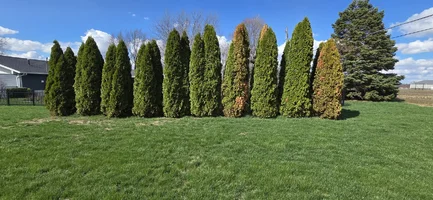
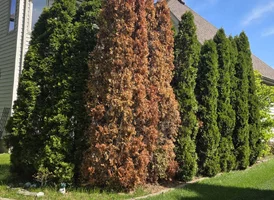
Quite a bit of Arborvitae (T. occidentalis) (a lot of Emerald Green...but there's a lot of Emerald Green planted).

Just smoked coming out of winter. Established trees (ages 10-25 years). Somewhat randomly within rows.

Very wet spring 2025. Pretty much quit raining in late July and the drought persisted until late March...but we had decent snow over the winter. Coldest winter in probably 10 years or so.

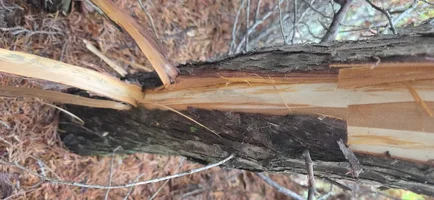
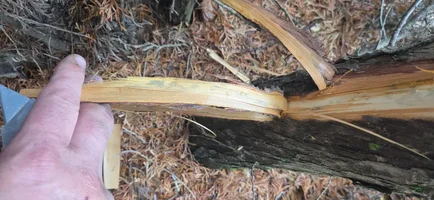
I thought maybe Cedar bark beetles..have seen that before. Some I looked at has little pitch dots on the bark. I forgot to peel bark when we tore them out.

Peeled bark on some today and there weren't any galleries, but a little bit of staining.
20260508_151329.webp20260508_151327.webp20260508_150928.webp20260409_163005.webp20260409_092322.webp
 
ATH,

I've seen this during Drought periods here in NJ both during as well as after. Many evergreens with their Pan shallow root systems, available water can quickly run out when the water table drops, areas of Abiotic stress like South exposure, Highway winds exposure, soil grade/wall changes, ect. Without supplemental water the Capillary water movement upwards will stop (air break).

I might have probed down a foot or so, to pull a couple soil cores to compare soil texture differences in the photo with the stone drywall, vs the still living arbs.

Look at soil elevation on the row with dead on higher ground, vs still living on the ends in lower ground......water table (dropping/less avail water) is my thinking in these first observations on site.

Secondary invaders/insects usually show up after the fact, but not always the cause of death.

Always a sad sight to see.
 
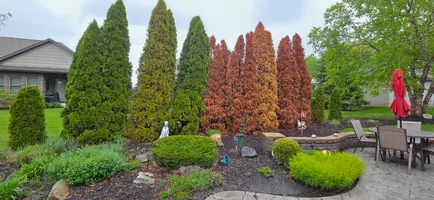
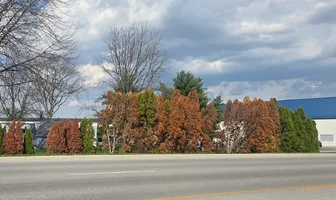
The first and third pictures are on "soil" that was probably a constructed berm in the neighborhood of 25 years ago (When the trees were planted). I tried looking for low spots and high spots and they're really wasn't any rhyme or reason to that.

I haven't been on site to look at that middle picture... Those are not emerald green like the rest of them are... Not sure if the variety, but they definitely have a more loose branching and foliage pattern. I'm guessing those are closer than 40 years old?

For sure, Cedar bark beetle would be a secondary past. Several years ago I saw quite a number of Arborvitae being hit by those.

Last season was certainly not the first or even worst drought that these trees have seen. But it could be a combination of the very wet spring limiting their root development followed by the drought.
 
I have seen a lot of different plants, though never every individual of course, respond especially badly to rapid cycling between extreme moisture profiles. I think it's been affecting trees of most species in the general western region over the last twenty years as we've gone through several major droughts and periods of very wet years, back and forth.
 
consider phytopthoria. I see this fairly regularly often starting and spreading down the line.
In your area maybe salt damage, and as you said wet winter so maybe the roots drowned?
Likely died a while back and just browning out with the warmer temps
 
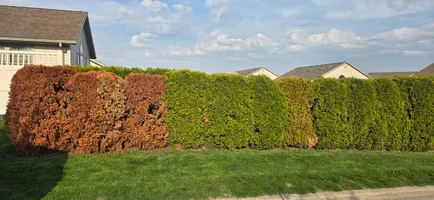
Not at the ones I posted. These were 3 different sites. Here is a 4th (also no pool). Some sit low, some sit high (relatively speaking...its very flat here).

20260406_160201.webp
 
For whatever it's worth to ya, I can think of several arbovitae hedges in Butte county that have the same thing going on. Can you attest to the planting practices at the other sites?

I'm not super familiar with them, other than what I read on a few nursery websites. I don't see a whole lot of them here- I think it's too hot and dry- and I have seen whole plantings fail in a few years, but I think those looked likely a combo of bad sites, poor planting practices, and inadequate irrigation- either not enough water, or too much water in the wrong places. Not saying that's what's going on here, but some maybe one or more of those is a factor.
 
Last edited:
  • Like
Reactions: ATH
Not at the ones I posted. These were 3 different sites. Here is a 4th (also no pool). Some sit low, some sit high (relatively speaking...its very flat here).

View attachment 102008
This really gets me scratching my head......

Heat Island on/off to the affected side?? Older Colorado Spruce only shows a bit of Cytospora Canker/ few dying branches. Are my eyes fooling me from a distance.... I see this in Stress areas too.

I do know the Heat Island/Ozone issue has become more noticed lately here in NJ.

Abiotic stress seems more inline with symptoms, BUT will keep an exe on this thread, and an Open mind meanwhile.
 
  • Like
Reactions: ATH
I have no doubt that environmental stress (wet spring 2025 and drought second half of summer and into fall/winter) play a big role. It would be an easier to feel really confident of that with young plantings...but as stated, these are what I would call "well-established, but not mature". That BYGL article was written last year. He mentioned the same wet spring/summer drought conditions. It wasn't as extreme in 2024, but 2 years in a row can certainly have a compounding effect.

It also mentioned "Arborvitaes exposed to excessive winter winds while roots are frozen can desiccate." As mentioned in the OP, we had a harder winter than has been "normal".

@Matias you asked about planting...I'd be shocked if they weren't planted too deep. Just about everything coming from every nursery I can find is too deep and almost nobody does anything about that at planting time. Deep planting certainly hurts the primary root system and trees will develop a secondary root system that is "good enough for now". Quite possible that "for now" ran out of time.

All that to say: maybe it is just failure of the root system to supply water to the canopy because of a series of unfortunate events coming together. I just don't want to write it off as that "simple" if there is something else going on here. Honestly, the list from the diagnostic lab in the BYGL doesn't give me a lot of confidence that I'll get anything terribly useful from them. A lot of needle blight. I don't doubt we'd find some of that on most over-crowded arborvitae...but that's not what is happening here. I'm confident it is a root and/or vascular issue with the rapid and complete death. There another lab (RAL) that can test for residual DNA for specific pathogens. Next time I get a call, I'll send samples to them for Phytopthora. The OSU lab will do a good job of finding that in an actively dying tree...but they culture is probably dead by the time they are getting it from trees like these.

Appreciate the feedback and I'll keep listening, reading, and digging.
 
....Older Colorado Spruce only shows a bit of Cytospora Canker/ few dying branches. Are my eyes fooling me from a distance.......
I didn't catch that, but it is probably one of the healthier Picea pungeon in this area. They all have Rhizosphaera needlecast and many that size have Cystospora. That one is very exposed, so likely dries out better than most others slowing disease development.
 
Looked at more today... As I was looking, it occurred to me: in the past when trees looked like this, I have been finding Cedar bark beetle. I have not been finding that this spring. I think it seems like the trees are dying too quickly for them to find a stressed tree and kill it off as we were normally expect. But maybe not?
1000016023.webp
 
Part of what I was driving at last post is the notion that perhaps they, as a species have a tendency to just shit the bed when they get upset? I have seen that as the general pattern in my area. They are either green, and growing along well enough. or mostly/fully dead all of a sudden. Is this common of the species where it gets planted often?
 
  • Like
Reactions: ATH
I don't know that I would say that across the board with T. occidentalis. Most of these are emerald green. Certainly anytime one genetic variety is widely planted you're opening the door to more widespread problems. But besides losing a tree here or there for reasons that I could usually explain, I wouldn't say this is "normal' behavior for the species or variety.
 

New threads New posts

Back
Top Bottom