What does liontailing a tree do?

What to recommend?

  • Crane removal, too decayed to climb and rig

    Votes: 3 75.0%
  • Climb and bomb limbs, no rigging

    Votes: 1 25.0%

  • Total voters
    4
Bob,
Because of the loss of roots there's an imbalance between root system and crown. Thus the dieback in the upper crown. Reducing the crown size can help the root system recover and create less of a sail in high winds, lessening the chance of failure.
 
not sure why we can't talk about liontailed branches and liontailed trees. The causes and the symptoms are identical; it's just a question of scale.

Reduction cuts are NOT undesirable for biological reasons. Why is that myth still being taught?

Gets back to Shigo.. we must define our terms...
Lionstailed is generally accepted to refer to limbs that look like a lion's tail... if you start applying that to entire trees, you're giving the term a second meaning, which creates ambiguity...
secondly lionstailing generally is seen to result in lack of taper to a limb, making it structurally weak...
this tree may have some lack of taper, and the real concern here is the decay associated with large cuts on the main stem...
This is a very common situation that often poses a lot of potential danger and bad consequences, yet we don;t have a name for it...
Because language effects consciousness, giving it a name will surely speed the development of awareness about the improper pruning techniques that cause it in the first place.


PS, I just looked at a red maple yesterday that I had pruned after a it sustained major storm damage.. It had bounced back with a new head of green growth and looked great... confirming (to me at least) how well the species responds to a hard prune..
 
Bob,
Because of the loss of roots there's an imbalance between root system and crown. Thus the dieback in the upper crown. Reducing the crown size can help the root system recover and create less of a sail in high winds, lessening the chance of failure.

That is not how I'm seeing it. I'm thinking the roots died due to the loss of the limbs and grew new ones to compensate. Why can't it be that way? The fullness of the crown is due to the trees need for energy to heal itself therefore let it do so. Watch it closely till it starts to dieback then prune it. Please correct me if I'm wrong.

What's the history on the roots, Guy? Was there work done around the house or some other problem?
 
its clearly a girdling root issue..
And yes the tree needs leaves to make energy to keep itself healthy and fight the infection.. More leaves the better it will do.. HOWEVER as arbs we get to balance the health of the tree with the needs of the people for safety.. (of course we aren;t doing the tree any favor by allowing it to fall apart in a storm either).... in this case given species and proximity to the house a significant reduction is not out of order.. we still haven;t seen pics of the CID (chainsaw induced decay)... got any Guy?
 
HISTORY AND BACKGROUND

1986: Rootzone compacted and a root growing toward new house killed by grading. Owner aerated the compacted soil and added sand and fertilizer. He used a car axle to do the aerating. :cool:

Not every leaf is precious-- a 20% reduction is routine, and very tolerable as Dan points out. I don't think notifying the neighbors to stay away in storms is a viable risk mgt strategy.

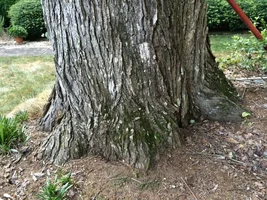
Liontailing is the same concept whether applied to trees or branches. Call it overraising if you want; it's the opposite of topping but maybe more common and almost as damaging, but it's a side issue in this tree. No decay is visible from the ground at the cuts. Strength loss at the base is significant, and needs to be addressed by reducing load. Pic is the eastern view; decay visible in all the sinuses. No girdling roots visible.

The owner's risk tolerance is yet to be expressed. He might decide to reduce the load by removing the tree, but with monitoring that is not needed imo. 20% off can increase stability 50%.
 

Attachments

  • photo 3.webp
    photo 3.webp
    129 KB · Views: 9
Gets back to Shigo.. we must define our terms...
Lionstailed is generally accepted to refer to limbs that look like a lion's tail... if you start applying that to entire trees, you're giving the term a second meaning, which creates ambiguity...
secondly lionstailing generally is seen to result in lack of taper to a limb, making it structurally weak...
this tree may have some lack of taper, and the real concern here is the decay associated with large cuts on the main stem...
This is a very common situation that often poses a lot of potential danger and bad consequences, yet we don;t have a name for it...
Because language effects consciousness, giving it a name will surely speed the development of awareness about the improper pruning techniques that cause it in the first place.


PS, I just looked at a red maple yesterday that I had pruned after a it sustained major storm damage.. It had bounced back with a new head of green growth and looked great... confirming (to me at least) how well the species responds to a hard prune..

The red maple as a species being hardy is good but that is a blanket statement but it very much depends on vigor and health. We do a lot of silver maples here and they can handle heavy prunes 'usually' but if you go by that with a low vigor tree the bigger wounds will become 'CID' as I read earlier I like that term
 
We have lots of acer rubrum and many have been topped and raised and generally hammered. Yes, they sprout but the rate of decay and extent seen in many trees leave them precarious with regular failures in high wind events.

This is a complex scenario and really starts with the risk tolerance level of the client. This is all about the future and any program must extend into the foreseeable future. What sort of monitoring & maintenance program will you be proposing? The associated costs need to be taken into account. For me, a fuller diagnosis is needed to really come to any sort of prescription.
 
Gets back to Shigo.. we must define our terms...
Lionstailed is generally accepted to refer to limbs that look like a lion's tail... if you start applying that to entire trees, you're giving the term a second meaning, which creates ambiguity...
secondly lionstailing generally is seen to result in lack of taper to a limb, making it structurally weak...
this tree may have some lack of taper, and the real concern here is the decay associated with large cuts on the main stem...
This is a very common situation that often poses a lot of potential danger and bad consequences, yet we don;t have a name for it...
Because language effects consciousness, giving it a name will surely speed the development of awareness about the improper pruning techniques that cause it in the first place.


PS, I just looked at a red maple yesterday that I had pruned after a it sustained major storm damage.. It had bounced back with a new head of green growth and looked great... confirming (to me at least) how well the species responds to a hard prune..
Good post.
 

New threads New posts

Back
Top Bottom