Tulip spar bounce and roll

Daniel

Carpal tunnel level member
IN case you didn't see this posted already:

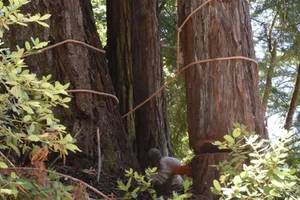
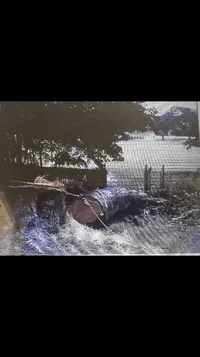
IN order to minimize lawn damage and keep the log out of the dirt and off the ground so its easier to cut without dulling, two logs from the top were used to cushion the fall, then one log was used to stop the roll and another long limb was used to keep the wood off the ground...


 
An addition would be to tie a choker rope just above the face and then below the face. Put the connection leg on the right side, in this case, and the butt is snubbed off...keeps control too
 
IN case you didn't see this posted already:

IN order to minimize lawn damage and keep the log out of the dirt and off the ground so its easier to cut without dulling, two logs from the top were used to cushion the fall, then one log was used to stop the roll and another long limb was used to keep the wood off the ground...

Ok and...
 
An addition would be to tie a choker rope just above the face and then below the face. Put the connection leg on the right side, in this case, and the butt is snubbed off...keeps control too
The old Butt-Hitch. Perfect trick for this job. A super simple, under utilized technique these days. Why is that?

Dropping a little 80ft spar sidehill on some very steep ground. Brand new asphalt road and water tank about 10 ft below, so the spar had to sit down once it hit the ground. A butt hitch was all it took.

DSC_0506.webp
 
Last edited:
The old Butt-Hitch. Perfect trick for this job. Under utilized technique these days. Why is that?

Dropping a little 80ft spar sidehill on some very steep ground. Brand new asphalt road and water tank about 10 ft below, so the spar had to sit down once it hit the ground. A simple butt hitch was all it took.

View attachment 53031
I still do when warranted Rico. Not anything like you but fence and golf coarse to get hammered not good..slope is way more extreme than pic shows.2018-07-25 09.24.21.webp
 
Always exceptions...but a choice of last resort

Disagree completely .... Leaving a stub(s) up to 4-5' is an excellent method to stop a tree from sliding downhill or rolling after impact..... That will be the simplest, fastest, easiest method, which makes it the first resort.. But hitch would be a back up as it takes longer, is more complicated and time consuming to set up and creates the potential for extremely high forces to damage or break a rope... Which is more reliable??? Well that''' get us back to the same old answer....

IT ALL DEPENDS
 
The old Butt-Hitch. Perfect trick for this job. A super simple, under utilized technique these days. Why is that?

Dropping a little 80ft spar sidehill on some very steep ground. Brand new asphalt road and water tank about 10 ft below, so the spar had to sit down once it hit the ground. A butt hitch was all it took.

View attachment 53031
I just found out within the last couple years that the half hitch is weaker than the knot. It was discussed in this or another forum at some length. I've been thinking about taking a wrap and then tying doubled bowling for the running hitch... That tree looks huge.. When dealing with extreme forces I've found using strong knots very important..
 
The results from using a butt hitch are dependable and repeatable. Few variations.

Breaking rope concern? Get a bigger rope

Stubs create unknowns.

In my experience.
no way of knowing how much force a big tree will create with all that dynamic mass and such a short piece of line with little stretch.. You can't even venture a guess. SO many variables..

Its not something I deal with a lot because of the size of the trees and the flat terrain around here.... Leave a stub or 3 facing the lay.. you know its going to dig in and put the breaks on. As long as there are no underground fixtures, its a lot more "known" than how much damage you;re going to do to your rope... Small trees may not be an issue.... but look at the one in Rico's picture.. How could ever trust that rope again???
 
Never busted a butt hitch line in my life. When stuff gets real big and heavy you can put multiple lines on it, or go to wire/chain.
 
I've done both rope and chain. Chain for the big nasties, but it can be a pain due to needing to release the tension afterwards. When you NEED to use this 20-30' of heavy rope is cheap and somewhat disposable, and a great way to recycle. I rather go with rope, and a tensionless hitch vrs a porty
 

New threads New posts

Back
Top Bottom