Tree spacing & selective removal thinning

macrocarpa

Branched out member
Location
Midwest
I've always liked giving trees ample space to reach their mature size with as little competition as possible for most urban landscape applications. But in a street tree setting where the mature street tree "tunnel" effect is the objective, how close is too close together?

Example: Pin oaks planted 30-40ft apart, they are now 12-14in dbh and near touching each other.

A community/neighborhood association could resist a selective removal plan, but in the long run what are the end results? My theory is that pin oaks will shade each other out and accumulate mass amounts of deadwood where sunlight is not reached on both sides and the lower canopy, becoming tuffs of live growth on the very upper canopy only. I think in the long run there is potential for more % canopy coverage and much healthier/fewer trees by selective removal and providing adequate space?????

I've been to seminars where presenters say things like "don't be afraid to plant trees close together, it is how they grow in the forest, they like being close to their friends". I can see this in planned clump plantings with select species, typically small-medium sized trees, or preserving forest remnant trees in clumps.

I appreciate any opinions and projected results of each scenario. Thanks!
 
Crowding is a big problem when urban foresters and their bosses want to boast about how many trees they got planted, with no clue how (or budget committed) to maintain them.

Pruning is usually a better solution to crowding than removal. It totally depends on species, site, and objective (tunnel etc.) I could see where pin or willow oaks should be thinned to make better trees with a lower canopy, but along the street it's probably better to just manage their spread with reduction cuts.

This calls for overcoming the "Removal cuts are better for the tree" myth that keeps getting repeated.
tongue.gif
 
Lifespan of the trees involved plays a part IMO. Potentially remove shorter lived trees to make room for longer lived ones. But keep in mind, when you remove trees, the remaining ones will have wind and sunlight buffers removed, potentially creating problems. Best to look at it on a case by case basis.
 
I ran Providence's municipal planting program for 8 years, and was responsible for the planting of over 4,000 trees. I was not trained in this field before I started, so a good percentage of those trees could have been planted more optimally, and I learned from my mistakes. I was also the tree inspector during this time, so I saw all the mistakes that were made before me as well. Sorry to dwell on the mistakes, but it just helps so much to teach us and point us toward the ideal.

You are asking the right questions with regard to species and shade tolerance. Overhead obstructions or lack thereof, available soil space, potential future use or changes of use in the area are also considerations. My goal was to maximize canopy with the conditions I was working with, keeping my hopes realistic. For instance, I would not plant a tuliptree/dawn redwood/pin oak in a spot where the root flare would likely cause a conflict with infrastructure, regardless of overhead space, because in so many cases I saw, infrastructure won in the end. Which is not always unreasonable. Right tree/right place, ya know? And the more we learn, the better we get at this. I would also add that the density and layout of the urban area will steer your overall plan. In Providence, we needed shade and canopy cover, but depending on the layout of the city or neighborhood you are planting in, this could be different.

With unlimited or ideal soil space, and no overhead or lateral obstructions, I would use a broad tree that would fill the space, and I would go for approximately 30-40 feet apart. Ironically, I planted several Q. macrocarpa (when I could obtain them) in situations like this in Providence. London Plane are another good candidate for areas where trees can spread. Linden are a good selection that you could use for an allee situation. Relatively upright in their formative years, and shade tolerant. Many trees, even if not shade tolerant, can commingle canopies. Don't be afraid to plant inside that 30 foot range. Sometimes two large trees close together will form one canopy down the road. Case by case, as I have heard someone say before. ;-)

-Tom
 
Thanks Tom!

It seems there is usually limited root space to work with when talking about street trees. Between sidewalk and curb, 5-12ft I would estimate. Some urban foresters/landscape architects don't hesitate to put oaks in the 5 ft space on 30' centers. But I have to wonder what will happen in 30-40 years when lets say those pin oaks are getting around 20in dbh? Over competition, Infrastructure damage? I think about a pin oak I measured that has a 103ft spread.

On the other hand who wants an urban forest full of ornamentals that don't reach taller than 30ft? Smaller trees have their place but wont give the same effect. Its a different mind set for right tree right place I think when dealing with street trees, because the sidewalk to curb space is limited in most cases.
 
I used those examples because of root flare, but there are plenty of larger trees that are less of an issue with roots. There are also quite a few mid sized trees that can fit the bill. Frontier elm is a good choice if you can find it.

-Tom
 
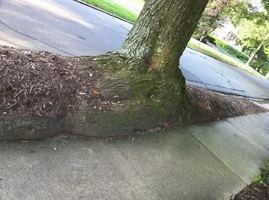
5' is fairly generous ime; I've worked with many q phellos that were in <4' wide areas. Yes, curbs and sidewalks must adapt; not ideal by any means. The attached is one of 38 along a street; 35 were managed with reduction pruning, 10-15' off. After 2 seasons they are looking good.

REPLACEMENT SPECIES
Like willow oaks, red and sugar maples form wide buttresses. They are not performing well on Oak Street, and they are not recommended. Willow oaks comprise 71% of the canopy if counted by number, and more if calculated in volume and contributions. They are generally well adapted, but their spreading buttresses do not fit the narrow, high-traffic site. Early training and use of root barriers would lessen and delay this problem, but not eliminate it. Any other species will tend to stick out, but some replacement options follow:
Zelkova serrulata are performing well, the foliage and crown shape are similar to willow oak, and they are readily available. Narrow forks splitting can be a stability concern as they mature. Structural pruning as these trees develop can save big losses later on.
Pistacia chinensis has a similar crown shape and narrow buttress, but the leaf shape and fall color are quite different.
Quercus, suber, variabilis, and other oaks have a relatively narrow base, and similar leaves and bark, but are rarely found in cultivation.
Celtis sp., hackberry, has a narrow base and is pest-resistant. The bark and leaves are lighter in color, and hackberry is not highly regarded as an ornamental.
Ginkgo biloba is a popular urban tree. Though it gets large, its buttress is not as expansive as a willow oak’s. Its wide foliage and triangular form in youth give it more potential as a standalone specimen tree. It might not mix well in a grove of willow oak and zelkova.
 

Attachments

  • 384250-rootbig.webp
    384250-rootbig.webp
    266.1 KB · Views: 34
"Zelkova serrulata are performing well, the foliage and crown shape are similar to willow oak, and they are readily available. Narrow forks splitting can be a stability concern as they mature."

serrulata OR serrata?
 
Perhaps Zelkova serrata 'musashino' is 'similar' to willow oak when young, but Zelkova is decurrent and willow oak is pretty much excurrent until well into maturity.

Tom
 

New threads New posts

Back
Top Bottom