Tree Frog method on DRT?

Rick, I'm hardly an authority on the subject-I've only been doing SRT ascents for a short time. However I have to suggest that you try using the Tree Frog SRT as it was intended. I'm sure that, while using the TF components DdRT does save some effort over merely footlocking the tail or using a Pantin on the tail it still involves a lot of repetitions to get up. The SRT use of the TF is the easiest ascent method I have ever tried. I'm one of those guys who uses it on mere 30-40 foot ascents. For transitioning into work mode or descent I am doing the following- I tie my friction hitch on my climbing line ( I use the split tail method utilizing a tress cord) and clip it onto my saddle as if it were a second lanyard with a very long tail. I go up my Ascent line SRT using the TF system. When I get to my Tie-In-Point I clip into it with my DdRT rigged climbing line. One body thrust on that takes the load off the TF ascenders and I can disconnect them. I stow the Handled ascender and just wear the Croll and Pantin. I usually secure my ascent line with a longtailed running Bowline for the ascent so, once unloded I can just pull it down to me, untie and, either drop it if I won't need to double crotch to work the tree or tie it to my saddle to recrotch later OR go ahead and reset that line and begin work double crotched if needed. I realize that carrying a second line on the ascent adds some drag but for the limited height ascents I usually make it isn't a serious handicap and it makes the transition simple and secure since there is no need to worry about dropping gear and (worst case scenario) winding up in the top of the tree hanging on a lanyard with no climbing line. (I break the 'rule' and frequntly climb alone.)
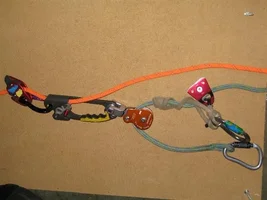
 
An alternative that could work in the right situation is to switch out the adjustable cow's tail in the TF system for a pulley with your Dbrt climbing system already threading through it (see attched photo, credit to Frans, I think). Add a rocker or prusik over the ascender and as soon as you get to point where you need to work you are ready to climb Dbrt off of your floating false crotch.
 

Attachments

  • 32063-rotator.webp
    32063-rotator.webp
    47.1 KB · Views: 159
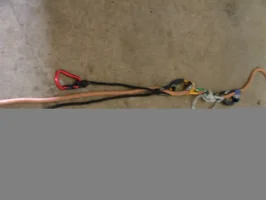
Here is a set up I have been using for about four years. (Sorry about the blurry picture) The red connection to the left goes to the saddle. The left foot goes into the loop. I use a Pantin on the right foot. The yellow assender is the primary, it is connected to the blue ascender (Back up) by a short tail. I set a single line (KM III usually). During the climb I typically tie up short here and there on my access line as added saftey. At the top of the climb I tie in traditionally unclip the red connection put a slip knot in the access line over top of the blue ascender, clip the red snap into it and let it hang. Either I or a groundie pull it out later.

Tony
 

Attachments

  • 32064-DSCF0042.webp
    32064-DSCF0042.webp
    106.4 KB · Views: 170
Rick, when I climb DdRT, I attach to my climbing using an HRC cord with the Knut hitch and a micro-pulley coupled with a Pantin on my foot. This is the same setup that I use for SRT.

As I climb I put my left foot on top of my right foot, like footlocking. This enables me to use both legs in the climb.

I like this setup better than the Tree Frog System because I don't have anything to remove or store once aloft.

Jim
 
Mechanically assisted static line ascents are the way to go for medium to long ascents. No dynamic, waste of energy nonsense and no outdated static line footlock either. A hand ascender, a good foot ascender ( preferably not the feeble pantin type ) , and a decent backup, and away you go . If there is work to do on the way up, then set up a floating crotch which can act as a backup as well. For lines set close to the trunk, i don't use the frog method as i find it more useful using my unattached foot to balance and push off the trunk / branches. For a overhead clear ascent then i attach a sling for my other foot ie frog system.
For newcomers to the above systems, don't be put off by initial attempts. It takes a while to sort out co-ordination, balance etc.
 
[ QUOTE ]
Myself , I find it to be a burn out and use way more calories because of the repetition.Hwever, it is much easier. So I stick to footlocking unless the heights are above 100'. Then SRT equiptment comes out which is the same as Drt for for me.


[/ QUOTE ]

Just curious. Since your SRT system is not a Frog System, what equipment do you use for SRT?

Thanks,
Jim
 
I have a foot ascender made by " SRT " , which is a company in Australia. I have yet to see this model in North America / Canada. It is a much more bulkier item that has a much larger surface area than the pantin. It doesn't dig in to the boot as much as the pantin neither does it twist or turn as much as the pantin. Works really well.
If a distributor like Sherill were to stock them i'm sure they would sell like cup cakes.
 
Gareth,

I've drooled over the pics of SRTE gear for years. They don't have a US distributor. Anyone whose familiar with the gear from ISC will recognize that SRTE builds in that same class.

Would you show us what foot ascender you use from SRTE?

http://www.srte.com.au/products.htm

Almost all people who I've seen using the Pantin don't mount it correctly on their boot. The rope should exit the top of the Panin just behind the knob of the ankle bone. Having it higher twists the ankle in a bad way. Read in ON ROPE about the early Gibb's foot ascenders.
 
Partly yes,
I'll see if i can attach the photo.
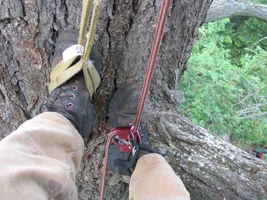
Notice the left foot setup is simply an old long sling that fits through the bottom of my hand ascender and down to where my boots fit snugly through the eyes.
 

Attachments

  • 32389-IMG_8790.webp
    32389-IMG_8790.webp
    628.8 KB · Views: 144
Gareth,

Thanks for the pic.

With the rope tailing so far in front of your ankle bone your ankle will get worn. Consider moving the unit back so that the rope tails behind your ankle. If you had the unit from the other "hand" it would make it easier.

A few years ago I played around with mounting one of the camming parts of a Kong ascender, without the handle, onto the heal plate of a snowboard binding. It worked...sort of...I was trying to come up with a step-in unit. A couple of months later the Pantin came onto the market so my idea went to rest.
 
Gareth,

Thanks for the pic.

With the rope tailing so far in front of your ankle bone your ankle will get worn. Consider moving the unit back so that the rope tails behind your ankle. If you had the unit from the other "hand" it would make it easier.

A few years ago I played around with mounting one of the camming parts of a Kong ascender, without the handle, onto the heel plate of a snowboard binding. It worked...sort of...I was trying to come up with a step-in unit. A couple of months later the Pantin came onto the market so my idea went to rest.
 
There is a time and a place for everything. I hip thrust too on short sections. Certainly wouldn't hip thrust on those long ascents. That's where a bit of gear and different techniques come in hand to improve efficiency and add some spice to your climb.
 
[ QUOTE ]
[ QUOTE ]
SRT is clear enough

[/ QUOTE ]

You climb a single leg of one rope.


[ QUOTE ]
DRT is clear enough, I suppose

[/ QUOTE ]

You climb/use two different ropes each of which has its own anchor point.


[ QUOTE ]
If I toss my rope over a limb, fasten one end of (terminate) it to myself and footlock the tail, that mechanism/process is to be indicated by which acronym?


[/ QUOTE ]

DdRT, because the rope is doubl<u>ed</u> over a tie-in point and you are using both legs of the rope. More precisely a dynamic DdRT because the two legs of rope are moving.


[ QUOTE ]
If I toss my rope over a limb and footlock both ends as one, in the exact same way as for an SRT, that process/mechanism is to be indicated by which acronym?

[/ QUOTE ]

Again, DdRT because the rope is doubled over a tie-in point and you are using both legs of the rope. More precisely a static DdRT because the two legs of rope are (relatively) stationary as you climb, i.e. they don't move up or down as in your previous example.

The difference is DRT = double rope technique, two ropes; and DdRT = doubl<u>ed</u> rope technique, one rope doubled over a tie-in point and the climber uses both legs of the rope for climbing.

[/ QUOTE ]

Just to clarify one more system.....climbing 1 leg of a line 'doubled' over a TIP/anchor, with the other leg tied off....SRT or DdRT?
 

New threads New posts

Back
Top Bottom