Tree Flex?

OSHA supercedes ANSI if I am correct? Does OSHA specify fp ratings.

In Ontario the OHSA outlines types of fp required and that they must meet or exceed CSA standards. That probably opens the door to superior product based upon superior testing.
 
did some digging and found:

1926.502(e)(3)
Connectors shall be drop forged, pressed or formed steel, or made of equivalent materials.

1926.502(e)(5)
Connecting assemblies shall have a minimum tensile strength of 5,000 pounds (22.2 kN)

I'm guessing this one is referring to the attachment points to the harness and our rope. Or that is how I take it. Depending on the rope bridge and the shackles it might pass it in that regard.

1926.502(e)(6)
Dee-rings and snap hooks shall be proof-tested to a minimum tensile load of 3,600 pounds (16 kN) without cracking, breaking, or taking permanent deformation.

This is another one that is up in the air depending on the hardware. If it’s the same principle as the treemotion then it would fail in this regard. If this is the only thing keeping it from complying with osha then its an easy fix. I'll keep digging to see if I can't find anymore.

If I can show that osha allows this saddle as a work positioning harness. I would think it would override ANSI and then therefore eliminate the liability for the employer. (kind of thinking out loud on this one, someone say something if that’s not sound logic)
 
[ QUOTE ]
did some digging and found:

1926.502(e)(3)
Connectors shall be drop forged, pressed or formed steel, or made of equivalent materials.

1926.502(e)(5)
Connecting assemblies shall have a minimum tensile strength of 5,000 pounds (22.2 kN)

I'm guessing this one is referring to the attachment points to the harness and our rope. Or that is how I take it. Depending on the rope bridge and the shackles it might pass it in that regard.

1926.502(e)(6)
Dee-rings and snap hooks shall be proof-tested to a minimum tensile load of 3,600 pounds (16 kN) without cracking, breaking, or taking permanent deformation.

This is another one that is up in the air depending on the hardware. If it’s the same principle as the treemotion then it would fail in this regard. If this is the only thing keeping it from complying with osha then its an easy fix. I'll keep digging to see if I can't find anymore.

If I can show that osha allows this saddle as a work positioning harness. I would think it would override ANSI and then therefore eliminate the liability for the employer. (kind of thinking out loud on this one, someone say something if that’s not sound logic)

[/ QUOTE ]

I think I'm correct in stating this is the review on connectors i.e. Karabiners and snaps, and shouldn't be mis-applied to harness manufacturer.

To answer the question, does TreeFlex meet ANSI, the answer is I personally don't know, because There are too many Osha standards and then the Z133.

Presumably ANZI Z133 should over ride other industry OSHA standards, because it is arb indutry specific?

This is the EN813 test report http://www.treemettlenexus.com/pdfs/test_report.pdf
 
From an article on TBzz:


[ QUOTE ]
OSHA or ANSI?
The majority of workplaces in the
United States are covered by the
Occupational Safety and Health Act (OSH
Act) of 1970. For many industries there are
specific standards within the OSH Act that
govern workplace practices, procedures
and equipment. For other industries there is
no specific standard within the OSH Act,
but those industries are still required to
abide by what is commonly called the
General Duty Clause. The General Duty
Clause states that each employer must:
“…furnish to each of his employees
employment and a place of employment
which are free from recognized hazards
that are causing or are likely to cause
death or serious physical harm to his
employees.”
The tree care industry is one of the
industries for which there is no specific
OSHA standard. To identify ‘recognized
hazards,’ OSHA will typically look to
industry consensus standards and for the
tree care industry; those consensus standards
are the ANSI Z133.1-2006. Through
this rather circuitous route arborists are
bound to follow the ANSI Z133.1-2006.
State, local or company regulations may be
stricter than ANSI Z133.1-2006 and, if so,
they supersede the ANSI Z133.1-2006.

[/ QUOTE ]


Jman, 1926 is for construction:


http://www.osha.gov/pls/oshaweb/owadisp.show_document?p_table=STANDARDS&p_id=10593


Note too:

[ QUOTE ]
1926.502 Fall protection systems criteria and practices.


[/ QUOTE ]


Our systems are for work positioning.


[ QUOTE ]
If I can show that osha allows this saddle as a work positioning harness. I would think it would override ANSI ...

[/ QUOTE ]


I understand why you want to do this, but attempting to use an incorrect OSHA standard to override ANSI would reverse the hard, and often times thankless, behind the scenes work that people have done for years to get OSHA to recognize the Z. Your time and energy would be of much better benefit to the industry if you'd encourage and educate ANSI to widen its view of acceptable equipment. The concept of 'fit for purpose' would be a great place to start.

 
[ QUOTE ]
If I can show that osha allows this saddle as a work positioning harness. I would think it would override ANSI ...

[/ QUOTE ]


I understand why you want to do this, but attempting to use an incorrect OSHA standard to override ANSI would reverse the hard, and often times thankless, behind the scenes work that people have done for years to get OSHA to recognize the Z. Your time and energy would be of much better benefit to the industry if you'd encourage and educate ANSI to widen its view of acceptable equipment. The concept of 'fit for purpose' would be a great place to start.


[/ QUOTE ]

I agree. All too often these disparate organizations work against each other.

For example the isa arborist cert vrs. tcia's certs.
 
[ QUOTE ]


I understand why you want to do this, but attempting to use an incorrect OSHA standard to override ANSI would reverse the hard, and often times thankless, behind the scenes work that people have done for years to get OSHA to recognize the Z. Your time and energy would be of much better benefit to the industry if you'd encourage and educate ANSI to widen its view of acceptable equipment. The concept of 'fit for purpose' would be a great place to start.

[/ QUOTE ]

Thanks for setting me strait. Before I totally derail this rant and rave topic. Where should I start? I would like to make a difference in the profession I work in day to day, but lobbying ANSI is above my education. Most of the OSHA is gibberish to me and so shows in the post above. How can we get ANSI to be a little more open with the equipment today? The equipment isn't what kills us; it’s the lack of knowledge and the training to do the job. Let get this started in a different thread so we don't take over this equipment review thread.

Also I wasn't trying to use incorrect standards. I was trying to get them clarified so I don't use them if they are not the right ones (my attention span runs off on me when I'm looking at 30 pages of text that repeats itself). I'm not trying to be under handed and pass something by when it shouldn’t be used. I'm just trying to get good equipment cleared for use.

And thank you for all who have passed the wonderful Z even though I feel like I'm fighting it here and there. I hope I'll make a difference somewhere somehow.
 
[ QUOTE ]
Also I wasn't trying to use incorrect standards.

[/ QUOTE ]


Sorry, I didn't mean to imply that it was intentional, just that it was misdirected.


[ QUOTE ]
Where should I start?

[/ QUOTE ]


ummm.......maybe starting that other thread would be a good place. Buy a copy of the Z. Read it. Or at least most of it. Gain some understanding of it and some fluidity with the topics. Pass that knowledge on to others and be vocal about what you think should be changed.
cool.gif
 
check, check, check. I've read the Z front to back more than twice. It’s a rough read to say the least with the legal wording. About the topping I dealt with a client that had her trees topped and we took one down and pruned two that where in trouble. I really try to tell our clients that topping is bad. Explain the reason and all that and just overall try to be a good arborist. I care and really try and show it by doing the right thing. Yes, that piece of dead wood that’s all the way out on the end of that branch is going be a pain in the @ss but I still go and get it even though I'm sick or just lazy that day. I talk to the people I work with everyday and try to work out the reason either the Z or my company does things. I try to get inside their heads and think from their side of the wall but sometimes it drives me crazy and I just say screw it and go about my daily job.

I’m looking for the specific OSHA work positioning code and the same ANZI code if anyone has it. I’m going to do a few days research to figure out what is going on and where I should start with this topic but I won’t clutter this thread anymore. You’ll be hearing from me in the next day or so with some good information. I’m hoping what the Peztel sales rep has said in the next forum above us is true because it makes things a lot easier for this topic.
 
Stick with ANSI to begin with. That's what guides our industry.

Be vocal to the ANSI committee. To do that you have to get in touch with ISA and/or TCIA, find out who the contact people are and start a discussion on what interests or annoys you. Hate to say it, but I think the time frame on all that (including what I put in my last post) is months or years, not days.

Tom D. and TMW are good references, for the Z, and Guy for the A300, But, as you've seen on this website, even they correct each other, ask questions, get frustrated, and have to do research.

Be prepared to spend a lot of time, and talk to a lot of people. Years, not months or days. But, you've already started.
cool.gif
 
[ QUOTE ]
...........Be prepared to spend a lot of time, and talk to a lot of people. Years, not months or days. But, you've already started.
cool.gif


[/ QUOTE ]

.....and years and years and years .........
smirk.gif


Thanks for straightening things up Mahk RE the Z etc.

Jman, you're not de-railing the thread - its all a part of getting to the bottom of a murky barrell. For my business, its not enough to just look and rely on any badge - I find out how and why it was awarded, and if its applicable to my requirements. Then keep an eye on it till I know how it performs in specific use over time. This is part of the 'Fit for purpose' concept, that is written in to UK regs.

I'd like to know the testing that US harnesses have to go through to prove each component, and the harness as a whole, meets 5000# tensile? Anyone with experience of that???
 
but.... (see attachement)


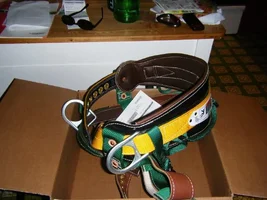
They sent the wrong saddle!!! I called Baileys and they were great, they have already sent the correct saddle and a label to return the Weaver floating D. I guess I'll have to wait another week....
 

Attachments

  • 128944-tfx2.webp
    128944-tfx2.webp
    71.2 KB · Views: 84
[ QUOTE ]
They sent the wrong saddle!!!

[/ QUOTE ]

I was gonna say...it looks different in the pictures!

Let us know how you like it when you get it,
I'm really thinking of gettin one.
 

New threads New posts

Kask Stihl NORTHEASTERN Arborists Wesspur TreeStuff.com Teufelberger Westminster X-Rigging Teufelberger
Back
Top Bottom