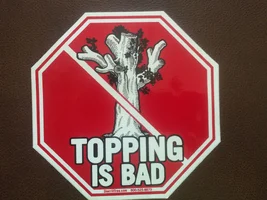
topping trees

Exactly, if someone wanted to deal with those tight crowded unions why not plant a Bradford pear instead. Same sort of mess.
And also, I want to reiterate what climbhightree's picture illustrates - on the left you see the recent beginnings of branch attachment, whereas on the right you see a long strong attachment. Which is why I always prefer leaving something that has history rather than cutting back to start again. Depending on how large the branch is you could have quite a contrast. No history of branch attachment coupled with decay in parent stem = not as healthy or strong.

View attachment 34235
Exactomungo!

So glad everyone is contributing and is taking this thread in this direction.

There is such and art and science to pruning trees. I learn something everyday about trees. Seeing the reactions from my good cuts years ago to others bad cuts years ago. Cutting them open after removals and reinforcing the basic understanding of how and why they grow the ways they do. Like doctors studying cadavers.

Most clients grasp the energy flow idea. The tree wants to flow the energy up. If you top that, it will most likely direct the energy in a non desirable growth pattern.
 
I performed an "extreme pruning" today for a buddy of mine. He originally asked me to do this work back in the summer because one of his trees was casting too large of a shadow onto the deck of his pool. I asked him to wait until the leaves fell off.
 
If that's what topping is... I've only topped a tree once.

I really tried to talk him out of it. He did not care and told me he knew what it was going to do to it. Cause it was done to the tree before, like 15 years ago. A Box Elder of course. Upon thorough inspection during the butchering ,it was obvious where the topping took place and how well the tree took it with out any further help.

We did not put the signs out by the road that day.
 
Last edited:
Topped a w. pine (with ambivalence / malice) for a couple, a few years ago. Too tall, too much shade, too many needles, too this, too that.
The deal was one of them really wanted the tree removed, and the other wanted to keep the tree, both with the understanding that topping wasn't gonna either make it look pretty, or benefit it.
It happens. Nice folks, and repeat customers, but it seemed like a lose - lose situation.
 
Topped a w. pine (with ambivalence / malice) for a couple, a few years ago. Too tall, too much shade, too many needles, too this, too that.
The deal was one of them really wanted the tree removed, and the other wanted to keep the tree, both with the understanding that topping wasn't gonna either make it look pretty, or benefit it.
It happens. Nice folks, and repeat customers, but it seemed like a lose - lose situation.
Almost like we should make them sign a form acknowledging what they are doing is generally accepted as bad stewardship. Not tying to shame them, but really make them think about it a little more.

The way I look at it too is, I'm going to be the one to deal with this in the future.

I think topping a conifer is much less an issue as compared to a deciduous.
 
I think topping a conifer is much less an issue as compared to a deciduous.

In my mind it's by species. Because I deal primarily with trees that experience regular snow-load, and are conifers, I find some will do fine with height reduction and others not. Ponderosa pine handles it well, good compartmentalization and because of its rounded growth habit will have natural "topping" with weather. Douglas-fir and Spruce react like you describe White pine, lots of bad attachments and once it loses its conical form and has multiple stems above the break/cut that regularly fail. I have had success with topping Fir and Spruce as long as I go back regularly and establish a top by cutting out the competing leads. The problem there is selling that to the client...
 
For real. We have spruce around here and of the conifers I've seen they handle topping like champs. My grandpa knew much about trees from experience. He was the one who first explained topping to me when I was 14. The few new leads from the first whorl below the cut start fast reaching for the sky. Maybe that's a key. The branches from a whorl with a deeper root/origin of growth versus a new shoot (or bunch or them) with starts only in the outer growth ring, a bunch too boot.
 
I see more codom failures after a heavy (50mph+) storm then anything else.

Why is topping stressed more then bolting or pruning to reduce codom failures. A tree ripped right in half usually needs to be put down. Topping usually just makes the tree look bad. A heavily included codom just looks like trouble waiting to happen. More so when they ooze the blackness from their evil soul.
 
We sometimes get freezing rain ... freezes to items on the ground after falling from the sky. I went skiing near the Blue Ridge Parkway at Wintergreen a few days after one severe freezing rain event, and the ice was still 2 inches thick in most places. While riding the ski lift, I was amazed at the sight before me because it looked like God had run a lawn mower over all the trees on the hillsides. Wintergreen was closed for a few days so they could clear all the broken limbs from the slopes, roadways and other areas. The Blue Ridge Parkway and Skyline Drive remained closed much longer for clean up. Mother Nature tops trees when she wants to.
 
We sometimes get freezing rain ... freezes to items on the ground after falling from the sky. I went skiing near the Blue Ridge Parkway at Wintergreen a few days after one severe freezing rain event, and the ice was still 2 inches thick in most places. While riding the ski lift, I was amazed at the sight before me because it looked like God had run a lawn mower over all the trees on the hillsides. Wintergreen was closed for a few days so they could clear all the broken limbs from the slopes, roadways and other areas. The Blue Ridge Parkway and Skyline Drive remained closed much longer for clean up. Mother Nature tops trees when she wants to.
I've seen a few people make statements similar to this, but I think it is a silly excuse. Sure the tree survives, so would we without and arm or two...but that doesn't make it the right thing to do.

Are we as arborist supposed to be like a storm, and destroy everything in our path? Or should we care about what we do, and strive to always do what is best, beneficial, etc?

What tree usually breaks first, a properly thinned and structured tree or a wild mismanaged tree?

We have had a few ice and wind storms here...and I have to say in general my customers trees faired pretty well.


Associate degree in forestry from PSU Mont Alto
"Kiss My Axe"
Certified Arborist
Owner/operator of Climb High Tree Service established in 2002
www.climbhightree.com
https://m.facebook.com/ClimbHighTreeService
https://www.youtube.com/user/climbhightree
https://www.youtube.com/user/2treekiller2
 
We have had a few ice and wind storms here...and I have to say in general my customers trees faired pretty well.

It's a hard business to be in where if you do too good of a job your clients don't ever need you again. ;)

We get a lot of repeat clients and after awhile you have taken care of all the issues with their trees... a storm comes and nobody calls.
 
I think topping a conifer is much less an issue as compared to a deciduous.

I agree. I think, by nature, the decurrent growth habit is screwed up more my topping. It reorients the growth in a way the tree is not naturally accustomed to...which looks more stupid too. The tree has to start from zero with a new habit and nothing to feed it. That's a lot to handle. The tree does its best with its new lot in life, but it takes many years to finally feel like a tree again...but watch out, if it starts looking too much like a tree, guess what time it is? :tonto:
 
It's a hard business to be in where if you do too good of a job your clients don't ever need you again. ;)

We get a lot of repeat clients and after awhile you have taken care of all the issues with their trees... a storm comes and nobody calls.
A tree needs trimmed every 3-5 yrs...I have had many repeat customers since 1998 (first 4 yrs was my boss' customers)

__________________________
Associate degree in forestry from PSU Mont Alto
"Kiss My Axe"
Certified Arborist
Owner/operator of Climb High Tree Service established in 2002
www.climbhightree.com
https://m.facebook.com/ClimbHighTreeService
https://www.youtube.com/user/climbhightree
https://www.youtube.com/user/2treekiller2
 
A tree needs trimmed every 3-5 yrs...I have had many repeat customers since 1998 (first 4 yrs was my boss' customers)

__________________________
Associate degree in forestry from PSU Mont Alto
"Kiss My Axe"
Certified Arborist
Owner/operator of Climb High Tree Service established in 2002
www.climbhightree.com
https://m.facebook.com/ClimbHighTreeService
https://www.youtube.com/user/climbhightree
https://www.youtube.com/user/2treekiller2

Right, I realize I wasn't being entirely accurate. I meant that when a storm comes along, their trees are all in good shape, so they don't need to call you.
Like you do too good of a job so they don't need you. ;)
 
Right, I realize I wasn't being entirely accurate. I meant that when a storm comes along, their trees are all in good shape, so they don't need to call you.
Like you do too good of a job so they don't need you. ;)
Because I do a good job...I'm currently booked to May. So I'm glad my customers don't receive storm damage, and I can stay on schedule.

__________________________
Associate degree in forestry from PSU Mont Alto
"Kiss My Axe"
Certified Arborist
Owner/operator of Climb High Tree Service established in 2002
www.climbhightree.com
https://m.facebook.com/ClimbHighTreeService
https://www.youtube.com/user/climbhightree
https://www.youtube.com/user/2treekiller2
 
Hoowasat, I think I was in the lift chair behind you at Wintergreen--nasty sight! Sometimes Mother Nature is not the best example to emulate.

"The few new leads from the first whorl below the cut start fast reaching for the sky. Maybe that's a key. The branches from a whorl with a deeper root/origin of growth..."

BINGO! That's why reduction cuts are made to nodes, where the dormant buds are. ENDOcormic growth is anchored INSIDE the core by pith trails and vascular connections.

" versus a new shoot (or bunch or them) with starts only in the outer growth ring, a bunch too boot."

EPIcormic growth from OUTSIDE the core. Big difference, that Shigo made clear, and I've been echoing for 13 years. But still the dogma that all sprouts are bad (or at best unreliable) drags on, at ISA and elsewhere. Disappointing when science is stifled by corporations that complain about the expense of revising their training materials.

"The pattern of dieback from the internodal cuts made in 2006 was extremely instructive. A few sprouts came off the stubs at odd locations, apparently growing from adventitious buds that were newly formed in response to the roundover pruning, but these did not thrive. The stable re-growth occurred further back in clusters from dormant buds that lay waiting. These were originally accessory buds, formed when the terminal bud was set at the same location on the branch when it was just a one-year old twig.
These dormant buds are carried out in the cambium as the branch expands, still connected to the core by pith trails.
These dormant buds are held fast in the core of the tree, as they are nourished by the vascular stream.
Decay spread downward through the stubs until it met the branch protection zone at the nodes. There, the trees were able to draw the chemical line,s with phenols and other natural wood preservatives, and the decay was compartmentalised.
There at the nodes, meristematic tissue went to work, cells divided and elongated. Buttresses were formed at the base of the new growth, strengthening it against the possibility of future breakage.
Had the original cuts been made to these nodes, decay would be better compartmentalised. That may be why ANSI’s definition of ‘topping’ was changed in 2008 to include making ‘internodal’ cuts. This prohibition applies to most shrubs, as well as trees. As Dr. Alex Shigo said, “Proper reduction cuts are made at nodes, or crotches.”
 

Attachments

Last edited:
"Nonselective reduction of tree size by cutting branches to create a predetermined crown shape, often using internodal cuts, and without regard to tree health or structural integrity."

Is this the standard definition?
True that!
I joke about my "competitor's" pruning work that get their bucket in the "best" spot then they close their eyes and swing the saw and cut till they cut no more... "Nonselective reduction" pretty much sums it up.
 

New threads New posts

Back
Top Bottom