Kev,
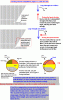
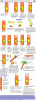
The theory is to place Dutchman on lean/power/compression side. Let it close early and push to center face as the other side (tension/open face) is still pulling. To operate both the compression push and the tension pull in unison to target.
Usually they operate seperately. And the pull has a slight counter in pull tothe opposite (lean) side. Then the compression Phase at closing starts; mainly pushing away from lean, but with some push formthe other closed face as well. Here (swing dutchy), the tension pulls, while the other face is closed, so there is no counter pull, jsut pure pull on lean to center. Likewise, the closed side of face pushing, does so without the usual countering push back, for the opposite face is open. So the pull operates without a pull back, the push, without a push back; so each are more empowered by that alone. Also, the push to center from lean, and the pull to center operate not seperately as a usual face/hinge would, but gang up on the lean in a unified effort. this compounds their actions, and their acting without counters to themselves too.
In climbing we can dutch/kerf the whole face, to pop/throw forth evenly for a snapcut on a horizontal, or applied to a small top, to hop over something. the push force is very pwoerful, from the closed kerf.
In the Swing Dutchy, we operate the L and the R side fo the face, as 2 seperate machines, not 1 generic one that pushes and/or pulls towards lean with some of it's force (rather than away); also making the forces work together, rather than sequentially handing the job off, each force(push/pull) acting independantly.
i think!...