Today's Work

Mark Chisholm

Administrator
Administrator
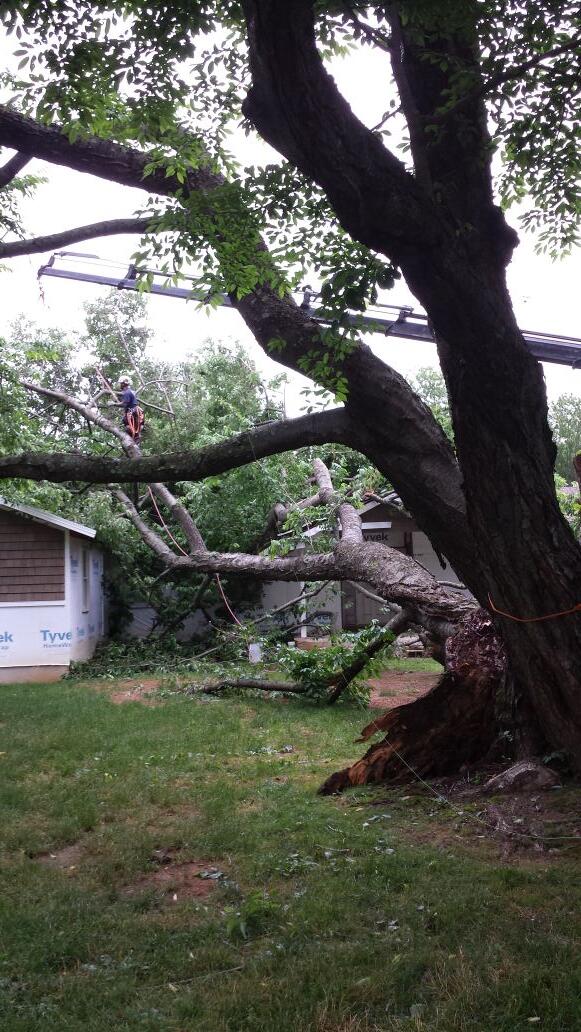
One of my favorite cherry trees that I climbed years ago failed the other day with no bad weather element. It was a real beauty. The owner really wanted to save the tree even if it only lasts a few more years. The rest of the tree deosn't threaten the house, so we pruned, lightened and cabled it. Take a look.
Bqhed7QIgAAGXK6.jpg

Bqhe4EbIYAEnnvd.jpg
 
Mark, I always appreciate when a client can understand targets and risk enough to want to save what's left of something like that. It's not always the case, but sometimes trees in tough shape can hold lots of character. I hope they can enjoy that tree into the indefinite future.
 
I'm curious what you did as you got it back to the root flare. What is the best option for the torn roots and massive decay possibilities? All I would do is cut it back as close as practical and hope the best for it. I am curious because I have also tried to save a similar type issue and it leaves you with a less than ideal solution, so I wonder what the steps you all take to make for the best outcome. I know with cherries there is more of a threat of ants and all.

Thanks for sharing Mark! Were they just re-siding their house or is that new construction? A sad situation, but It looks like it was an intriguing job. Well done!
 
I'm curious what you did as you got it back to the root flare. What is the best option for the torn roots and massive decay possibilities? All I would do is cut it back as close as practical and hope the best for it. I am curious because I have also tried to save a similar type issue and it leaves you with a less than ideal solution, so I wonder what the steps you all take to make for the best outcome. I know with cherries there is more of a threat of ants and all.

Thanks for sharing Mark! Were they just re-siding their house or is that new construction? A sad situation, but It looks like it was an intriguing job. Well done!
That's a good question I've wondered that myself but figured just like pruning small as possible to heal no 'chicken spurs' but that question is almost good enough for its own thread.

On that note it looks like a nice tree, professional looking rig/ crew
 
Hi guys. The root flare was what I spoke to the owner about in detail. As I see it, it's a given that decay will be a problem in years to come. He is alerted to inspecting it and is fine with the idea of making a decision in a few years as to whether or not to keep the tree longer. He hopes 10 more years and I said that I would think that it is realistic. One other concern I have is how the other leads will do with wind loads now that there is such an opening. It is a learning experience for sure.

The root flare was fractured to ground level. One of the guys made a small cut on the side of it and it and then on the underside. The rest was broken.
 
Oh, and he liked how it looked later saying that it wasn't very noticeable from the road that anything happened.

And to answer the question about the construction- the house was being renovated since his father passed away and he has 4 boys and needs more space. It did little damage to anything other than the porch roof.
 
Hard to believe there were no cables put in that grandmother..
triangulated cables are amazingly strong..
Had a cherry removal of similar size with 95%+ decay that was held by some old low cables.
They were triangulated and that made the difference IMO...
 
Does any of the remaining tree lean over the house or any targets, or are they clear now that that section is gone?

I've worked on a basswood like this but much smaller and the one stem towards the yard was left and every couple years reduce the over the house section to mitigate any problems
 
The other night, our power got knocked out from one side of a co-dom failing. Then 3 days later the other side failed. I have seen enough of these low co-doms fail one right after another that I would have a hard time ever telling a customer that the other side would be fine to leave. At least not without a lot of warning.


Does anyone know of any studies done as to the probabilities of sequential co-dom failure? I'd love some stats or a study...
 
Good question Daniel I've only seen work done on co dom red oaks but they were pulled to failure.
I was told, no paperwork to confirm, that when the way codoms work together with dampening each other if you can at least assess the tree reduction of height and or sail can be very important because usually all the crown is on 1 side and with the wind patterns changing they can twist more the the tree engineered it's self for with its original buffers in place.

Again just a rumour I heard not sure on the science but it made sence to me after looking at co dom breaks and reading up on some of ed gilmans wind studies, looking at a few different biomechanics approaches helped me.
Unless somebody smarter on here says I'm nuts and can back that up but for now thats what I have for you.
 
Does any of the remaining tree lean over the house or any targets, or are they clear now that that section is gone?

I've worked on a basswood like this but much smaller and the one stem towards the yard was left and every couple years reduce the over the house section to mitigate any problems

No more targets really. That's why it was easy to agree on preserving it.
 
Too bad no cabling. Dang! Nice cherry.

Right you are, Gerry--that rib of response growth was screaming for attention. Mark, I'm guessing your crew cabled the remaining leaders together and lightened them up to reduce movement and strain; that and monitoring should be good, with any target. The first thing my clients keep in mind--the tree is its own 'target', the first item of value threatened by failure.

What care are the roots getting, to help them, and the tree, recover from this loss?

"As I see it, it's a given that decay will be a problem in years to come. He is alerted to inspecting it and is fine with the idea of making a decision in a few years as to whether or not to keep the tree longer. He hopes 10 more years and I said that I would think that it is realistic."

As I see it, it's a given that the tree will put on response growth in years to come. How long it can last depends on how it responds, and how humans respond to that response! 50 years is not unrealistic.
 
the way codoms work together with dampening each other if you can at least assess the tree reduction of height and or sail can be very important because usually all the crown is on 1 side and with the wind patterns changing they can twist more the the tree engineered it's self for with its original buffers in place.

Again just a rumour I heard not sure on the science but it made sence to me after looking at co dom breaks and reading up on some of ed gilmans wind studies, looking at a few different biomechanics approaches helped me.
Unless somebody smarter on here says I'm nuts and can back that up but for now thats what I have for you.

Thanks for that.. good point on reduction cuts... I AM a HUGE believer in their value in tree preservation..
One point to consider is the difference between cabling two co-doms and a triangulated cable system with three! ITS HUGE!
The triangle is the most stable geometric shape... triangulated cables tend to eliminates twisting which has a great advantage in support at the union... of course, less movement in the top will tend to put more force on the tree, below the union.. which is rarely much of an issue IME
 
The first thing my clients keep in mind--the tree is its own 'target', the first item of value threatened by failure.

What care are the roots getting, to help them, and the tree, recover from this loss?

50 years is not unrealistic.

I like that idea Guy! The tree can hurt itself first and foremost.

50 yrs would be great, but it does have other problems with splits and rot. We will see.
 
Thanks for that.. good point on reduction cuts... I AM a HUGE believer in their value in tree preservation..
One point to consider is the difference between cabling two co-doms and a triangulated cable system with three! ITS HUGE!
The triangle is the most stable geometric shape... triangulated cables tend to eliminates twisting which has a great advantage in support at the union... of course, less movement in the top will tend to put more force on the tree, below the union.. which is rarely much of an issue IME
Daniel yeas the triangle is great when possible.
Wondering though, if each of the 3 tops/sections is supposed to flex,twist and bend to dampen say the wind load send the load down to the main trunk, each side of the main trunk sees 33.3% of the load so it is sort of spread around.

(I know these percentages can be argued for wind direction, etc I'm just using easy math here)

If you properly install 3 lets say steel cables in the triangle configuration how does that correlate to the main trunk? Are you flying 3 tops as 1 now because that could transfer 100% of the load to the main trunk on 1 side? If you stiffen up the top are you increasing the odds of wind throw? I know the cables take away a lot of the dampening actions twist, bend, etc, where does that energy go?

Last note is we always reduce weight before cabling. It could be branch,top, or any weight/ sail reduction but our general rule is if your tree requires a cable than it must have an issue to address. Does anyone just cable or is prune then cable pretty standard?
 
Pruning before cabling IS a SHALL in the ANSI standard, tho how much to prune...depends.

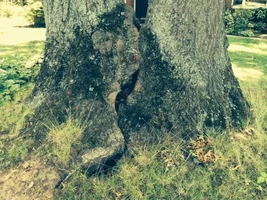
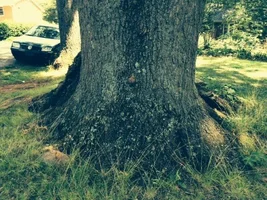
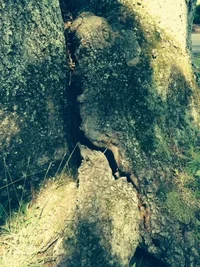
Here's a triangulated cabling job from ~10 years back. The leaningest trunk slipped sideways 4-6". Kinda freaked me out, but the cables still look good, so i just bid 3 hrs to prune it back 20%.

The leaningest trunk is just over landscape only
photo 1.webp photo 2.webp photo 3.webp photo 4.webp
, but the other 2 are over house and high wires.
 
Last edited:
Just wanted to reference David Lloyd Jones in regards to cabling multi stem trees. In his book he talks about a neglected multi stem beech that was cabled and fell shortly after. Fluke. Possibly. But for sure when all stems move in unison, the forces below the crotch are increased. Uncabled stems can move at different frequencies, cancelling each other out to some degree before transferring below the crotch. Reduction pruning in combination would have likely saved the tree. Or even reduction pruning on its own. I find where risk of failure only ruins the tree I often go with reduction alone, as I know that the risk is reduced from high to medium. Then I know I only have a few years until I reduce again, bringing the risk from medium to low, making a cable almost useless. Depending if poor structure is caused by bad growth of by decay.
 

New threads New posts

Back
Top Bottom