[ QUOTE ]
[ QUOTE ]
I wonder why a more symmetrical notch wasn't formed. It would drastically ease the task by reducing the amount of rip-cutting, if not merely reducing the amount of cutting required to form the notch.
[/ QUOTE ]
I'm not sure I follow Glen? What do you mean by more symmetrical?
[/ QUOTE ]
Hi Mark,
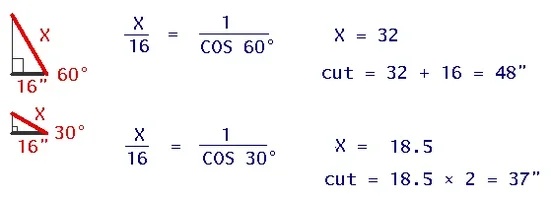
I mean more symmetrical about the horizon, rather than being one-sided. Refer to the attachment.
Cutting along the hypotenuse and the bottom side of the upper diagram yields 60° included angle and requires cutting 48" of material. Now, granted, the width of the upper cut tapers rather abruptly, but it's much closer to being a rip cut than a cross cut.
To achieve the same included angle by mirroring the top cut on the bottom (the top half of which is indicated in the bottom diagram), you're cutting much less linear distance and it's much closer to being a cross cut than a rip cut. The trade-offs are that you're cutting a slightly larger diameter on the bottom so the hypotenuse would usually be a bit longer there, and you're cutting it up hill. Further advantage is that you can make the bottom cut and the apex slightly higher while maintaining the same upper extremity of the upper cut of the first method; thus reducing the diameter of the tree at the cut, slightly, as well as reducing (also slightly) the length of the felled tree.
Just some considerations.
I agree that there's no better and safer way to form the hinge in a plumb or head-leaning tree than by boring it in, but with a tree that's a back-leaner there's plenty of time to form the hinge in the conventional manner. Indeed, it's actually safer to do so since you can readily follow your saw in with wedges where they have the most leverage.
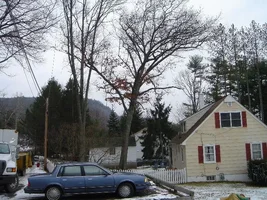
Red oak is my favorite fire wood, all things considered, and it looks like you've got a couple cords of it there.
By the way, you could save a fair amount of communication time with the server if you saved your images at 65-75 image quality rather than the 90 you're using. Try it once and see if the loss of fine detail is too great with the smaller file sizes.
Also, would you please consider enabling HTML code for me here?
Glen
[ QUOTE ]
I wonder why a more symmetrical notch wasn't formed. It would drastically ease the task by reducing the amount of rip-cutting, if not merely reducing the amount of cutting required to form the notch.
[/ QUOTE ]
I'm not sure I follow Glen? What do you mean by more symmetrical?
[/ QUOTE ]
Hi Mark,
I mean more symmetrical about the horizon, rather than being one-sided. Refer to the attachment.
Cutting along the hypotenuse and the bottom side of the upper diagram yields 60° included angle and requires cutting 48" of material. Now, granted, the width of the upper cut tapers rather abruptly, but it's much closer to being a rip cut than a cross cut.
To achieve the same included angle by mirroring the top cut on the bottom (the top half of which is indicated in the bottom diagram), you're cutting much less linear distance and it's much closer to being a cross cut than a rip cut. The trade-offs are that you're cutting a slightly larger diameter on the bottom so the hypotenuse would usually be a bit longer there, and you're cutting it up hill. Further advantage is that you can make the bottom cut and the apex slightly higher while maintaining the same upper extremity of the upper cut of the first method; thus reducing the diameter of the tree at the cut, slightly, as well as reducing (also slightly) the length of the felled tree.
Just some considerations.
I agree that there's no better and safer way to form the hinge in a plumb or head-leaning tree than by boring it in, but with a tree that's a back-leaner there's plenty of time to form the hinge in the conventional manner. Indeed, it's actually safer to do so since you can readily follow your saw in with wedges where they have the most leverage.
Red oak is my favorite fire wood, all things considered, and it looks like you've got a couple cords of it there.
By the way, you could save a fair amount of communication time with the server if you saved your images at 65-75 image quality rather than the 90 you're using. Try it once and see if the loss of fine detail is too great with the smaller file sizes.
Also, would you please consider enabling HTML code for me here?
Glen