To far gone to cable, 10 year staged removal?

Well, you are the arborist on site and I am just looking at pictures so your judgment on this will have a better perspective. That said having the tree already short for the girth is good. Having all the limb structure that will limit lateral movement at the split is good. The callus growth is well developed, old and strong so that is good.
If it is like most cedars the wood above the split is probably sound enough to put cables in so you could skip the bracing and just go with that. You do not need to go 2/3's up, that is not a rule, it is a guideline. If it makes more sense to place it in another, stronger location, do so.
I am definitely not trying to talk you into doing something that you honestly feel won't work. Just pointing out some things from what I can see.
I certainly know what I'd do if this were my tree (cable, and monitor)! The squat is certainly a plus, I'd add that it's moderately protected from prevailing winds. It's the winds out of the north that really get the trees here, about every 5-10 years, and the wear pattern on the limbs indicated to me that it's likely that it shifted with the last one a few years ago.
Retaining the tree is very important for reducing water runoff and slope stability. The decay resistance of cedar is damn good.
Mostly I'm building a list of options for the client to choose from. Hence the question.
I see 4 options:
1) do nothing (accept a good amount of risk)
2) remove the tree (live in a bubble)
3) replant, and remove the tree over the course of a pre-determined timeline (outline). (mitigate short term risk, remove risk entirely over time)
4) cable and structural prune, and (accept some risk)

Obviously I have 1,2 and 4 down pretty well. I am seeking advise on #3, isn't this what retrenchment is all about +/- the removal or death as a end result (yes, i know Guy, no it isn't)? I'm simply just seeking an accelerated form. Obviously it's unlikely if this tree were cabled that it could not be allowed to grow to a 190' giant. I work on a cedar about the same diameter which was struck by lighting, it's a 30' stick and a sea of reiterated tops. Every few years I reduce these tops, and thin a few out. However I don't call it crown reduction, I call it small diameter topping or re-topping because that's exactly what it is.

So to ask the question once again, or at least get a conversation going on the viability of staged removal as a valid practice. Does anyone here have the experience of doing something like this?

https://wdfw.wa.gov/living/snags/

Scroll down to figure 1. The drawing, is this not valid? Is it a viable way of reducing risk, while retaining an asset? What about creating a snag in stages, over time.
 
Why kill it?
Reduction Pruning and/ or cable and brace.

How isn't a rotting snag over the lower house not going to become an issue? Far enough back?

Still can plant more.
 
The tree is far enough away from the slope/bluff as is right now. The target is the clients house/deck. The only reasons I brought up the bluff situation is this tree is very important to the upper integrity, in a indirect way.
Once more have you done a staged removal? Made a hazardous tree safe by questionable industry standards. Let’s make a conversation about it!
I’ve had bigleaf maple logs sprout for two years, remove off site in my driveway. So turning a tree into a living snag, with a plan is butchery?
Hell, let’s even take this tree out of the conversation. Let’s talk about benefits of staged removals over the course of say a decade? I’m not talking about all trees, but when the situation calls for it! What is that situation, and who’s call should it be?
 
I've made many wildlife habitat trees.

I've reduces hazards to fit the location on a pretty huge cedar that they wanted to down after a big split. I topped, reduced the failing leader. Chipped and mulched at the base.
No pic.


Just deadwooded the dead top ( 50% ) of a drought stresses WRC, chipping and mulching the root zone.

Just bid on a habitat tree as part of a project. Multiple broken tops over years in a for with cavities that could reach the house and parking area. Reduce instead of remove...in this case, branch structure requires no reduction, as in your fig 1.


Habitat snags are better if damaged a bunch and left to grow.
--wood present at time of wounding, wall 4, and solid outer rind of new growth will give greater longevity.

Breaking instead of cutting.
Some people will even shoot off branches (safely, of course).
 
Last edited:
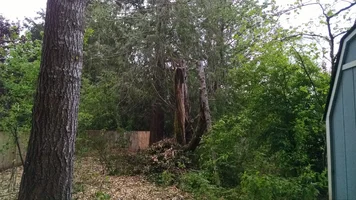
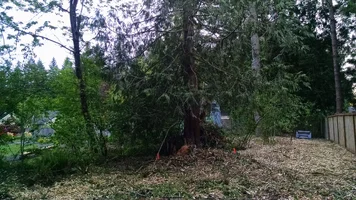
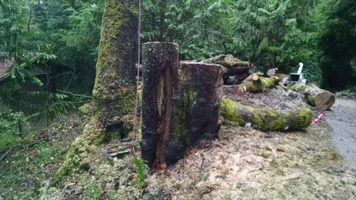
IMG_20180505_193056999.webp IMG_20180505_193159036.webp IMG_20180123_123244290.webp If the cedar can live for a decade, it will
Probably stand a long, long time, imo. Topping cut for totally dead top (broken water column??) isjust out of frame, by chance.


P.s. I consider perch branches for birds. Stubs suck to climb over, but, I'm extra careful, or work top to bottom.
Again, breaking over cutting. Lifting snaps branches easiest, they're build to withstand downward force more than upward.


Very occupied Willow snag from years ago. Stacked two leaders upright for perches and cavity nesting (butt of cedar to, upwards for width at height).

Added a Coarse woody debris component (stacks of smaller logs), and some mixed piles of Coarse and Finer Woody Debris (chips and branches, with smaller logs).


Maples will sprout from base (girdled to make management easier for homeowner. Sprouts will form over while stump this year from stored resources, with the upper sprouts dying quickly, providing dead branches as perches up top, allowing the Homeownet or us to manage, as we see fit ( cut/ thin) some suckers of base every year or two.
 
Last edited:
  • Like
Reactions: evo
View attachment 51661 View attachment 51662 View attachment 51663 If the cedar can live for a decade, it will
Probably stand a long, long time, imo. Topping cut for totally dead top (broken water column??) isjust out of frame, by chance.

P.s. I consider perch branches for birds. Stubs suck to climb over, but, I'm extra careful, or work top to bottom.
Again, breaking over cutting. Lifting snaps branches easiest, they're build to withstand downward force more than upward.

Very occupied Willow snag from years ago. Stacked two leaders upright for perches and cavity nesting (butt of cedar to, upwards for width at height).

Added a Coarse woody debris component (stacks of smaller logs), and some mixed piles of Coarse and Finer Woody Debris (chips and branches, with smaller logs).

Maples will sprout from base (girdled to make management easier for homeowner. Sprouts will form over while stump this year from stored resources, with the upper sprouts dying quickly, providing dead branches as perches up top, allowing the Homeownet or us to manage, as we see fit ( cut/ thin) some suckers of base every year or two.

Now this is what I'm talking about. It's a viable option, and not mutilation as Guy suggested. There isn't a snag within 100 yards or more to the property, so habitat could be prime. It's a little short for a eagle's nest.

Fracture pruned stubs can suck to climb down, but if you leave them long enough it can reduce risk of jabs. I've been working on my wood pecker holes with the MS 150. I'm not expecting a pecker or flicker to finish what I started, but creating a entry point for bugs and crud...
 
I get jealous, too.
It's beautiful. And 170' cedars?! I know that our eastern redcedar is a different critter, but getting to climb a sixty footer is a rare occurance.
 
Come out for a work-cation.

I just bought a house. trying to figure out a zipline to my friends' house across a wetland area to the base of their grove of 150' doug-firs. Would be cool to figure a way to make a tree-top traverse across the grove, checking out the Olympic mountains.

I'll have to check the view from the highest tree on my property, might see a tiny bit of the Olympics...so what kills alders ;)
 
What about weighting down some low limbs, if any, to the soil, scraping back the bark first (?), and seeing if you can get some adventitious (?) rooting, for increased bank stabilization.

One of my discussion points with homeowners is the malleability/ train-ability of trees (e.g. training and pruning for certain effects) is amazing!
 
Reaction wood will continue to grow after bracing is installed; maybe just 1/4" bolts to secure branches to branches. That, with *light* reduction of sprawl to lessen motion and loading, might suffice.

T. plicata are popular here, replacing leylandii after canker etc. do them in.

Actually, I have a fair amount of hair for 67.6 trips around that ball of burning gas... :)
 
What about weighting down some low limbs, if any, to the soil, scraping back the bark first (?), and seeing if you can get some adventitious (?) rooting, for increased bank stabilization.
One of my discussion points with homeowners is the malleability/ train-ability of trees (e.g. training and pruning for certain effects) is amazing!

Yes, "layering" limbs can work with many species. Raitas to Raices (sp?) in espanol.
 
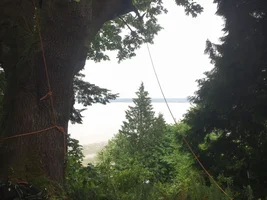
457A9616-E206-45D3-8B03-7D71E6BFE033.webp 87618E71-42B6-4141-BF14-D147E0A176ED.webp Meeting with the clients next weekend, so will present them with options and see what they say.
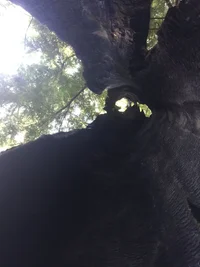
Re reading my OG post I failed to mention that the stem is cracked about 10-12' below the union. The picture looking down into the cracked union is about 5' deep. Little to no self correction in the tippy tops, and I'd feel comfortable saying the tippy tops are well over a 10' span from each other.

When I meet with the client I will try to get whole tree photos from a distance which shows the bigger picture.

Layering the limbs wouldnt work as the skirt is too high. I might be able to bend a few down but that would require hanging a few pier posts from the limbs.


So it sounds like Sean and I are the only ones who have considered long term removals as a viable strategy, or living snags...
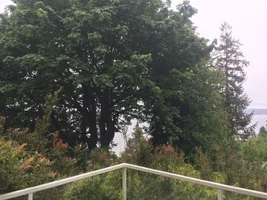
Here is a A. macrophyllum I did a minor view window on at the same site. The photo with the corner of the deck railing gives an idea of the landscape/terrain. The maple is on the edge of a 60 to 70 degree slope (vertical in sections) to the beach community below. The Thuja is just beyond the deck and to the left out of the frame.
 
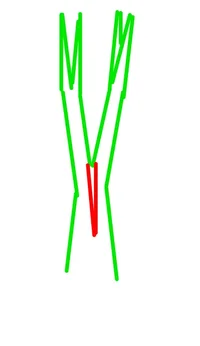
Could you draw a picture of the tree if you don't have full-tree pics?

It's hard to understand the overall structure. 4 main leaders?


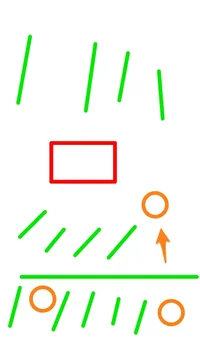
Maybe a simple site diagram.


Seems like reduction is managing/ reducing risk without need for the tree to die. No need to cut to good laterals in the more typical fashion. Stubbing a top a distance above live limbs will serve habitat value and wildlife watching.
 
Drawings show more phototropism than there really is
668B714F-DE9E-4E35-A587-CFEA05757B0D.webp
The angled green lines are suppose to designate degree of slope. Both steep enough it’s difficult to scramble straight up, could traverse with out a rope. There is a road uphill contributing to runoff. The red square has a post and pier deck not drawn, but in range. Orange circles are notable trees (2 big leaf) the one with the arrow is the cedar.

C0FEFBA6-8E63-48C2-B657-9EB83A3CF0E8.webp Here are some crude drawings.
 
Others definitely have considered long term removals as a viable strategy, and living snags...when warranted! It still seems like you are grossly underestimating the toughness of the wood.

If failure at the fork is the concern, cable and reduce.

Do they want the top cut off to improve the view?
 
The bad fork is low. Take the strain off, give it some support. Plant some more trees for the longer term.

Around here, sometimes people have one tree in their yard, but usually not. Other times people have property with acres and acres of trees. One defective tree here or there, going away, rather than becoming giant and defective is pretty normal.

My neighbor has a cedar with 4 big trunks and one cobra cable around the four. Yesterday, I started to wonder if the cable on the trunks is what is making the squeeking noise. Pretty much, if that thing peels apart at a defective fork, at least one house is done. A local arborist put that in for her. No follow up. I mentioned to her that she should consider getting him over there.


Guy, by "reduce" can you spec what you mean?
 
Others definitely have considered long term removals as a viable strategy, and living snags...when warranted! It still seems like you are grossly underestimating the toughness of the wood.

If failure at the fork is the concern, cable and reduce.

Do they want the top cut off to improve the view?
Nope, view isn’t a issue with this tree. Personally I view any kind of vertical reduction on a conifer topping, because that’s exactly what it is. Only difference is the size of top. A four inch cut on a main leader is going to produce similar or the same regeneration. The only difference is wound size, and volume of green coming off. Sure a smaller 2-5" cut will callus over faster with less decay, but would result in nearly the same maintenance as a 6-10" which would also shorten the part of the tree bringing the target out of the drop zone.
 

New threads New posts

Back
Top Bottom