Tips and Tricks

Hey thanks for the welcome, yeah, maybe it's not common lingo... For my climbing ropes, I have a 120' and a "shorty" which is about 70'. When I can use the shorter one, it much nicer all around, especially not having so much extra rope to pull through to isolate it as you move around the tree.

There's plenty of times where my tie in is close to 35' so knowing for sure if the rope will be long enough is now as easy as looking at the throw line that's already dangling there.
 
[ QUOTE ]
Put a mark on your throw line the same length as your shorty. No more guessing...

[/ QUOTE ]

Nice, I like that, thanks for sharing.

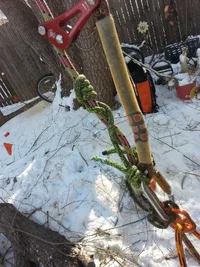
I tried out the pinto on the bridge ring setup with my WR. It was nice to free up some room on the top of the 'biner, it was a little sloppy but not bad over-all. Thanks for the idea Aaronf.
 

Attachments

  • 380113-20140108_125114.webp
    380113-20140108_125114.webp
    332.6 KB · Views: 341
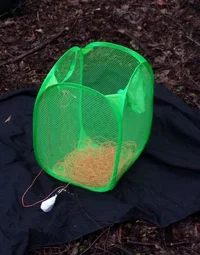
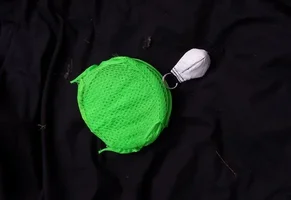
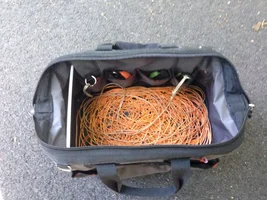
how much line fits in there?
It is a laundry basket? I suppose you could put a couple of thousand feet in there, just don't send it to the dryer, it would get tangled for sure!
Kidding aside this was 180' of 1.4mm jetset and it worked quite well. I forgot my normal small cube for, in the tree tosses, in San Fransisco so I was trying to make do.
 
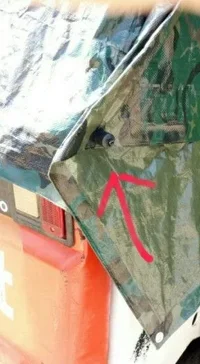
Tying a tarp down over a piece of equipment sometimes is a struggle, finding the right place to tie the corners down or pulling a rope all the way under the equipment etc.
Here is a solution for holding the tarp down without knots or line. Magic of magnets. Of course if your equipment is made of wood or plastic this won't work. :-)
 

Attachments

  • magnet.webp
    magnet.webp
    28.9 KB · Views: 339
This is more of a safety tip than anything else.
The other day I was climbing, actually clearing up from sleeping in the trees and in the process got caught in a heavy downpour. I backed up my descent device with a munter and ended up getting some twist and tangle from the throwline I was trying to leave in position in the tree for others. When I got to the ground and tried to pull my cinched anchor, for whatever reason, it would not budge. I planed on going back up to check the line but could see a potential fatal error for anyone needing to return for a cinched anchor.
Scenario: You get to the ground, remove your climbing device and start pulling out your climbing line, you tug, reposition, stand back to see what the problem is, return and pull some more....SOMEHOW, IN THE PROCESS YOU GET THE LINES CONFUSED and don't realize it, by mistake connect to the tail to re-ascend, 50' up it finally lets go....
Solution: I will never climb up to free a stuck canopy anchor without putting a friction hitch on the "other" leg even if I am 100% certain of which leg I'm climbing on. It is easy to install and self tends soon after you leave the ground. Another solution would be to never having two lines in this position by using a throw line for your recovery leg. Personally, the tail is the DdRT system I later use to traverse or progress past my TIP. I also often reset the TIP as I move to other trees or move up.

 

New threads New posts

Kask Stihl NORTHEASTERN Arborists Wesspur TreeStuff.com Teufelberger Westminster X-Rigging Teufelberger
Back
Top Bottom