The physics of rope bends

I am really hoping to get a solid lesson from TheTreeSpyder among others about this topic. Please explain how the rope gains and loses strength as it bends. I am referring to both knots and over pulleys, friction savers, biners etc. How do you calculate the strength loss say of a rope girth hitched over a limb to be used as a footlock line? Why do some ropes lose strength when wet? Also, how knots gain and lose strength. For example, is a double grapevine, aka double fishermans, a neutral knot with little strength loss, because it is in line? If rope is rated at x kN breaking strength, why would it matter what the diameter is?

Is it all about friction? I have labored through all of Spyders posts and he is so knowledgeable about MA and friction, where is the book man. Why are we so fixated with 5,400 lbs when our bodies break at much less? Is there a physics book that every arborist should read? I anxiously await...
 
5,400 # comes from a rather odd place. When the original ANSI committee wrote the rope spec they decided that synthetic ropes would only be allowed. Since that was decided and there was only one rope made just for arborist climbing lines the breaking strength of that rope was chosen. This is another issue that has been rassled with at Z meetings. Maybe this time around we can bring in science instead of just history.

Arborplex was the rope...

You'll find different numbers for the same knots/hitches because of different cordage fibers.

Arborist Equipment does a good job of explaining the basics.
 
Bring the science, bring the science. History is mostly for the books, so we can read it and learn from it. Arborist Equip. does a good job, but do they do it as elaboratly as Spyder, seemilgly off the cuff?
 
Where is the love. There is chatter in the Northeast that certain parties want to keep us in the dark ages climbing on 1/2 inch, prusiks and all. No names, don't ask. Their argument hinges on these bend strength losses and other false facts. I will continue to wait.
 
This is a multi-dimensional question. Lots of info in other thread: Blocks Sharing Loads. i don't know how to answer such an intro.
bigeyes.gif


In that we have several factors compounding each other. There are the base/nominal forces as predictables taking place on the straight tensioned run of the Standing Tension part in it's Natural/minimal loss force/ state and loaded weight force. Any bend/deformation of the line conducting force can leverage force by angle, and weaken the line be deformity. Some of these are akin to hinging stresses. The lines though are flexibles, and only conduct force to carry load on the inline(cosine) axis, and only on tensioned directions(unlike wood).

We have a given rope strength, and a given load force. Then we have increases in load force multipliers and reduction of rope strength efficiencies; all at once't. See this as a pivotal change, whereby the increase in loading is set against a decrease in rope efficiency. This is like putting more load on a weaker line. The quicker/smaller distance a given change takes place over, the more sudden and impacting the change is.

Any bend in the Standing Tension part(s); give higher leveraged force on the line at that point. Thus, a reduction in the remaining rope efficiency. Also, there will be other changes impacting. As the line goes around it's host load, or as it is bent by a choke of it's own non-supporting leg(s) we have frictions. These frictions can cause also less stretching, than the loaded and leveraged parts. These both are changes (change in rope tension and stretch) happening suddenly; making them impacting changes (even as we are looking at a static system).

But then, we have weakness in the line at the tight bight around the line or host, krab etc. This is more like hinging, both wood and rope are fibres... Rope, works under tension, but in the tight bight, the rope side on the inside of the turn creating bight compresses, the stiffer and larger a rope is gives more compression. This compressed area, can't be tensioned, so it is not carrying the load force. Only the outer part of the bight is carrying said tension. Even the distance inbetween is just leveraged distance, not carrying much load (like as in a hinge as it bends). Like a hinge a rope's tight bight has to form 3 non-inline points, but rope can't support on compression like wood fibre. So rope is a cosine and tree is cosine and sine considerations. So, the rope efficiency/strength is reduced below 100% at this point. Certainly a lot going on, even with these basics.

Each situation, material, braid, thickness, knot type, teepee height etc. contributes something to the equation. Thus, the same material etc. in a flat sling on a curve (that isn't moving which would tear up a flat 'line'; in fact a rope is round for easier handling and moving around items) is stronger, because it will bend easier and has less 'height' on the bent dimension(2 compounding factors). How tight the teepee/choke is set, gives how deformed and tight the line is that raises the line tension).

Different knots will yield different, especially dressded by different peoples, and in different materials etc. See a single turn noose as just bending the Standing as is stated above. Giving a sudden change in tension (by deforming) and stretch. But a superior dbl.Noose/ scaffold/"fisherman's"(for some) does the same, but commits the deformation/change and stretch over a longer distance, so is less dramatic/impacting, so is 'stronger' or less loading and weakening.

Now, the difference in them in tying is taking a half hitch construction and making it into a round turn/anchor hitch, and using any round turn is usually better. But notice, if we take a round turn around the krab, then give dble.noose the effect is lost, like the the remaining rope tension is reduced, and so the noose just bends the line; doesn't have the tensions to empower the round turn to buffer the loading effects by how it grips the standing with residual tension in line making it as it bends the Standing too(?).

And also, realize the difference in how a knot lacing that serves / T-Bonz to the host mount perpendicularly isn't leveraged like one meeting pairallell, and how the latter is leveraged a different way (like timber for pulling straight away from a rail perpendicularly, and killick for an inline pull on same or to drag etc.

many combinations possible, what worx in braid doesn't in fishline, manilla had hairs to grips securely and buffer some shox(so many knots that were trusted loss favour when synthetics came along and became cheaper, stronger, longer lasting, lighter etc..).

Still, 1 can dress differently,teepee higher, angle better, deform less, run different etc. a seemingly matching system than another that is more surely crafted at each turn.

This can't be complete, hope it answers sum of those questions that burn in may of us. But, ya should really ask others like knude and Mahk...

propeller.gif
 
[quote/]But then, we have weakness in the line at the tight bight around the line or host, krab etc. This is more like hinging, both wood and rope are fibres... Rope, works under tension, but in the tight bight, the rope side on the inside of the turn creating bight compresses, the stiffer and larger a rope is gives more compression.

[/ QUOTE ]

Thank you kind sir. I really enjoy all of your posts, super informative. I do hope others chime in. knudeNoggin (kN) pun intended? It must take years to be able to interpret and deliver this information, where do you find the time?

Is more compression good? It creates more heat and friction, right? So would smaller diameter be less compression, less heat? Or is it the same with a different numerical ratio factor? It apears we are dealing with big numbers on a small scale, so the 1.7mm difference could be large? This is why we want to bend around more than one krab, ring etc, less compression?
 
[ QUOTE ]
Please explain how the rope gains and loses strength as it bends. I am referring to both knots and over pulleys, friction savers, biners etc. How do you calculate the strength loss say of a rope girth hitched over a limb to be used as a footlock line? Why do some ropes lose strength when wet? Also, how knots gain and lose strength. For example, is a double grapevine, aka double fishermans, a neutral knot with little strength loss, because it is in line? If rope is rated at x kN breaking strength, why would it matter what the diameter is?
Is it all about friction?

[/ QUOTE ]

The short answer is, to my mind, that there needs yet to be
much more exploration of such questions/issues, with good
minds applied and careful testing executed. I frequently
lament (to remind others) that in most test reports that
are public, there is way too little information given to
enable understanding, to enable repeat testing--such as
which end of the common Fig.8 eyeknot is loaded (not to
mention how that knot is dressed).

There is some reason to question what one means (or should
mean) by "strength": typical data come from slow-pull
test devices; but is this a good model or indicator for
practical purposes? --where likely failures arise from
rapid loading, or from repeated loading & general abuse
(thinking of how well protected the key parts of a Grape-
vine bend are, e.g.). [Btw, Dbl. Grapevine = TRIPLE
Fisherman's, G = DF (and why I favor using "G--" vice
"DF" nomenclature, matching quantitative indicator to
visible overwraps.]

From some few specimens of broken ropes that I've
examined, it seems that rupture begins on the inside
of a bend, from compresion or friction--not on the
convex side, from elongation, as one can read being
speculated (or stronger) in some books.

[ QUOTE ]
Why are we so fixated with 5,400 lbs when our bodies break at much less?
||
<TomD> Because that happened to be the strength of a LONE extant arborist rope when the rule was written.

[/ QUOTE ]
And that's of course a quite lame basis for a rule.
As I opined elsewhere, I could that diameter might figure
in regard to handling/grip, or abrasion/cut resistance;
but tensile strength as given seems arbitrary. (Or,
rather, quite self-interested, with the rope maker
wanting to lock in motivation to purchase a product.)

*kN*
 
[ QUOTE ]
Please explain how the rope gains and loses strength as it bends. I am referring to both knots and over pulleys, friction savers, biners etc. How do you calculate the strength loss say of a rope girth hitched over a limb to be used as a footlock line? Why do some ropes lose strength when wet? Also, how knots gain and lose strength. For example, is a double grapevine, aka double fisherman's, a neutral knot with little strength loss, because it is in line? If rope is rated at x kN breaking strength, why would it matter what the diameter is?

[/ QUOTE ]

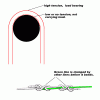
If you can understand why cars need differentials, you can understand why ropes weaken when bent. Two circles of different radii have different circumferences. The fibers of a rope bent over form multiple circles with the inside being the smallest and the outside being the largest. The larger the diameter of rope or the smaller the bend radius the more the inside and outside circumference differs. If only half of a ropes fibers are bearing the load, the rope will break at half the strength.


Knots tied into rope are just tight bends to the fibers. Fisherman's knots are strong because they cinch on the rope before it bends.

The minimum rope bend (for synthetic rope) around sheaves or branches that I was always taught was 4 times the rope diameter. For example, when the rope diameter is half inch; .5 X 4 = 2 inch diameter. I was also taught that 20 times the rope diameter is 100% of the rope strength. So that would be 10 inches for a 1/2 inch rope. Now we all exceed the minimums every time we tie a knot or run over a small pulley, but this is why we use rope that can hold many times the weight of the climber. The strength loss due to knots, age, bend radii and other unknowns are already factored in. It is good to know the hows and whys of strength loss, but don't sweat over it.

Dave

PS. Webbing is good for high bends if you have no choice.
144662-rope.gif
 

Attachments

  • 144662-rope.gif
    144662-rope.gif
    31.8 KB · Views: 82
[ QUOTE ]
...Two circles of different radii have different circumferences. The fibers of a rope bent over form multiple circles with the inside being the smallest and the outside being the largest. The larger the diameter of rope or the smaller the bend radius the more the inside and outside circumference differs. If only half of a ropes fibers are bearing the load, the rope will break at half the strength....It is good to know the hows and whys of strength loss, but don't sweat over it.

[/ QUOTE ]

I think in the main this is on the right track, but the devil is in the details. First, the difference between the inner and outer circumference doesn't vary with the bend radius--it is constant. What is probably important is whether this difference can be absorbed over a long piece of rope (big radius) or not.

Another factor that may matter is the rope material. It seems likely (though I haven't really thought it through) that a stretchy rope (e.g. nylon) will be less adversely affected by a tight radius than a a stiffer one (e.g. polyester).

Lastly there is this idea that fibers in the outer circumference are under more tension than fibers in the inner curve. But who are these fibers? All the fibers take roughly spiral tracks through the weave of the rope such that every fiber spends time on both the inner and outer curves.

One would think that, if the supposed difference in fiber length were real, that it would be mighty hard to bend a 1/2-inch rope around a 2-inch pulley. This would require actually stretching the outer fibers 1.5 inches or compressing the inner ones 1.5 inches, or some combination thereof. The fact that it takes almost no force at all to bend the rope as described proves that there is little or no stretching or compressing going on. Instead there is deformation of the structure of the rope--the fibers themselves are pretty much unaffected.

Nevertheless the basic idea is probably sound, but the weakening effect due to bending is much diluted. The beauty of a modern rope is that it has much of the integrity and toughness of a solid rod but much of the pliability and strength of the individual fibers.

I'm with Dave on this one: keep this stuff in mind, stay far away from the rope's limits, and then don't sweat it.
 
i think the rope stiffness gives the resistance to bend on a tight bight, which empowers the leveraging X the length of 'height' on that most deformed axis.

i don't think you can take 100' of line, and tug the threads on one part of an end and feel the tug on the other end isolated to those threads; because the frictions in the weave allow the passing of forces to the other fibres. But, the deformation on the bent axis makes a 'hot spot' (that becomnes the weakest link of the chain) before the force is spread out to other fibres. Bedded on a pulley, we have (at Zer0 dgrees deflection/ non spread angle), 2 legs of straight pull, and then a 'top' point where the force also comes in from the side, causing deformation on that axis.

If the relation ship between stiffness, tight bight and 'height' on the bent axis is intense enough the inner part of the bight even becomes compressed, and rope is a tension only device on inline pulls. For, it doesn't resist on the it's counter axis or even direction on it's own axis. So, now there are less fibres carrying the load.

i think a 16 strand with core, resists bending more than same without core. So, a flat line will resist the bend less and also give less dimension on the bent axis; for a more pivotal change in support of static load on bend. i think rope is round for ease of handling, knotting and working around curves. On a straight, undeformed line equal to same strength material in flat line. On a bight around something (where it lays nicely and doesn't deform it's width) not moving is better than round. But, cranking around the bight loaded, round is better, presenting less friction area to 'tear up' etc.
 
[ QUOTE ]

I think in the main this is on the right track, but the devil is in the details. First, the difference between the inner and outer circumference doesn't vary with the bend radius--it is constant.


[/ QUOTE ]

Maybe we are thinking about two different things here so I will give an example as I see it.

Pretend we have a .5 inch rope, we will wrap it around a 1 inch bend and a 10 inch bend and measure the half circle of the bend using pi*D and then dividing by 2 for the half circle.

example 1:

1 inch bend inside track of rope
pi*d/2
3.14*1/2
=1.57 inches

1 inch bend outside track of rope
pi*d/2
3.14*(1+.5+.5)/2
=3.14 inches

The outside track is double the inside track. This would be high stress

10 inch bend inside track of rope
pi*d/2
3.14*10/2
=15.7 inches

10 inch bend outside track of rope
pi*d/2
3.14*(10+.5+.5)/2
=17.27 inches

The outside track is not double the inside in fact it is only 9% different. Low Stress

Dave
 
Dave, we agree completely. But note, by your own (correct) numbers, the difference, 1.57 in., is the same in both cases.
As you say, over a long radius that difference becomes small percentage-wise, and that fact must diminish the weakening effect. It would be nice to tie all this together with a simple equation including terms for bend radius, rope diameter, rope material, and rope tensile strength; but rope is such a complicated engineering structure that we are probably going to have to be satisfied with rough generalities.

A factor no one has mentioned is internal friction in the rope. Manufacturers lubricate the fibers to lower this friction. This would obviously make it easier for the rope to deform under load, which would have the effect of shifting load from high-stress fibers to low-stress fibers. I have read reports that the lubrication significantly increases the strength of the rope, presumably when the rope is bent.
 
i think the internal frictions allow load balancing amongst the fibers. In elongation, the scrubbing would give heat on stretch and recoil (lessening the total impacts therefore i think). But, then also, the frictions (looking at the other side of the sword), would give some weakening, so relieveing that some, would give better strength, even on a straight run??
 

New threads New posts

Back
Top Bottom