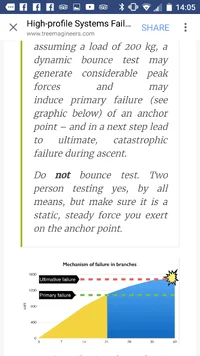
Testing the Primary Support Point for Canopy and Basal Anchors.

Who knows of a climber whos PSP failed?


  • Total voters
    23
If the noob remark got you, you must feel that way about yourself....

Really though, I would try not to take me so seriously.

And for the record, it's okay to have an opinion that varies from Richard's.
 
If the noob remark got you, you must feel that way about yourself....

Really though, I would try not to take me so seriously.

And for the record, it's okay to have an opinion that varies from Richard's.

I honestly tend to. Right up until I go work with anyone who is theoretically as experienced as I am...

I'm extra grumbly about the luck I have had fishing this weekend on one of the "best" trout rivers in the country. Must be what is wrong with me.
 
Richard, has your opinion changed on this matter in light of the 2 recent tip failures which occurred after the tip had been loaded with more weight than the climber?
 
Richard, has your opinion changed on this matter in light of the 2 recent tip failures which occurred after the tip had been loaded with more weight than the climber?
It makes me realize we can do more to figure this out. I do think it takes more than seconds to evaluate a sustained load and I'm still of the opinion a bounce that applies an unknown force in an intermittent nature unlike our climb does not give reliable results.
I talked about this a year ago but let's get together and break some branches.
 
Since making this video and doing some research and testing...
I set the primary support point, either basal or cinched.
If I'm totally comfortable with it I climb it, no stress test or bounce check.
If I think it needs verification, I give it a sustained stress to 2 times the anticipated load.
If there are three of us, I will have two of us stand on the line with foot ascenders while the 3rd makes observations.
If there are two of us, I will do the mechanical advantage to 2X the load while the other observes.
If I'm by myself, I set the MA method and quietly and with patience observe the anchor giving it time to respond.

Whether by foot ascender or MA or any other means, I hope that we see less TIP failures.

Sorry for the repeat post but I'm really happy to see other verification of this.
 
Last edited:
I'm lovin how many big suckers I can break to get my rope down into a bushy crotch with this yoyo test. No fat dads necessary! I've started two climbs with an immediate assplant from the invisible sucker hiding in the middle of the fork breaking out.
Intentions aside, thanks for the help with my throwline accuracy issues.
Godamn throw line....
 

New threads New posts

Back
Top Bottom