- Location
- Denver, CO, USA
Hey all,
As you know, I'm a rank noob when it comes to SRT. Finally saw the light trying to horse up a Ghost Pine in GV on my familiar old DdRT. Hello, tendonitis! I have exactly one short, slow and low climb on my RW, but I've been thinking through some of the potential issues I might come across. I will probably shell out for the SRT manual once I've got a few more jobs in the bank and the rent is paid, but for now, I'd appreciate some help.
1. My understanding with SRT is that SOME of the appeal is in not having to isolate your PSP with the throwline. so how much deflection on small bits and pieces is tolerable in the system?
I used an old-skool SRT setup the other day to ascend a big pondo, and the rope ran over the outside of the canopy, through my psp and back down the outside of the canopy. This lent the system a certain amount of "bounce" and gave me a few small pieces of breakage (snapped twigs the rope had run over) to clean up on my way to the top.
Are guys spending some time isolating for SRT as well?
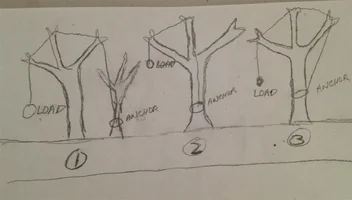
2. On the physics of the thing: The PSP on a basal-tied SRT line supports 2x the climber's weight. How does that number change when there's an angle greater than 0* between the two legs over that PSP? For example; climbing with Bix the other day, he set his line and tied in not at the base of the tree we were climbing but at the base of a neighboring oak about 50' away. I'd say the angle was like 60* or so?
I know from playing with RA rescue setups that it's relatively easy to deflect a taut line in the center - deflection can be used to haul a victim without setting up mechanical advantage using hardware. Does that effect translate in reverse here? In other words, does a wide-angle of tie in mean the PSP is supporting a fraction of the climber's usual doubled-weight?
I wish I could draw what I'm saying. Maybe time to play with MSpaint a little bit, huh?
Thanks, SRT club!
C
As you know, I'm a rank noob when it comes to SRT. Finally saw the light trying to horse up a Ghost Pine in GV on my familiar old DdRT. Hello, tendonitis! I have exactly one short, slow and low climb on my RW, but I've been thinking through some of the potential issues I might come across. I will probably shell out for the SRT manual once I've got a few more jobs in the bank and the rent is paid, but for now, I'd appreciate some help.
1. My understanding with SRT is that SOME of the appeal is in not having to isolate your PSP with the throwline. so how much deflection on small bits and pieces is tolerable in the system?
I used an old-skool SRT setup the other day to ascend a big pondo, and the rope ran over the outside of the canopy, through my psp and back down the outside of the canopy. This lent the system a certain amount of "bounce" and gave me a few small pieces of breakage (snapped twigs the rope had run over) to clean up on my way to the top.
Are guys spending some time isolating for SRT as well?
2. On the physics of the thing: The PSP on a basal-tied SRT line supports 2x the climber's weight. How does that number change when there's an angle greater than 0* between the two legs over that PSP? For example; climbing with Bix the other day, he set his line and tied in not at the base of the tree we were climbing but at the base of a neighboring oak about 50' away. I'd say the angle was like 60* or so?
I know from playing with RA rescue setups that it's relatively easy to deflect a taut line in the center - deflection can be used to haul a victim without setting up mechanical advantage using hardware. Does that effect translate in reverse here? In other words, does a wide-angle of tie in mean the PSP is supporting a fraction of the climber's usual doubled-weight?
I wish I could draw what I'm saying. Maybe time to play with MSpaint a little bit, huh?
Thanks, SRT club!
C