
I have been climbing SRT for almost a year now and it is unbelievable how much it helps when doing a large pruning job. Today I was using it on a removal and one of my groundies asked me what advantages it gave me on a removal over DRT. If he had asked in reference to pruning I would have had a laundry list of reasons for them, but was somewhat at a loss for reasons on a removal. Outside of the ability it gives you to easily ascend into a tree, what kind of advantages do you guys find to climbing SRT on removals?

Navigation
Install the app
How to install the app on iOS
Follow along with the video below to see how to install our site as a web app on your home screen.
Note: This feature may not be available in some browsers.
More options
You are using an out of date browser. It may not display this or other websites correctly.
You should upgrade or use an alternative browser.
You should upgrade or use an alternative browser.
SRT on removals
- Thread starter Outdoorcrazy
- Start date

- Location
- Retired in Minneapolis
Choking off the rope up above and still being able to escape to the ground or reposition easily for the next cut.
Sometimes I would keep the tail of my rope in a bag hanging below my feet. If I was bombing pieces I sure didn't want to have them snag my rope or hit it on the ground. With SRT there's less rope going in and out of the bag.
Doing removals was a way to perfect RADS for pruning. This is back in ancient times before there were things like the Uni/RW/HH
There are more too...someone else will add to the list.
Sometimes I would keep the tail of my rope in a bag hanging below my feet. If I was bombing pieces I sure didn't want to have them snag my rope or hit it on the ground. With SRT there's less rope going in and out of the bag.
Doing removals was a way to perfect RADS for pruning. This is back in ancient times before there were things like the Uni/RW/HH
There are more too...someone else will add to the list.

The working tail of an SRT system needs to be attached to a rotary gear reduction spool on the climber's back, that's integral to his saddle, and pivots passively towards the TIP on a single axis via spring pressure.
This system would in fact make the climber a true spiderman. The choice of locating the spool feed behind you or in front of you is what I'm wrestling with now. Logic tells me put your encumberences to an unobstructed working field behind you.
My gut tells me to keep danger right in front of you where it can be seen and reacted upon.
Do you realize how little 100 feet of today's lightweight rated climbing ropes weigh? Like 5 lbs?
jomoco
This system would in fact make the climber a true spiderman. The choice of locating the spool feed behind you or in front of you is what I'm wrestling with now. Logic tells me put your encumberences to an unobstructed working field behind you.
My gut tells me to keep danger right in front of you where it can be seen and reacted upon.
Do you realize how little 100 feet of today's lightweight rated climbing ropes weigh? Like 5 lbs?
jomoco

treebing
Been here much more than a while
- Location
- Detroit, Mi.
being able to use a short rope. Redirects, spar work. I will admit though, I sometimes miss a nice two to one when I am lugging a saw up and down.

countryboypa31
New member
- Location
- PA
i like that i only have to tend half the rope. Also no change over for spar work.


Will the rope wrench slip or give line when seriously loaded?
If not? Is that a problem?
jomoco
If not? Is that a problem?
jomoco
- Location
- Springfield MO
I've been climbing single rope with a f8 above my hitch while blocking spars for years. My boss ordered in two wrenches last week for us to use, as far as removals go I will be able to cinch an anchor and ascend with no additional load on what will probably be a questionable tree, tie a chainsaw on my tail to tend slack while gafing up and pull it up to me when needed without additional slack. Descend and ascend when needed throughout the whole process at 1:1 ratio. I will also be able to cinch an anchor wherever needed thus eliminating the need for any stub to hang a safety line from.
Keep in mind these thoughts are coming from a person that has not yet drank the koolaide so to speak. 1:1 has always made more sense to me on removals rope wrench or not.
Keep in mind these thoughts are coming from a person that has not yet drank the koolaide so to speak. 1:1 has always made more sense to me on removals rope wrench or not.

hey bro, the rw and hitch will slip when seriously loaded, this is a good thing in my opinion.
[ QUOTE ]
I've been climbing single rope with a f8 above my hitch while blocking spars for years. My boss ordered in two wrenches last week for us to use, as far as removals go I will be able to cinch an anchor and ascend with no additional load on what will probably be a questionable tree, tie a chainsaw on my tail to tend slack while gafing up and pull it up to me when needed without additional slack.
[/ QUOTE ]
Doesn't that thrash the heck out of your chainsaw?
What about groundies below, are they at risk of getting slapped around by your saw dancing like about?
jomoco
I've been climbing single rope with a f8 above my hitch while blocking spars for years. My boss ordered in two wrenches last week for us to use, as far as removals go I will be able to cinch an anchor and ascend with no additional load on what will probably be a questionable tree, tie a chainsaw on my tail to tend slack while gafing up and pull it up to me when needed without additional slack.
[/ QUOTE ]
Doesn't that thrash the heck out of your chainsaw?
What about groundies below, are they at risk of getting slapped around by your saw dancing like about?
jomoco
- Location
- Retired in Minneapolis
J...do you mean that you ascend into the tree with a chainsaw hanging from your harness?
Most climbers ascend as far as they can without a saw, tie in, then haul the saw up to themselves. I've never damaged a saw by doing this in my career. The only time that a saw was ever dropped was when the groundie didn't tie it on properly. No one ever got hit by the falling saw, I can only remember handles being bent...and the next time that groundie tied on a saw it was checked before hauling.
Most climbers ascend as far as they can without a saw, tie in, then haul the saw up to themselves. I've never damaged a saw by doing this in my career. The only time that a saw was ever dropped was when the groundie didn't tie it on properly. No one ever got hit by the falling saw, I can only remember handles being bent...and the next time that groundie tied on a saw it was checked before hauling.
Ask Will. he's the one tending slack with a saw, and pulling it up when needed. He doesn't state whether this is just to reach his TIP, or whether he works the entire tree with his chainsaw tending slack for him?
If the latter?
Seems kinda sorta sketchy.
When I wear gaffs I almost always have an ms200 on my saddle, unless I'm way up or out there where the weight of a chainsaw forces me to strap it down on the trunk and handsaw the brush off without it..
This is removals right?
jomoco
If the latter?
Seems kinda sorta sketchy.
When I wear gaffs I almost always have an ms200 on my saddle, unless I'm way up or out there where the weight of a chainsaw forces me to strap it down on the trunk and handsaw the brush off without it..
This is removals right?
jomoco
- Location
- Retired in Minneapolis
If extra weight is needed to allow any SRT system to slide up the rope all that's needed is a 16oz throwbag on the tail of the rope. I have one with a small shoelace loop on it. The bag goes on the tail, I ascend. It becomes my in-tree throwbag once I yard up the tail of my rope.
Too much weight will pull the rope out of my Pantin.
Too much weight will pull the rope out of my Pantin.

[ QUOTE ]
If extra weight is needed to allow any SRT system to slide up the rope all that's needed is a 16oz throwbag on the tail of the rope. I have one with a small shoelace loop on it. The bag goes on the tail, I ascend. It becomes my in-tree throwbag once I yard up the tail of my rope.
Too much weight will pull the rope out of my Pantin.
[/ QUOTE ]
So you use the shoelace as a prusik in order to secure it at the ground? I like this idea.
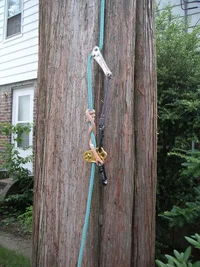
I just, after owning a rw for several months now fully experienced the advantage just the other day. It went all smoothly with the GB-nek rope walker except for leaving the ground. It can get a little tiring to keep reaching down to pull slack through or reset the pantin.
If extra weight is needed to allow any SRT system to slide up the rope all that's needed is a 16oz throwbag on the tail of the rope. I have one with a small shoelace loop on it. The bag goes on the tail, I ascend. It becomes my in-tree throwbag once I yard up the tail of my rope.
Too much weight will pull the rope out of my Pantin.
[/ QUOTE ]
So you use the shoelace as a prusik in order to secure it at the ground? I like this idea.
I just, after owning a rw for several months now fully experienced the advantage just the other day. It went all smoothly with the GB-nek rope walker except for leaving the ground. It can get a little tiring to keep reaching down to pull slack through or reset the pantin.
Attachments
- Location
- Retired in Minneapolis
Not to secure it to the ground, just add a bit more weight.
There is a height for each ascent system where the rope weight takes over and self feeds. If there is a lot of friction in the system the height is higher so the weight willhave to be heavier.
One of the crucial parts of having an efficient SRT system is having everything tuned. Once you hit that it is smoooooth
There is a height for each ascent system where the rope weight takes over and self feeds. If there is a lot of friction in the system the height is higher so the weight willhave to be heavier.
One of the crucial parts of having an efficient SRT system is having everything tuned. Once you hit that it is smoooooth
"At" the ground I said, Tom. Which does seem to be what the shoelace is for, correct? To use as a prusik below the pantin. And then it is on the rope and adjustable for weighing the tail end for throwing up over branches while tailing. This is a two for one deal. I like it.
And while on the subject of tuning... I use a keychain biner to attach the bungee from the pantin to the rw. This was not the perfect set up. The path of the bungee although it worked smoothly, was crossed over to much of what was going on with the ascent. What else can the keychain biner be attached too?
Is there a thread going on around here that I missed about this?
And while on the subject of tuning... I use a keychain biner to attach the bungee from the pantin to the rw. This was not the perfect set up. The path of the bungee although it worked smoothly, was crossed over to much of what was going on with the ascent. What else can the keychain biner be attached too?
Is there a thread going on around here that I missed about this?
- Location
- Springfield MO
Hmm guess I should make it clear that a chainsaw tied to the end of my single ascent line is resting on the ground not flying around at face level, also the saw doesn't move much at all during ascent. When I need my saw i pull it up to me and keep it with me for the duration of the climb.

- Location
- NJ
There's a couple of things I like about set for removals. Makes me think the whole climb through. If pulling a top at the end I install my line where the pull line wood go and tie it off down where I would be making my cut but in a way to not foul the rigging or vise versa.
I use a webbing strap and carabiner quite often as my redirect. Don't need to bother leaving nubs and can create better working angles as well as safer ones. If climbing out on high angles much faster to install one then trailing your line through a crotch.
Always knowing no matter how big a peace comes down that even if to lands on my line and I need to descend right away I still can and not have to wait for the ground crew to free me up.
I use a webbing strap and carabiner quite often as my redirect. Don't need to bother leaving nubs and can create better working angles as well as safer ones. If climbing out on high angles much faster to install one then trailing your line through a crotch.
Always knowing no matter how big a peace comes down that even if to lands on my line and I need to descend right away I still can and not have to wait for the ground crew to free me up.
- Location
- Lexington, Kentucky
I've tied my saw on as well once or twice to have some added weight, along with the fact that the groundy was busy doing other things, so it was just as easy to set it on the ground and tie it on.

Bixler
Participating member
- Location
- Nevada City, CA
Great info so far guys. I've noticed how nice it is to be able to spin around so freely, without worrying about crossing your climb line up.
Also, it's nice to be able to blindly reach up with one hand for your rope and to know it's not the wrong end of your climb line your pulling on.
I appreciate SRT, it's been a huge help for me, saves loads of effort and fits my style of climbing. I've made a natural switch from DRT to SRT on almost all climbs. It now saves me time, and has allowed me to make more money.
There have also been times where re-directing through various crotches, and while continuing the climb, the stems are being pulled together rather than collapsing with too much weight.
Around here, it's usually like working in a forest, with a house and other stuff thrown in the mix. I usually can start at a high point in one tree, and can safely and efficiently move to many other trees to work on as well.
I still need to get my foot ascender attached to my right spur, at least to further 'tune' my system. - I love that idea.
I've also noticed having a foot ascender on my right foot, and a spur on my left works well for quite sometime while piecing out a tree. Before too long I need to strap on the other spur and lower the heavy stuff.
SRT on removals... for me is the way to go.

Also, it's nice to be able to blindly reach up with one hand for your rope and to know it's not the wrong end of your climb line your pulling on.
I appreciate SRT, it's been a huge help for me, saves loads of effort and fits my style of climbing. I've made a natural switch from DRT to SRT on almost all climbs. It now saves me time, and has allowed me to make more money.
There have also been times where re-directing through various crotches, and while continuing the climb, the stems are being pulled together rather than collapsing with too much weight.
Around here, it's usually like working in a forest, with a house and other stuff thrown in the mix. I usually can start at a high point in one tree, and can safely and efficiently move to many other trees to work on as well.
I still need to get my foot ascender attached to my right spur, at least to further 'tune' my system. - I love that idea.
I've also noticed having a foot ascender on my right foot, and a spur on my left works well for quite sometime while piecing out a tree. Before too long I need to strap on the other spur and lower the heavy stuff.
SRT on removals... for me is the way to go.

New threads New posts
-
test
-

-

-
KBNest -Midline Attachable SRS Canopy Anchor.
- Started by TreeSteward
- Replies: 6
-

-
-


