
SRT on 1/2" rope

Tom could you also consider 8.2.4 and 8.2.5 pp 31 of Z133-2017 in commenting too please?

Addenda: Excerpt from Z133 as per Tom's request below:

Cheers
@ghostice


man explanation of those exceptions would take a LOT of typing. I’m using my phone and my thumbs would be nubs before I could type it out or edit the voice reply

short answer...that applies to electrical utility line clearance workers who fall under an OSHA reg. Arborist aren’t covered in that reg
 
I think the wraps cause the majority of the friction, the ring just below them buffers the load on the bottom cord as it starts the bottom wrap. This ring also forms a slight bend from the twist, not just a crossover, or braid in back. This twist is also what keeps the slack that is produced when the hitch is compressed from migrating from the wraps to the legs and eyes. Something can be used, like a ring or piece of tubing, with the twist, to prevent the unneeded friction it causes, this hardware also helps with the tending.
All this below the wraps, the finish, causes enough friction so that the wraps can be released in a controlled manner. The finish, or multiples of them don’t generate enough friction to hold a climber though.
So I have looked through the whole thread on the Stitch Hitch and the reason for using a loop is because I had them for Friction hitches before I started researching the depth of systems there are (aka when I was reading Freedom of the Hills, mountaineering stuff) and see as my funds are limited atm for thicker cordage that would be appropriate (as described in the Stitch Hitch Thread), so I figured the looped line would give a parallel diameter? I realize that does not translate in terms of friction applied...). I guess I'm a monkey see monkey do and I am still trying to visualize how all the parts actually work together. Back to the thread, I assume there is a video in there of it in action. AGAIN, a noob, XD
 
So I have looked through the whole thread on the Stitch Hitch and the reason for using a loop is because I had them for Friction hitches before I started researching the depth of systems there are (aka when I was reading Freedom of the Hills, mountaineering stuff) and see as my funds are limited atm for thicker cordage that would be appropriate (as described in the Stitch Hitch Thread), so I figured the looped line would give a parallel diameter? I realize that does not translate in terms of friction applied...). I guess I'm a monkey see monkey do and I am still trying to visualize how all the parts actually work together. Back to the thread, I assume there is a video in there of it in action. AGAIN, a noob, XD
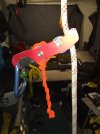
The Bobbin RW 'idea', obviously for show with the twist tie, BUT I'm pretty sure I can make this work... Tends easily with force applied at the second runner and if the carabineer is pulled by hand you get an extra bit of bite!
 

Attachments

  • 16051435436548866416369523628810.jpg
    16051435436548866416369523628810.jpg
    264.5 KB · Views: 22
I wonder if your second carabiner would be able to adjust the amount of friction it can generate while in use.

Not sure what you’re referring to about needing a large diameter cord for the Sticht, I found the adjustability can allow just about all diameters to work.
 

New threads New posts

Back
Top Bottom