SRT anchors

[ QUOTE ]
Adding friction hitches does add a layer of redundancy. Carefully choosing the hitch and cord is important because some combos will lock off with very little shock load. If this happens during a rescue are the rescuers trained in techniques to add a piggy back system to release the load on the jammed hitch?

As we know, hitches that work in DdRT will jam hard in SRT. The same thing will likely happen using hitches on a single line rescue setup.

[/ QUOTE ]

Hi Tom,

I much prefer a fall arrester (not the webbing types) as they are designed to take the heat and abrasion from a shock loaded rope. A basic inch worm system will take the load off enough to allow lowering (and no need to cut off a welded prussik afterwards....
wink.gif
)
 
If you are in a possition where you have one rescuer and two guys on the ground a great sysyem to use is a lowering and raising in one system.
If the rescuer is on a singal line that has a high point so the other end comes back down to the ground you will be able to lock that off to a rescue eight or rack. Attach the eight/rack to a MA 3:1, 4:1 whatevre your team uses. This was you will be able to lower and raise on the same system from the ground allowing the rescuer to concintrat on just the vic and not lowering or climbing.

I forgot to ad in at the base of the tree you should anchor a pulley with some kind of auto-block/cath all/ safety so if the person lowering the system has a brain fart and lets go of the rope the system will lock up. Wich will not be a problem because you have the MA attached to the system.

Again im sure there a thousand other ways to do this but with min equipment and safety still in mind it works great.
 
Fairfield,

That's kind of what we set up except the descender replaces the fig8 and autoblock/catch all as it does both jobs. I add a shock absorber so that the system will never be shock loaded in the case of a climber fall (TIP failure and a lower branch catching the fall). We have a inchworm (MA 3:1) at the bottom to take the load off the shock absorber after you shorten up the rope through the descender. In training one person can safely lower the climber in minutes (add a few extra for brain farts in real emergencies
wink.gif
) and is pretty gea

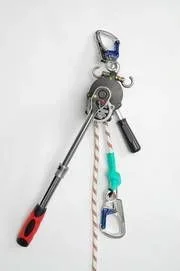
For non tree work (day job) our rescue kit costs about £1000 and is the easiest thing to use - one bod can lift 200kg and then lower it hands free (great fun to play - i mean practice with)
 
Tom,

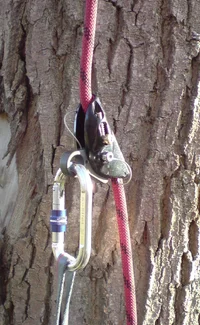
The fall arrester is basicly a cammed rope grab with a specialy designed cam. It grabs the rope but allows it to slip slightly to dissipate energy in case of a fall - like a shunt but it works
wink.gif
'forgot to mention it's also certified as a fall arrester'

As you pointed out diferent friction cords act differently with different rope and finding out it's performance during an emergency is not the best.... If you throw rain/tree sap/mud/frith and two body weights into the equasion then autoblocks start to look less and less appealing (you should really run two if there are two bods on the line).

I like the way this type of thread has developed from should you anchor at the base of a tree to what is the best set up for an anchor/rescue point. Setting up your work system to incorporate rescue is definatly the way to be thinking. To many companies have their rescue gear in the van.
 
Hi Fairfield,

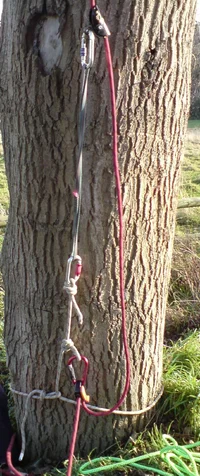
The setup I use for tree climbing is the attachment for the post titled "attached I think" above, the only thing not shown is the inchworm. I'll have to grab a shot of it (it's just a shell cam ascender attached to a simple pulley system)

The whole set up is a running bowline around a tree base up to an alpine butterfly for the descender to attach to then up to a barrel knot or fig8 knot. There is a sling from the barrel knot to the fall arrester on the rope (the actual anchor point) to give nice clear working space to operate the descender if needed - this can be left out if you use a longer rope for the running bowline. A big loop of the climbing rope leads down to the descender to allow for slippage if the fall arrester has to deploy (worst case scenario)

To rescue someone all you need to do is pull the slack through the descender, clip the ascender of the inchworm above the fall arrester on the climbing rope and the bottom pulley next to the descender on the running bowline, pull using the 3:1 enough to take the load of the fall arrester, undo it and then release until the descender has taken the load. Lower the vic on the descender.

You can just clip the rope straight into a descender, but some have a nasty habit of locking (Petzl I'D) if they get shock loaded - plus I'm a real stickler for using shock abosorbsion as I've seen some grim stories of falls without them (torn livers, ruptured aortas, etc).

Ive attached a pic of my work rescue kit (I add a second sling and a rope grab and pulley for deviations). It is great to just step into free air and let go....
 

Attachments

  • 180413-9962c0b83c.webp
    180413-9962c0b83c.webp
    4.4 KB · Views: 144

New threads New posts

Back
Top Bottom