
Navigation
Install the app
How to install the app on iOS
Follow along with the video below to see how to install our site as a web app on your home screen.
Note: This feature may not be available in some browsers.
More options
You are using an out of date browser. It may not display this or other websites correctly.
You should upgrade or use an alternative browser.
You should upgrade or use an alternative browser.
splice concerns
- Thread starter ficus
- Start date


This is really a great question.
In the splicing business, a lot of guys will use the rule of thumb that nylon ropes (for instance, double braid nylon) ropes get whipping while polyester (like all arborist climbing lines) don't get whipping.
My opinion is that you would be perfectly safe climbing on any of those lines with the whipping removed. If you don't believe me, just try to undo one of the splices by pulling the throat of the splice back down the long section of the rope. In our shop, we have never been able to undo a finished splice on 24 or 16 strand polyester, especially after it has been loaded. I would bet it would be impossible for you to do the same.
There is a lot of misconception on splices with regard to the whipping/lockstitch by the splice. Some guys think it is absolutely mandatory, while others don't want them at all.
We do them because we have to follow mfg. specs, but to guarantee a safe splice, I feel they are totally unnecessary.
In the splicing business, a lot of guys will use the rule of thumb that nylon ropes (for instance, double braid nylon) ropes get whipping while polyester (like all arborist climbing lines) don't get whipping.
My opinion is that you would be perfectly safe climbing on any of those lines with the whipping removed. If you don't believe me, just try to undo one of the splices by pulling the throat of the splice back down the long section of the rope. In our shop, we have never been able to undo a finished splice on 24 or 16 strand polyester, especially after it has been loaded. I would bet it would be impossible for you to do the same.
There is a lot of misconception on splices with regard to the whipping/lockstitch by the splice. Some guys think it is absolutely mandatory, while others don't want them at all.
We do them because we have to follow mfg. specs, but to guarantee a safe splice, I feel they are totally unnecessary.

robinia
Participating member
- Location
- Ontario, Canada
I'm curious to see the responses about the bend...
I've always avoided spliced climbing line because I figured even the strength lost from forming a knot was better than loading in the EXACT same place every time (cycles to failure?). At least with a knot the load is moved around endlessly.
I've got no proof to this theory- it only seems to make good sense.
I've always avoided spliced climbing line because I figured even the strength lost from forming a knot was better than loading in the EXACT same place every time (cycles to failure?). At least with a knot the load is moved around endlessly.
I've got no proof to this theory- it only seems to make good sense.
[ QUOTE ]
I'm curious to see the responses about the bend...
I've always avoided spliced climbing line because I figured even the strength lost from forming a knot was better than loading in the EXACT same place every time (cycles to failure?). At least with a knot the load is moved around endlessly.
I've got no proof to this theory- it only seems to make good sense.
[/ QUOTE ]
Interesting idea......
A splice strength is easily going to be in the range of 80% of the avg. break strength. A knot will put you at about 60 to 50% of the break strength. As long as the rope fibers are intact you are not going to see any decrease in strength, no matter how many times it gets loaded.
Rigging ropes are a bit of a different story, but climbing lines.....that splice is always going to be stronger than any knot, safer to use, quicker to attach to, and better looking than a knot.
Splice Tight - Climb Right
I'm curious to see the responses about the bend...
I've always avoided spliced climbing line because I figured even the strength lost from forming a knot was better than loading in the EXACT same place every time (cycles to failure?). At least with a knot the load is moved around endlessly.
I've got no proof to this theory- it only seems to make good sense.
[/ QUOTE ]
Interesting idea......
A splice strength is easily going to be in the range of 80% of the avg. break strength. A knot will put you at about 60 to 50% of the break strength. As long as the rope fibers are intact you are not going to see any decrease in strength, no matter how many times it gets loaded.
Rigging ropes are a bit of a different story, but climbing lines.....that splice is always going to be stronger than any knot, safer to use, quicker to attach to, and better looking than a knot.
Splice Tight - Climb Right

- Location
- St. Paul, MN
[ QUOTE ]
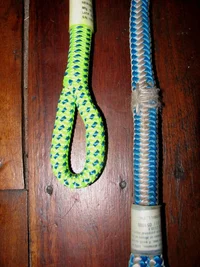
Know very little about splices. Concerned about the whipping coming off the blue streak and the bend in the new tachyon. Should I be concerned?
[/ QUOTE ]
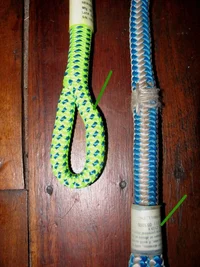
Where's the bend in the Tachyon? Are you refering to the crooked part in the eye? Looks to me like the core/cover relationship in the eye was not equalized. Not the end of the world (it's not going to fall apart or break in a climbing situation), but it wasn't finished properly IMO. If the bend in the Tachyon is in the throat of the splice, it's most likely a bulge created by the crossover. Tachyon is so tightly woven it's hard to make it look 100% smooth.
Know very little about splices. Concerned about the whipping coming off the blue streak and the bend in the new tachyon. Should I be concerned?
[/ QUOTE ]
Where's the bend in the Tachyon? Are you refering to the crooked part in the eye? Looks to me like the core/cover relationship in the eye was not equalized. Not the end of the world (it's not going to fall apart or break in a climbing situation), but it wasn't finished properly IMO. If the bend in the Tachyon is in the throat of the splice, it's most likely a bulge created by the crossover. Tachyon is so tightly woven it's hard to make it look 100% smooth.
A little more info
The blue streak damage is from the heat shrink cylinder sliding and rubbing the whipping. Should I cut it off?
The Tachyon looks weird to me cause the rope seems to turn a corner a bit around the shoulder of the splice(before it enter the sheath)
Another question-Sometimes I choke the blue streak off. Does this create unfavorable bends in the splice?
Thanks
The blue streak damage is from the heat shrink cylinder sliding and rubbing the whipping. Should I cut it off?
The Tachyon looks weird to me cause the rope seems to turn a corner a bit around the shoulder of the splice(before it enter the sheath)
Another question-Sometimes I choke the blue streak off. Does this create unfavorable bends in the splice?
Thanks
Attachments
- Location
- St. Paul, MN
OK, yep that was the bend I saw. Pinch the rope with your fingers where it enters itself and then milk the rope around the circumference of the eye to where you made the mark. Does the cover bunch up? If it does, the core/cover relationship was not equalized.

countryboypa31
New member
- Location
- PA
I wouldn't attempt to cut the shrink wrap for the concern of cutting my rope.

NickfromWI
Participating member
- Location
- Los Angeles, CA
[ QUOTE ]
In the splicing business, a lot of guys will use the rule of thumb that nylon ropes (for instance, double braid nylon) ropes get whipping while polyester (like all arborist climbing lines) don't get whipping.
My opinion is that you would be perfectly safe climbing on any of those lines with the whipping removed. If you don't believe me, just try to undo one of the splices by pulling the throat of the splice back down the long section of the rope. In our shop, we have never been able to undo a finished splice on 24 or 16 strand polyester, especially after it has been loaded. I would bet it would be impossible for you to do the same.
There is a lot of misconception on splices with regard to the whipping/lockstitch by the splice. Some guys think it is absolutely mandatory, while others don't want them at all.
[/ QUOTE ]
John- I've not heard this about nylon vs. polyester before.
Though I agree with you 100% about whipping not being necessary in ropes like tachyon, blaze, velocity, poison ivy- I have to disagree with you about the sixteen strand ropes. Following manufacturers specs, it's not difficult at all to pull the tail out of an unwhipped 16 strand rope, even after repeated use.
If the stitching fell off my 16 strand rope, I'd replace it before reusing it, no exception.
The only proper splice I've heard of failing (not talking ROPE failure here) was a non-stitched 16 strand splice.
love
nick
In the splicing business, a lot of guys will use the rule of thumb that nylon ropes (for instance, double braid nylon) ropes get whipping while polyester (like all arborist climbing lines) don't get whipping.
My opinion is that you would be perfectly safe climbing on any of those lines with the whipping removed. If you don't believe me, just try to undo one of the splices by pulling the throat of the splice back down the long section of the rope. In our shop, we have never been able to undo a finished splice on 24 or 16 strand polyester, especially after it has been loaded. I would bet it would be impossible for you to do the same.
There is a lot of misconception on splices with regard to the whipping/lockstitch by the splice. Some guys think it is absolutely mandatory, while others don't want them at all.
[/ QUOTE ]
John- I've not heard this about nylon vs. polyester before.
Though I agree with you 100% about whipping not being necessary in ropes like tachyon, blaze, velocity, poison ivy- I have to disagree with you about the sixteen strand ropes. Following manufacturers specs, it's not difficult at all to pull the tail out of an unwhipped 16 strand rope, even after repeated use.
If the stitching fell off my 16 strand rope, I'd replace it before reusing it, no exception.
The only proper splice I've heard of failing (not talking ROPE failure here) was a non-stitched 16 strand splice.
love
nick
NickfromWI
Participating member
- Location
- Los Angeles, CA
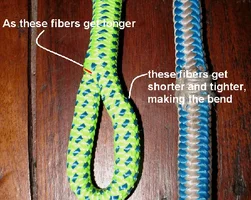
That bend in the rope is from strand tension. There's nothing wrong. See the attached pic.
If you look at the beginning of the throat of the splice, you'll see some strands pulled up a lot (marked red in my pic). Follow them up into the splice and you'll see that they are being pulled tight which puts a little kink in the eye.
This isn't noticed on small eyes, but your eye is quite large (too large, in my opinion) so the kink really stands out.
The whipping on the blue streak looks sloppy, but it doesn't look unsafe to me. It is still mostly in tact. If you are at all unsure about it, snip it off and replace it.
love
nick
If you look at the beginning of the throat of the splice, you'll see some strands pulled up a lot (marked red in my pic). Follow them up into the splice and you'll see that they are being pulled tight which puts a little kink in the eye.
This isn't noticed on small eyes, but your eye is quite large (too large, in my opinion) so the kink really stands out.
The whipping on the blue streak looks sloppy, but it doesn't look unsafe to me. It is still mostly in tact. If you are at all unsure about it, snip it off and replace it.
love
nick
Attachments
- Location
- Rannoch, Scotland
John and Nick
I appreciate your comments about the difference in importance of whipping over a range of rope constructions. However, my observation is that the large majority of tree workers struggle to differentiate between a 24 strand double braid and a 16 strand hollow braid with a filler core (some seem to struggle to tell their ar$e from their elbows!).
For me, at least until there is a greater and wider knowledge in our industry, there has to be a clear line re whipping i.e. it must be present, correctly located, of an appropriate pattern and material, in good condition (functional) and both easily and regularly inspected.
I feel your comments could be easily misinterpreted, regardless of whether they are correct or not.
Chris
I appreciate your comments about the difference in importance of whipping over a range of rope constructions. However, my observation is that the large majority of tree workers struggle to differentiate between a 24 strand double braid and a 16 strand hollow braid with a filler core (some seem to struggle to tell their ar$e from their elbows!).
For me, at least until there is a greater and wider knowledge in our industry, there has to be a clear line re whipping i.e. it must be present, correctly located, of an appropriate pattern and material, in good condition (functional) and both easily and regularly inspected.
I feel your comments could be easily misinterpreted, regardless of whether they are correct or not.
Chris

- Location
- Chapel Hill, NC
Whipping looks cool and should be done for that reason alone.
I wouldn't sweat that splice except it appears to be a peculiar size. Will you girth hitch it or just clip straight through?
I wouldn't sweat that splice except it appears to be a peculiar size. Will you girth hitch it or just clip straight through?
I have used a blue bandit (rubber bannds) to tighten the eye and keep it tight on the biner.
I'm still a little fuzzy on the blue streak issue as there does not seem to be a consensus.
Nick- I have noticed two of the vertical strands in the whipping are broken and the horizontal ones are coming out.
Replacement time? Can you give me the link on this whipping/
Thanks
I'm still a little fuzzy on the blue streak issue as there does not seem to be a consensus.
Nick- I have noticed two of the vertical strands in the whipping are broken and the horizontal ones are coming out.
Replacement time? Can you give me the link on this whipping/
Thanks
- Location
- Chapel Hill, NC
Yale whiplock instructions
These are good basic whiplock instructions... #4 whipping twine works well; be neat.
These are good basic whiplock instructions... #4 whipping twine works well; be neat.
NickfromWI
Participating member
- Location
- Los Angeles, CA
Ficus- I didn't realize the strands were cut. Yeah- replacement time for sure.
Some people also like these instructions that some silly guy put on his website.
love
nick
Some people also like these instructions that some silly guy put on his website.
love
nick

- Location
- nj
hey does anybody know of any spliceing class around nj, or somebody that i can hook up with and teach me

Having to train our own 20 climbers plus others, stictch locking needs to be mandatory. About 2 years ago I was doing an all day hands on demo. A climber showed me his hi-ve. The stitch lock was gone. I was easily able to pull it out. The rope was about a years old with daily use. The climbers jaw dropped.
- Location
- St. Paul, MN
[ QUOTE ]
That bend in the rope is from strand tension. There's nothing wrong. See the attached pic.
If you look at the beginning of the throat of the splice, you'll see some strands pulled up a lot (marked red in my pic). Follow them up into the splice and you'll see that they are being pulled tight which puts a little kink in the eye.
[/ QUOTE ]
Hey Nick, that is an excellent observation as usual. However, I find that the kink is exacerbated by the excess slack in the cover around the eye. If the splicer milks the cover from entry point back toward the kink, punch in an awl and yank the core tail and core back into alignment (like we should be doing anyway), this allows the tightness in the kink to relax and broadcast over more surface area.
That bend in the rope is from strand tension. There's nothing wrong. See the attached pic.
If you look at the beginning of the throat of the splice, you'll see some strands pulled up a lot (marked red in my pic). Follow them up into the splice and you'll see that they are being pulled tight which puts a little kink in the eye.
[/ QUOTE ]
Hey Nick, that is an excellent observation as usual. However, I find that the kink is exacerbated by the excess slack in the cover around the eye. If the splicer milks the cover from entry point back toward the kink, punch in an awl and yank the core tail and core back into alignment (like we should be doing anyway), this allows the tightness in the kink to relax and broadcast over more surface area.
New threads New posts
-
test
-
-

-
-
 Fruit tree holding on by a thread, client wants to get another year out of it. Thoughts?
- Started by climbingmonkey24
- Replies: 55
-
-

