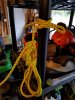
Speed line came untied at the ground

I use a clove hitch frequently to hang a stowed short hank of line from any handy stationary object. Coil up the loose end of a rope and hang it from a nearby sapling.
 

Attachments

  • Clove hitch with slip.jpg
    Clove hitch with slip.jpg
    429.3 KB · Views: 15
I back up my clove hitches mostly even when tied to a static tree etc. Just a matter of habit, but not necessary. The direction of loading matters more than the force. So on any near balance point tie off, I will always go with a doubled running bowline.

When we tie off to the skid loader we usually just take three or four wraps around the bar of the grapple on the bucket and take another around the backside of the working end of the line, and come back thru as you would in a normal clove and finish with a couple of half hitches, or just take 3-4 wraps and 2 half hitches. BUT if we are going to be doing a lot of on and off as would be the case for speed lining, there is a D-ring welded to the middle of the bucket to attach a porty with a shackle...

Here's how I tie off to the stump grinderView attachment 70352
"A couple of half hitches" is a clove hitch. Now if you are terminated a few round turns with a clove, the clove is the backup and doesn't need to be backed up as it doesn't see any loading.

Point is there are many knots which are better than a clove for rigging. period. None of your examples in this post suggests you'd use a clove hitch.

I learned long ago, a clove around a tree trunk or other static object can and will become a axe knot when loaded with moderate 'tree work' forces

A clove hitch is a Boy Scout knot, good for accessory use, light rigging. I use them all the time lowering limbs, I will clove 2-6 limbs on the rigging line and lower them all at once. It's a shitty rigging termination knot, end of point
 
I learned long ago, a clove around a tree trunk or other static object can and will become a axe knot when loaded with moderate 'tree work' forces
The clove only locks up when it is loaded across itself (if that makes sense). Basically, the clove hitch is a directional knot. SOOOOO anytime the rigger is not sure of the balance of the piece, there is a chance that the clove could be loaded across itself and lock up. Then it's best to use another option. Taking tops and butt tied limbs, there is no chance the clove will lock up if it is tied properly.
 
i think hanging a rope hank is different.
Also, would prefer slipped Bag knot.
Hmm. Slipped bag knot is one I don't know. I'll have to check it out.

My point was just that there are lots of excellent uses for a clove hitch, and plenty of inappropriate uses. If life, limb, or property "hang" in the safety of the knot, I don't use a clove hitch.
 
Hmm. Slipped bag knot is one I don't know. I'll have to check it out.

My point was just that there are lots of excellent uses for a clove hitch, and plenty of inappropriate uses. If life, limb, or property "hang" in the safety of the knot, I don't use a clove hitch.
Ahh. Slipped bag knot is also known as a slipped reef knot. My sailing roots get that. It's a knot I use all the time when either reefing a sail or packing away a mainsail. A.k.a. slipped square knot.
 
The clove only locks up when it is loaded across itself (if that makes sense). Basically, the clove hitch is a directional knot. SOOOOO anytime the rigger is not sure of the balance of the piece, there is a chance that the clove could be loaded across itself and lock up. Then it's best to use another option. Taking tops and butt tied limbs, there is no chance the clove will lock up if it is tied properly.
I get it, it’s my fault and not a stupid knot (hitch)
 
All mechanix are directional.
In any other real pro discipline for securing, follow "1 is none, and 2 is 1" safety philosophy.
.
i think self-crossing lock of Clove is a valid player here for a continuous direction, trapping rite against host hard, no 'rattling' around.
In lowering that would be more of a butt tie with CoG inline to grab and farther away to pull straight/true inline to clove trapping it self
>>w/o relief, only constant pull. So movements and jarrings of lowering can make 'less constant' pressure.
While locking into any branch, deformation, taper etc. can be helpful
.
i would prefer running DBY with Half Hitch preceding/'pre-fix'. Clove on real rigged load for me would always have Half Hitch 'pre-fix'.(or dogged into branch crotches)
>>let Half Hitch negotiate loading forces, and another grab on load as host.
.
The increase from 1 (single, simple Turn) to 3 arcs (whether Round Turn, Cow or Clove type bases etc. ) gives the architecture tools to resist 2 dimensional pulls,
>>not just simplest 1 dimensional pulls in straight line from most proper right angle grab on host.
>>Because flexibles/rope is not rigid on cross axis, rope doesn't show 3 dimensional loading, like a sideLean on hinge does.
.
All 3 , 3arc base designs(Round Turn, Cow or Clove) can take standard, simple, inline pull as single arc Half Hitch,
but then also pulls away from arcs on host to grab that way like force lines of metal bracings
or across arcs to grab and lock like pop-lock of awning knot with more arcs.
More away from proper right angle pull on host and more towards what Ashley calls 'lengthwise' (to the host rail/spar etc.) as the WORST ANGLE OF PULL.
.
i still find stop(per) as appropriate SWL /fail-safe type strategy of cotter key etc.
(fail-safe serially as 2nd lock, not parallel of alternate path)
Single lock in any other kind of mechanics is as too, a maybe baby on the battlefield!
.
Counter-Torque of the reverse of Backhand Turn (Cow, Muenter)
>>compared to continuous direction uncrossed (Round Turn) or crossed (Clove) bases,
makes Backhand Turn types least likely to walk tighter or free, but would fail-safe pin it too.
( Backhand types can be seen as 3arc w/crossing too, but crossing is off host; compared to Clove on host crossing).
Backhand types also uniquely pull from center of host diameter more like Half Hitch (single Turn)
>>compared to continuous direction multiple arc types characteristically pull from side, like recoil on saw.
.
Pile Hitch is hybrid of loaded from Crossed Turn (Clove type) side and then backed by Backhand (Cow type) ,so takes game to another level
>> but still, in pro use, to the art, prefer mechanical end run/stop here too.
Pile's sibling/similar Clove + Cow form "Sailor's Hitch" more problematic to stopper,
>>but already has 2 best nip point(opposing side of hast than linear input of Standing Part) control like no other, as possible exception,
>>but with intermittent , random direction loading, still would favor end stop in heavy / pro use.
.

 
Last edited:

New threads New posts

Back
Top Bottom