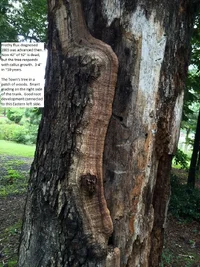
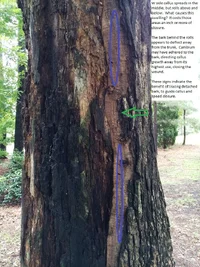
slim flux on willow oak

I already have the book...ah nevermind.

Thanks for the picts and text. Quite some fruiting body. Any contribution to the infection suspected from nearby spicket? Wound source pretty obvious.

Very systematic and based on a Dendro article. But isn't that you quoting yourself. Ah...nevermind. "Apply heat, cauterize"...now we have something...is the latter term in Sinclair? Blow torch likely not?

I know you do a great job and have the best of intentions but just wonder about that particular treatment and what it is based on. I might try it sometime myself if I knew.

What were your goals in pruning? Reduction pruning?
 
Pel, what kind of field test for pH do you recommend?

I don't, Guy.
I think a professional soil lab or agricultural extension service, perhaps through a university might be the way to go if I was in the biz of "feeding trees" to help them recover from being zapped by lightning strikes or blowtorches.
btw, what kinda question was that you asked me anyway? Something along the lines of "when did you stop beating your wife?"
 
Dave when 7 smart people review something, it's not just the author involved. The gardenweb thread was useful thanks but that tree got charred; heat should only be applied until the sizzling stops. The objective is drying, not burning! Applying heat is based on centuries of pomological applications to...trees.

At first i also thought moisture was the big issue but drainage there is very good. Yes the pruning objective was to reduce load and retain health and appearance; what else?

Pel, pH kits are sold over the counter in hardware stores; hardly a trick question. It's kinda curious that some arborists react so skeptically to natural cultural treatment like heat, yet routinely kill trees based on dubious assessments, no diagnosis, sketchy ideas about mitigation, the perfunctory practice of removing assets at great expense. That's the snake oil we need to go after! :mad:
 
Guy, I think everyone's problem is that you are so avant garde. Many times you go against the grain with what the industry is teaching, and then you belittle us for questioning you. Do we believe Guy, or do we believe the industry that certified us?

Personally, I appreciate the amount of time and effort you put into furthering the science of arboriculture. I think your blowtorch idea has promise. I also think in the wrong hands it could do more damage than good. In the last post you finally explained the intricacies of what you look for when using it.

Science is an ever changing process. What we believed yesterday might not be true today. But it'll take more than 24 hours for everyone to accept it.
 
Pel, pH kits are sold over the counter in hardware stores; hardly a trick question. :mad:

Would you consider those hardware store kits to be able to yield results that are accurate and replicable for companies selling deep root fertilization???
Of course you had no ulterior motive in asking me what kit I'd recommend, lol.
 
Yes they're accurate enough--why assume they are not? No need to allege and assume just to try to justify 'not going there' into the scary territory of disease management. If all you want to do is cut, that's your business, as long as you don't try to sell removals with bogus info.

TL I'm not contradicting most of that info, I'm just not misreading "should"s as "shall"s, or applying "rules of thumb" as if they were Commandments. Take a second look at what the industry's teaching, and what limitations there are in our knowledge, before asserting certainty.

Read what Karl Niklas says about assumptions and generalizations in biomechanics, and the severe limitations they impose.
In his keynote presentation, Kark
Niklas started his presentation titled
“What We Don’t Know about Tree
Biomechanics” by admitting the truth:
conclusions from research into the
science of mechanics are severely limited
by simplifications and assumptions.
Try applying this research to living,
responding systems such as trees, and
you will find what Niklas calls “very
large gaps in our knowledge regarding
the mechanical behaviour of trees.”
These limitations are so great that tree
assessments must rely more on the tree’s
body language—the swear words and
also the songs.
For instance, the assumption made by
many arborists that tree roots systems
are broad and shallow is often not true.
Tree species, soil type, and movement
can initiate roots that grow downward.
These are “bayonet roots” or “grappling
hooks”, in Niklas’ estimation, but they are
discounted due to their locations. The
anchoring effect of these sinker roots,
added to the “guy wires” in roots near the
surface, substantially reduces the risk
of uprooting. We don’t often see these
because such trees seldom flip over for
us to examine.
He then portrayed a redwood tree
that had an opening carved in its base
to build a road through it, yet it has
survived without incident (or visible
decay) for decades. When trees shed
their heartwood naturally, as they often
do, Niklas reminded us that the tubes
are very strong structures. Hollowing
increases flexibility, sheds waste
products and weight, and decreases
the likelihood of shear cracks forming
when the trunk twists in the wind.
After decades of hearing questionable
conclusions about risk based on invasive
measuring of stem wall thickness, these
reminders were refreshing.
 
Last edited:
Abide by the text book. In some and most cases yes. But the thing is trees don't read. They don't behave like we want them to
 
Guy, I think everyone's problem is that you are so avant garde. Many times you go against the grain with what the industry is teaching, and then you belittle us for questioning you. Do we believe Guy, or do we believe the industry that certified us?

Personally, I appreciate the amount of time and effort you put into furthering the science of arboriculture. I think your blowtorch idea has promise. I also think in the wrong hands it could do more damage than good. In the last post you finally explained the intricacies of what you look for when using it.

Science is an ever changing process. What we believed yesterday might not be true today. But it'll take more than 24 hours for everyone to accept it.

Avant garde? I think presumptuous (assumes he knows more re when a tree should be removed than anyone), arrogant and condescending might be more on spot. You have been running this blow torch spiel for the 7 years I have known you. Since I cannot get any scientific data re your blow torch treatments after repeated attempts this leaves me to believe there is none. And since you are not in any way shape or means a scientist then I assume that you simply think your second hand information is better than any one else's (I'd hate to think you are making this stuff up as you go). When you don't provide all the services a typical Arborist provides, a one trick pony so to speak, then your trick/tricks just have to be BETTER than ANYONE else's or you at least have to get the client to THINK they are.

You came all the way to Cincinnati from North Carolina...to do that?

Science is or should be ever changing when performed correctly with proper data and method.

If the goal is "drying and not burning" why do we have a torch?
 
Here i am at 26 years old. I've put my heart in soul into the work portion of this industy.
Recently all i can think about is how i want to grow to be more.
 
Dave, I stopped between Milwaukee (where I learned a lot at the ISA conference, much of which was based on exhaustive and painstaking research) and NC. I had hoped to bask in your wisdom there but o well. I made enough in a day to make it well worthwhile. My clients value their trees; &%#! the rest. Flames can dry without burning. There's nothing second hand about direct experience; that's oxymoronic. Thread's dead when namecalling and Godfather-uber-alles worship takes over.
 
Good advice Web. Let us know how it turns out!

Here's an oak with frothy flux; been watching it for 15 years or so.

Bark tracing may seem avant-garde, but it's been done for centuries/millennia. This is why.
 

Attachments

  • frothy callus.webp
    frothy callus.webp
    275.3 KB · Views: 9
  • frothy callus roll.webp
    frothy callus roll.webp
    229.1 KB · Views: 8
Last edited:

New threads New posts

Back
Top Bottom