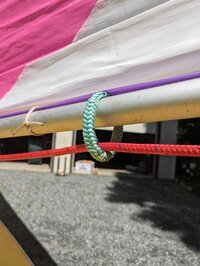
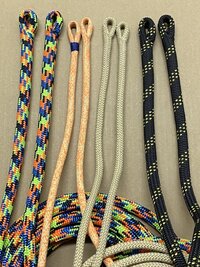
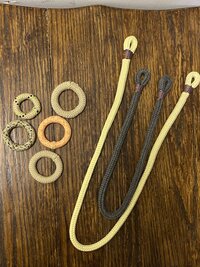
Show off them splices

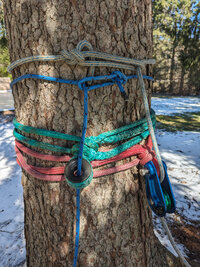
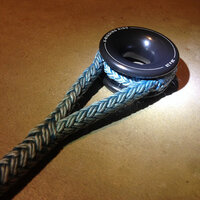
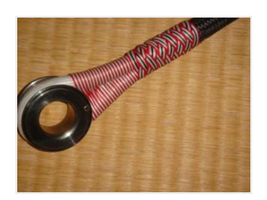
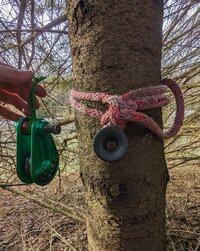
Somewhere in the distant past, I was taught to tie off a block as close to a spar as possible , and also to load a splice by terminating over the two long legs of the eye, leaving the throat to begin its bend as it lead around the spar.

Is it me or do some of these designs not really allow setting the ring tightly against the spar based on the principles above?

I’m not trying to say anyone is in danger, but maybe I’m also not aware of how these tools are being applied. G’head. Hammer me.
 
Somewhere in the distant past, I was taught to tie off a block as close to a spar as possible , and also to load a splice by terminating over the two long legs of the eye, leaving the throat to begin its bend as it lead around the spar.

Is it me or do some of these designs not really allow setting the ring tightly against the spar based on the principles above?

I’m not trying to say anyone is in danger, but maybe I’m also not aware of how these tools are being applied. G’head. Hammer me.
The pocket/chain/ultra sling can be sloppy sometimes, but I know a guy who always rigs off a block tied up with a running bowline, and doesn't re tie it for every cut. That gets really sloppy sometimes, and I haven't seen any serious harm come of it.
 
Last edited:
Somewhere in the distant past, I was taught to tie off a block as close to a spar as possible , and also to load a splice by terminating over the two long legs of the eye, leaving the throat to begin its bend as it lead around the spar.

Is it me or do some of these designs not really allow setting the ring tightly against the spar based on the principles above?

I’m not trying to say anyone is in danger, but maybe I’m also not aware of how these tools are being applied. G’head. Hammer me.
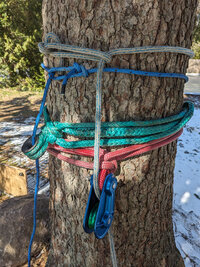
Far as I know, the principle of using the long splices for blocks comes from double braid slings. I'm not sure how it applies to Tenex and brummels. I would be surprised if the principle applies the same way. The way the DB splice is made, it's really hard on it to bend it sideways. Tenex just feels different, at least to me. Can't splice any size ring with a long-leg splice, unless you girth hitch it, which cuts into the strength of the setup.

As far as slop in ring setups, I don't see it as any more slop than with the big blocks...

PXL_20240324_154208584.jpg
PXL_20240324_154221013.jpg
 
Last edited:
Far as I know, the principle of using the long splices for blocks comes from double braid slings. I'm not sure how it applies to Tenex and brummels. I would be surprised if the principle applies the same way. The way the DB splice is made, it's really hard on it to bend it sideways. Tenex just feels different, at least to me. Can't splice any size ring with a long-leg splice, unless you girth hitch it, which cuts into the strength of the setup.

As far as slop in ring setups, I don't see it as any more slop than with the big blocks...

View attachment 93252
View attachment 93254
Hollow braid is definitely a different beast than double braid, but bending a throat will still alter the tension of the fibers within. I’m mostly thinking about what a lock stitch would experience in a hollow braid splice. They function as a lock under no load but also as an indicator of being overloaded.

I began with blocks and went to almost all rings for maybe close to 5 years, but then went to mixed blocks/rings for a few reasons. Lots of span rigs and lifting scenarios and less blocking down spars after the spider crane came into play.
 
I thought the reason for having long splices was to add more rope in the system. Two parts of line at the choke point instead of one spreading the wear and tear over two parts instead of one. “Two is one, one is none” philosophy I guess.
 
I thought the reason for having long splices was to add more rope in the system. Two parts of line at the choke point instead of one spreading the wear and tear over two parts instead of one. “Two is one, one is none” philosophy I guess.
That’s a bit of the idea as well. A while ago I made an effort to set a long eye around a ring that wouldn’t allow the ring to fall out. Not sure if it was in this thread or not. Maybe I can dig up the photo…
 
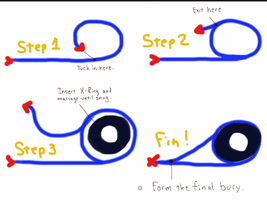
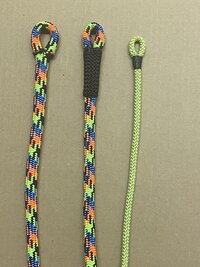
While trying to figure out how a Lankhorst A3 splice is done, the splicing is all done in the eye, I came up with another way to make eyes in the twisted parallel cored ropes. Xstatic’s break strength is 7192 lbs, the left one broke at 6031, and the other, which had a foot and a half feet piece of 3mm Amsteel in the eye, at 6621.
IMG_6764.jpeg
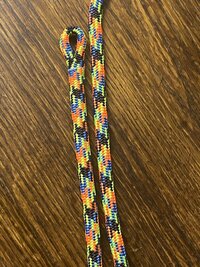
After sending the two never nude naked eye spliced examples in to be tested, I thought of another method to give a better looking end result, might be a little stronger also.
IMG_6798.jpeg
 
Last edited:
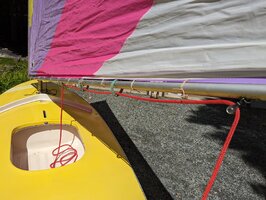
View attachment 95151View attachment 95150
I picked up a cheap old sunfish on a whim a couple weeks ago. She was in sorry shape but the hull is tight and I've been replacing the parts as I need to. Today I made these main sheet hangers, to keep the line from drooping on tacks and snagging my hat.
I made one of those for a loop to hang my weed whacker on the harness. I was enamored with the idea of a clean loop of rope
 
Branching out into the exciting, fast paced, ever changing world of fashion, also?
View attachment 88814
I made a belt out of webbing and plastic buckles hoping to avoid removing it for airport security. Nope. They didn't like the plastic buckles. Didn't care that there was no metal in it. It set off the detector (the one you stand inside with your arms up in the air). Maybe rope rings would work? Is there any stiffener inside the rings?
 
I made a belt out of webbing and plastic buckles hoping to avoid removing it for airport security. Nope. They didn't like the plastic buckles. Didn't care that there was no metal in it. It set off the detector (the one you stand inside with your arms up in the air). Maybe rope rings would work? Is there any stiffener inside the rings?
I tried to stiffen some cord up enough, but at the time wasn’t successful, put some cover on a non welded steel d ring instead.
Recently came up with a way by bringing the ends inside itself to the middle, add as many twisted strands as possible, and sew the ends together.
IMG_7083.jpeg
 

New threads New posts

Kask Stihl NORTHEASTERN Arborists Wesspur TreeStuff.com Teufelberger Westminster X-Rigging Teufelberger
Back
Top Bottom