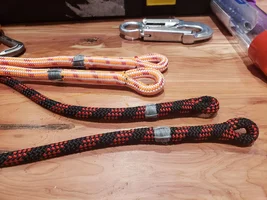
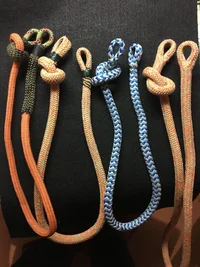
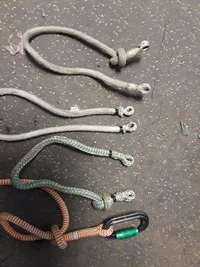
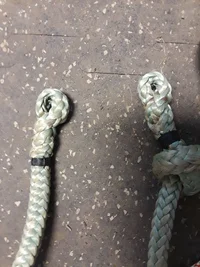
Show off them splices

Yes.. you have a very good point about the toss wand.. i didn't even think of that.. I also never used one.. i don't get the impression your supposed to go very hard yanking & wanking with them..lol.

Soft Fid -
I typically just use the wire to penetrate cover & feed the soft fid through.. Then I feed the soft fid into the wire fid just like you would a core or cover bury, it's nothing size wise so it glides right through the bury. (It's literally a 10 second process.) The actual stuff i use isn't even arb or rope splicing related.. it's expandable sleeving for electrical wire.. Advantages of this compared to a legit brand name soft fid are, it's plastic so it slides through buries pretty good, it can expand way larger than what you usually need, it will also finger trap/shrink down pretty damn small as well, it's pretty damn strong, i have yet to snap my original 3ft peice anchored off while yanking like a brute... & lastly, it's dirt frigging cheap as oppose to some over priced soft fid from d-splicer.. Usefull sizes are 1/8", 1/4", 1/2" & then possibly next size up for 3/4 - 7/8ths rig rope splicing. I think i use 1/4" the most for 8mm-13mm cordage. I do all my automotive wiring with this stuff to keep a clean/oem appearance, so i just happen to have a bunch of it to fit write sizes 18ga to oversized 000ga. I think Pepboys has it in their laughable "go-fast" section, but it's way overpriced. It's Amazon for the win on this one.. only 5-10 bucks.

Definitely, try it.. it's one of those things where you'll say "wtf, why didn't i think of that!!!"
I just got on the McMaster-Carr website and they sell expandable sleeving in many different material types and diameters and in lengths ranging from 10-1000 foot rolls.
 
I just got on the McMaster-Carr website and they sell expandable sleeving in many different material types and diameters and in lengths ranging from 10-1000 foot rolls.
Yes.. there's a gazillion different types including a lot of the same materials we use in cordage.. Technora, Nomex, Fire resistant, Fire Proof... Some of it can get very expensive as you go up in size (think space shuttles etc). But in reality, it's basically just a braided cover.. For this use though, all you need is a cheapo PET version.. that is unless you can find a material that slipperier.. did i just make that word up?

Velocity eye splice

Teufelberger sirius 10mm

Haha.. Ironic.. i literally just finished up a couple Multi-Slings..


Question to those who push the splicing envelope -
Is it possible to get the flexibility out of a normal db splice somewhat similar to what you get out of a sewn eye..?

Do we have to pack as much cordage as we normally do into that bury in order to get legitimate break strengths? I think of this in terms of general cordage strength, whereas cordage will usually break wherever there is a deviation/disruption in it's size, right? If someone was to try & make the splice somewhat similar to the size of the cordage , would that be stronger or weaker than a jam packed swollen splice?

If i wanted to slim the splice down to make it more flexible & there is indeed a compromise with that, could i counteract that by measuring a longer fid length in the first measuring step to allow for a longer super tapered bury in the end? Could i do that without throwing all of the other measurements out of wack? My thought is to go full fid, maybe more, on the bury, but have it be super thin/tapered & flexible..

These are just my thoughts/qeustion.... I'd much rather just do everything normal & then go super slim in the tapers like some of my prespliced hitch cords seem to be.. However, other hitch cords i have are your normal swollen/hard splices, so if all things prespliced are supposed to be legit, deductive reasoning would say the slim/flexy tapers/splices are ok.. I just don't know what to think & haven't seen much talk about this particular topic..

 
Yes.. there's a gazillion different types including a lot of the same materials we use in cordage.. Technora, Nomex, Fire resistant, Fire Proof... Some of it can get very expensive as you go up in size (think space shuttles etc). But in reality, it's basically just a braided cover.. For this use though, all you need is a cheapo PET version.. that is unless you can find a material that slipperier.. did i just make that word up?


Haha.. Ironic.. i literally just finished up a couple Multi-Slings..


Question to those who push the splicing envelope -
Is it possible to get the flexibility out of a normal db splice somewhat similar to what you get out of a sewn eye..?

Do we have to pack as much cordage as we normally do into that bury in order to get legitimate break strengths? I think of this in terms of general cordage strength, whereas cordage will usually break wherever there is a deviation/disruption in it's size, right? If someone was to try & make the splice somewhat similar to the size of the cordage , would that be stronger or weaker than a jam packed swollen splice?

If i wanted to slim the splice down to make it more flexible & there is indeed a compromise with that, could i counteract that by measuring a longer fid length in the first measuring step to allow for a longer super tapered bury in the end? Could i do that without throwing all of the other measurements out of wack? My thought is to go full fid, maybe more, on the bury, but have it be super thin/tapered & flexible..

These are just my thoughts/qeustion.... I'd much rather just do everything normal & then go super slim in the tapers like some of my prespliced hitch cords seem to be.. However, other hitch cords i have are your normal swollen/hard splices, so if all things prespliced are supposed to be legit, deductive reasoning would say the slim/flexy tapers/splices are ok.. I just don't know what to think & haven't seen much talk about this particular topic..

I just did a couple hitch cords that turned out super supple. They were ice tail and hrc. So, not typical double braids of course. I did both with a brumel, the ice tail with very long overlapping burys to make it thicker and hoping it would hold round better, and the hrc with naked eyes and normal length burys. Not exactly what you are talking about, but the result was the suppleness you are looking for. Then I put a single eye on a long length of 10mm ocean to use with my captain hook. The ocean splice has a very hard and long throat which made me wonder how anyone would use that as a hitch cord. I will post pictures when I get a chance.
 
I just did a couple hitch cords that turned out super supple. They were ice tail and hrc. So, not typical double braids of course. I did both with a brumel, the ice tail with very long overlapping burys to make it thicker and hoping it would hold round better, and the hrc with naked eyes and normal length burys. Not exactly what you are talking about, but the result was the suppleness you are looking for. Then I put a single eye on a long length of 10mm ocean to use with my captain hook. The ocean splice has a very hard and long throat which made me wonder how anyone would use that as a hitch cord. I will post pictures when I get a chance.

I don't want my question to get buried, but i have to ask..
Did u use different instructions for the Ocean or something? If everything is the same, the stiffness & length of the throat is going to be determined by how your going about your tapers & buries. Yeah, some will end up stiffer, but that's where you vary your techniques/tapers/bury lengths etc.. Oddly enough g not to discount your difficulty, but i find Ocean to be one of the easiest to splice. The cover is very forgiving in my opinion. (I use @NickfromWI method on the cover).

Generally speaking & side from my question in last post, I'll do very short buries on hitch cords (short fid) just to have a longer useable middle section.
 
I don't want my question to get buried, but i have to ask..

Did u use different instructions for the Ocean or something? If everything is the same, the stiffness & length of the throat is going to be determined by how your going about your tapers & buries. Yeah, some will end up stiffer, but that's where you vary your techniques/tapers/bury lengths etc.. Oddly enough g not to discount your difficulty, but i find Ocean to be one of the easiest to splice. The cover is very forgiving in my opinion. (I use @NickfromWI method on the cover).

Generally speaking & side from my question in last post, I'll do very short buries on hitch cords (short fid) just to have a longer useable middle section.
I found the splice to be pretty easy too. Perhaps I should say it was long and hard for a hitch cord. I've never had a 10mm hand spliced double braid hitch cord, so maybe it came out totally normal, it just suprised me people can use that, or I thought there is another way. I used the nick wi taper method and samson double braid measurements.
 
I’ve had some success in the flexibility, but haven’t had them tested for strength.
BE9F8D47-EE7F-4FC0-9065-807119F7BF0F.webp
The first, a class II locked brummel and bury, would be strong as only the cover is changed, by sewing on a larger cover over the splice area. The next two are cover only splices that have overlapping tails. The last one has the core taper reduced to half the strands before the eye, the core and cover are locked brummeled together after the eye, and tapered and buried.
 
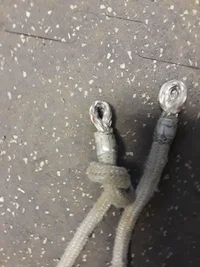
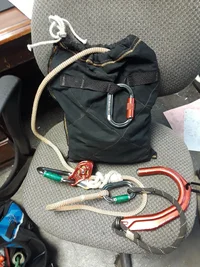
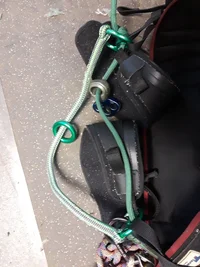
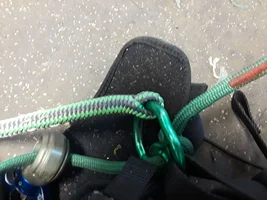
Hrc naked eyes, ice tail brumel and long overlapping burys to add girth and hold round better, and my new captain hook setup with 50 ft. of ocean in a bag I made. Knots tied to show flexibility of different splices.
Btw, What do we use to coat naked eyes and how important is it to do so?
20191007_120513.webp20191007_120532.webp20191007_120524.webp20191007_122157.webp
 
I’ve had some success in the flexibility, but haven’t had them tested for strength.
View attachment 62699
The first, a class II locked brummel and bury, would be strong as only the cover is changed, by sewing on a larger cover over the splice area. The next two are cover only splices that have overlapping tails. The last one has the core taper reduced to half the strands before the eye, the core and cover are locked brummeled together after the eye, and tapered and buried.

The Epi furthest to the right, is that the result of the method you sent me a diagram of?

Assuming you understood my question a couple posts back, would you rather stick with the method you outlined in that drawing or try what i mentioned about long but very slim tapers.?
I feel your outline would be more reliable/safe assuming my idea is not recommended.

I'm suprised you haven't had that method tested considering the amount of stuff you follow through on breaking.
 
Oh yea, I did this too. Samson hawkeye, 11 inch overlapping burys plus 6 inches on each side of the overlap area. I tried 2 inches on each side but I couldn't milk the burys back in the whole way. It was very tight (and thick) and I doubt it would have ever come apart, but I wasn't comfortable with it not being right. So this is try #2 and it all came out right.
20191007_121921.webp20191007_121929.webp
 
Oh yea, I did this too. Samson hawkeye, 11 inch overlapping burys plus 6 inches on each side of the overlap area. I tried 2 inches on each side but I couldn't milk the burys back in the whole way. It was very tight (and thick) and I doubt it would have ever come apart, but I wasn't comfortable with it not being right. So this is try #2 and it all came out right.
View attachment 62706View attachment 62707
I thought hand spliced bridges were a no-no..??? Something about constantly working the ring over the splice area & working it free... Basically the same "no-no" principles applied to a splice anywhere else..
 
I thought hand spliced bridges were a no-no..??? Something about constantly working the ring over the splice area & working it free... Basically the same "no-no" principles applied to a splice anywhere else..
I've been warned, but I've never accualy heard of anyone doing it, or any failures. I previously did a much longer bridge with double braid and it never budged, but much different splice of course. I couldn't make it short enough to not suck with double braid. I only use it for my captain hook or a secondary tie in, never my primary. In the mean time, I watch it like a hawk (eye) no pun intended. There was a thread I started discussing the hand spliced bridge.
 
The Epi furthest to the right, is that the result of the method you sent me a diagram of?

Assuming you understood my question a couple posts back, would you rather stick with the method you outlined in that drawing or try what i mentioned about long but very slim tapers.?
I feel your outline would be more reliable/safe assuming my idea is not recommended.

I'm suprised you haven't had that method tested considering the amount of stuff you follow through on breaking.

Yes, I tapered the core below the eye to half diameter, locked brummelled the cover and tail, and buried them in the taper reduced core. I did have one splice like it tested, but didn’t reduce the core for flexibility. It was slightly more than 90% of the rope break strength.

The long, thin tail might work, but it would expand the cord making it stiffer, a looser cover like Beeline or HRC might not be as affected. There is also the problem not reducing the core too abruptly, and still be flexible.
 
Yes, I tapered the core below the eye to half diameter, locked brummelled the cover and tail, and buried them in the taper reduced core. I did have one splice like it tested, but didn’t reduce the core for flexibility. It was slightly more than 90% of the rope break strength.

The long, thin tail might work, but it would expand the cord making it stiffer, a looser cover like Beeline or HRC might not be as affected. There is also the problem not reducing the core too abruptly, and still be flexible.

Thanks for the update Brock..
Your thoughts on that make sense. I will eventually get around to trying that outlined method.. it's very very interesting, but it's one of those things where i need to sit down & plan the process out.. 90% is still an impressive number regardless if it's flexible, i think your into something.

I know this has been posted somewhere on here but, are we cool to do regular class 1 db eyes in those two referenced cordages (Beeline / HRC)? I've never really understood the benefit of the naked version.. I've also never used either so that may be why.. At one point was it thought to be the only acceptable way to splice them or something?


Side note- it will be nice if manufacturers could post individual strengths of cover & cores.. I think it would lend a much deeper understanding of what you can or cannot get away with.
 
Those two are class II as far as I know. The naked eyes is a easy way to be able to do locked brummels on both ends, with the cover going on last. Doing covered eyes is comparable to splicing both ends onto a ring, the second eye is a challenge.
 
Those two are class II as far as I know. The naked eyes is a easy way to be able to do locked brummels on both ends, with the cover going on last. Doing covered eyes is comparable to splicing both ends onto a ring, the second eye is a challenge.

Right Right.. DB rings can definitely become a pain. I definately struggled on my first couple.. both 12 strand as well as DB

These are the covered beeline splices that promted the question..

S190190-16.jpg


Ironically, in the photo you can see the exit markers on the cover... Whatchya think.. does that look like a class 2 bury length or just a long class 1?
 
Right Right.. DB rings can definitely become a pain. I definately struggled on my first couple.. both 12 strand as well as DB

These are the covered beeline splices that promted the question..

S190190-16.jpg


Ironically, in the photo you can see the exit markers on the cover... Whatchya think.. does that look like a class 2 bury length or just a long class 1?

Just looking at the pic and the green markers, but my thought is that is the exit point for the opposite eyes and there is a tapered cross over to keep diameter more uniform. ??
 
Hey Joey you may be right about someone saying they were doing Class I splices on Beeline. The cord in the picture doesn’t look like the buries were overlapped, so the green marks might be were the core exits on a Class I double braid splice.
 
Hey Joey you may be right about someone saying they were doing Class I splices on Beeline. The cord in the picture doesn’t look like the buries were overlapped, so the green marks might be were the core exits on a Class I double braid splice.

Yeah.. i heard it somewhere here first a while back, then just happened to see it for sale like this a couple times since.. I just can't tell if it looks like a class 2 db bury there... Those marks do look kinda far away from the throat for a typical 8mm Long Fid bury, but 2x's the length idk. (Im going off the premise class 2 db's use 2x the fid length on buries). Maybe they just found a happy medium that's a bit longer than normal.
 

New threads New posts

Kask Stihl NORTHEASTERN Arborists Wesspur TreeStuff.com Teufelberger Westminster X-Rigging Teufelberger
Back
Top Bottom