Show off them splices

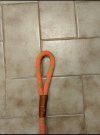
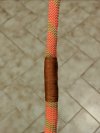
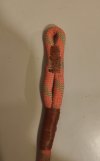
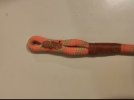
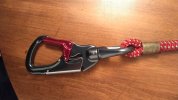
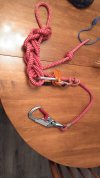
My first successful splice. This one is just some dock line for the boat. I seriously doubted the part where the sheath goes into the core would ever bury into the line, but after cranking on it and pulling my table across the warehouse, damn if it didn't seat! Have to say it is a really satisfying feeling of accomplishment. I know I have a long way to go to come anywhere close to the beautiful splices I have seen here, but that is what makes this thread such a great resource. Something to always strive toward.

The rope was purchased on eBay years ago and was listed as 1/2" Double Braided Multifilament Polypropylene (MFP) Dock Line. I don't know how to tell how many strands it has, or much else for that matter. :)
splice.jpg
Whiplash.jpg
 
Last edited:
My first successful splice. This one is just some dock line for the boat. I seriously doubted the part where the sheath goes into the core would ever bury into the line, but after cranking on it and pulling my table across the warehouse, damn if it didn't seat! Have to say it is a really satisfying feeling of accomplishment. I know I have a long way to go to come anywhere close to the beautiful splices I have seen here, but that is what makes this thread such a great resource. Something to always strive toward.

The rope was purchased on eBay years ago and was listed as 1/2" Double Braided Multifilament Polypropylene (MFP) Dock Line. I don't know how to tell how many strands it has, or much else for that matter. :)
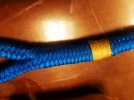
View attachment 79980
View attachment 79981
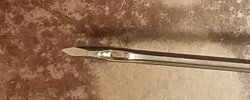
Looks way better than my first splice. If remember correctly, the Speedy Stitcher comes with needles that have a triangular cross section where the edges are sharp. I could be wrong about that, but if I'm right those edges tend to cut fibers when you push the needle through. You can get a round point needle to replace the triangular ones, but you need to grind down the shank to get it into the Speedy Stitcher. Am I correct in this?
 
Looks way better than my first splice. If remember correctly, the Speedy Stitcher comes with needles that have a triangular cross section (where the edges are sharp. I could be wrong about that, but if I'm right those edges tend to cut fibers when you push the needle through. You can get a round point needle to replace the triangular ones, but you need to grind down the shank to get it into the Speedy Stitcher. Am I correct in this?
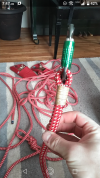
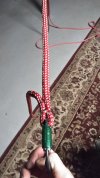
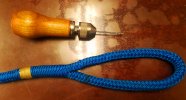
Thanks for the heads up. The body is smooth, but you are right; the very tip is a triangular wedge (chisel point?). Is even that too much? I have some large needles somewhere. I can easily smooth the current needle on my belt sharpener and polish it up like glass (with a rounded point).
20220126_173026~3.jpg
 
Last edited:
Looks way better than my first splice. If remember correctly, the Speedy Stitcher comes with needles that have a triangular cross section where the edges are sharp. I could be wrong about that, but if I'm right those edges tend to cut fibers when you push the needle through. You can get a round point needle to replace the triangular ones, but you need to grind down the shank to get it into the Speedy Stitcher. Am I correct in this?
You're correct. All the info can be found in one of @moss threads titled "Documenting my hand-sewn eye process. "
 
Ball tipped is the term used. Being polypropylene makes it harder to splice than nylon and polyester, it is almost like a weak Velcro, just doesn’t want to slid easily. Nice job, but is that a mark about an inch from the throat?
 
Last edited:
Ball tipped is the term used. Being polypropylene makes it harden to splice than nylon and polyester, it is almost like a weak Velcro, just doesn’t want to slid easily. Nice job, but is that a mark about an inch from the throat?

Yes, that is probably my original eye mark. :) This is just a practice splice, the first I was ever able to get to actually work. Thank goodness this is harder to splice than polyester. I almost gave up after several tries and two different very sticky cheap boat ropes.
 
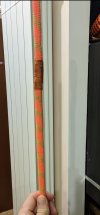
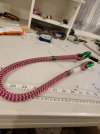
Yale safari 48 kernmantle class II Tuck splice e/ Samson II whipping + cinching sewn eye setup

Credit Brooky&Moss
 

Attachments

  • IMG_20220128_212248.jpg
    IMG_20220128_212248.jpg
    230.5 KB · Views: 31
  • IMG_20220128_212308.jpg
    IMG_20220128_212308.jpg
    99.8 KB · Views: 27
  • IMG_20220128_212330.jpg
    IMG_20220128_212330.jpg
    70.2 KB · Views: 29
  • IMG_20220128_212345.jpg
    IMG_20220128_212345.jpg
    51 KB · Views: 32
  • IMG_20220128_212359.jpg
    IMG_20220128_212359.jpg
    37 KB · Views: 33
Yale safari 48 kernmantle class II Tuck splice e/ Samson II whipping + cinching sewn eye setup

Credit Brooky&Moss

That's a cool splice. On a double eye, how much strength do you need between the two eyes? I'm thinking the sewing could fail between eyes but not drop you to the ground, just rattle your two carabiners, or whatever, together before you recover.
 
That's a cool splice. On a double eye, how much strength do you need between the two eyes? I'm thinking the sewing could fail between eyes but not drop you to the ground, just rattle your two carabiners, or whatever, together before you recover.

The eye splice is 5"ish. Sewing is tested with a 400lbs static load for 10'. Climbing on that cinching setup style for an year now with a completed sewn eye, no troubles.
0,9mil 3strands poly thread rated@ 60lbs/Mt.
 
Whipping line size and material: Reading the Samson whipping instructions, this jumped out at me:

"The twine used should be approximately twice the diameter of the strands in the rope."

I see that we don't do that here. It looks like we use much smaller diameter twine. At least that's what my rookie eye is seeing. Again, first year climber (not yet a year actually), so I apologize for my ignorance. Why are the splices posted here using much smaller twine?

They also recommend braided nylon twine, with polyester as an option. Poly is far less effected by sunlight, is hydrophobic, almost as strong, and doesn't dramatically stretch when wet. Shouldn't poly be first choice?

Next question. Samson shows two whipping methods plus a lashing method in their book. Is choice based on personal preference, or is this rope and splice-type dependent?
 
"The twine used should be approximately twice the diameter of the strands in the rope."

It should be twice the diameter of a single strand if you have a double carrier sheath.
Lay down your whipping twine on the rope and check if the diameter is as wide as a single/double strand.

"They also recommend braided nylon twine, with polyester as an option*

Ain't recommend, is preferred. Braided is better definitely.

As of the whipping method, I'd been taught method 1 for class one ropes , method 2 for class 2 with jacket.

My two penny worth!
 
No I pulled desperately to get enough cover taper but I'll never go that short again. I meant to be 3+" longer but didn't account for the length lost due to getting wider at the splice throats
Damn! Desperately might be an understatement. Shortest I’ve made is 5’ and that is the shortest I’d comfortably go.
 

New threads New posts

Kask Stihl NORTHEASTERN Arborists Wesspur TreeStuff.com Teufelberger Westminster X-Rigging Teufelberger
Back
Top Bottom