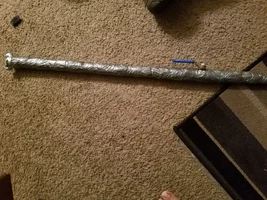
Shop made RCX tool :Home Spade Homespade Shopspade

I measured the efficiency by how much soil I could break up and blow out of the hole in a given time. There weren't any stopwatches used. Just observational.

It shouldn't be hard to add a water injector. Just another hose to drag around.

What pressure is needed to be effective? Is household/hose-end pressure enough or would we need a pressure washer to up the water pressure?

When I hve time I'll put up pictures.
 
I didn't run either tool because the school probably would not have liked that, but watching Tom I did not see much, if any, difference between the tools. In fact, though I hate to admit it, I think Tom's might have worked better.

We talked about another experiment next time I have a RCX. I am going to test the two against each other on a 185 cfm compressor, on the theory that the bigger compressor is able to push more air through the unrestricted nozzle (we were only using one tool at a time for this test).
 
Regarding the water and air tool combo. Household pressure is all you need. I've used the AK water tool, the first one ever built, and you only need the slightest trickle of water to eliminate dust. A little more water and you can start to hydrate and break up the driest soil.

As far as the home made tool and nozzle issue.
(I may get into a heap of trouble here as my boss is the AK distributor)
I ran our AK this winter until the nozzle froze solid. I took it off and set it by the exhaust to melt the ice. Well I forgot to put it back on and started blowing. (we use air to dig holes for tree planting). I could not believe how much more effective the tool was with out the tip.
I would compare the difference to using the "big gun" versus the regular tool.

How heavy is your homespade?
 
I'll weigh the HS and let you know.

Keith brought along his length of lightweight hose to add to the end of the thicker hose. Since the air pressure pushes back on the tool I never really felt any 'weight' when I didn't have the lighter hose. Keith and I talked about the difference though. We both agreed that the difference may become more evident after a whole day of spading.
 
very interesting tom . why do you think a ball valve is better then a gate valve ? a gate valve will have more play then a ball valve . there is a store called grainger not sure if you have that store where you are but you can order online .they have all kinds of stuff i bet you could find a spring loaded ball valve there .
 
Yep i found a spring loaded ball valve on Grainger but the price is $155. (http://www.grainger.com/Grainger/APOLLO-Ball-Valve-3EEZ6?Pid=search)

Up until reading this thread i didn't bother asking my boss for an RCX tool as i knew it would be shot-down. I work at a small (~80 acres) Christian university and the landscaping budget is on of the first to go. About 90% of the trees planted in the last decade have girdling roots on them. They were probably the cheapest trees at the time (lowest quality).

What PSI do these tools run at?
 
Ball valves are more efficient. They are smooth and flow more air.

I couldn't find a spring loaded ball valve. The counter guy at Grainger's was clueless
frown.gif


Spring loaded gate valve

Air pressure is only a small part of the issue. Volume is a big issue too. We ran two HomeSpades so we had a 375 CFM/100psi rental unit.

What worked well was to have one of the 1/4" nozzles on one HS to break up the soil and then other without any tip, just straight 3/4" pipe to deliver volume to 'sweep' or loft the debris out of the root zone pit.
 
I'm glad this thread got dug up. I'll be adding a home spade to my to build list!

Likewise - Whole new range of possibilities........... ! Also very much appreciate the range of input from the people who have used, made and compared these tools. Thank you.

I may try some agricultural "plastic" irrigation pipe slid over the metal pipe to act as insulator; maybe sealed with a slow flow of water through the pipe for cooling and feeding water to the tip. A side mounted handle from e.g. hammer drill on the pipe would help for pointing accuracy. Weight could become a problem but, as Tom said earlier, some of the weight is relieved by the back pressure of the air flow from the tip.

Cheers Peter
 
Last edited:
Am I correct in thinking that the orginal air spade wand is made out of some sort of non electrical conductive material. The much larger industrial share of these tools are used to find buried utilities or at least thats what i always thought.
 
Good luck! I never really understood why the tool is so expensive. I know the nozzle was designed by a NASA guy etc., etc. But the nozzle is not made of gold. After all its just a stick that blows air!
AirSpade/Air Knife cost a lot because they've been through the testing necessary for the manufacturers to be insurable. I dare say that if you took the time to ask your insurance agent what your GL underwriting company thinks of you utilizing a homemade pneumatic excavation device operating off 185 CFM or more at 150 PSI, you'd soon find yourself paying for an air spade over and over again in increased insurance premiums. Should the use of that homemade tool result in any kind of injury or damage, don't be surprised if your insurance company walks away from it.

If any pneumatic excavation work you've done on a tree ever comes into question in a tort issue, or forensic product related to an inspection done with the tool, you can count on spending lots of time explaining why you're not using one of two widely available industry-standard tools for pneumatic excavation.
 
AirSpade/Air Knife cost a lot because they've been through the testing necessary for the manufacturers to be insurable. I dare say that if you took the time to ask your insurance agent what your GL underwriting company thinks of you utilizing a homemade pneumatic excavation device operating off 185 CFM or more at 150 PSI, you'd soon find yourself paying for an air spade over and over again in increased insurance premiums. Should the use of that homemade tool result in any kind of injury or damage, don't be surprised if your insurance company walks away from it.

If any pneumatic excavation work you've done on a tree ever comes into question in a tort issue, or forensic product related to an inspection done with the tool, you can count on spending lots of time explaining why you're not using one of two widely available industry-standard tools for pneumatic excavation.

As much as it hurts my heart, I know all of this to be true.
 
I have a question for you air spaders... Do you ever use partial "throttle" on the spade or do you always run it wide open?

I'm asking because I'm thinking of building one using a 12v solenoid operated ball valve. Should be pretty easy with a 9 volt battery and a toggle switch. Valves are cheap too, 3/4" full port stainless ball valves are under $35 on eBay. Downfall is it will only be on or off and nothing in between.
 
I think you'll find that a 12V gel cell battery in a fanny pack is what you'll need. A small, 1A battery maintainer will keep it charged up between uses.

I have several homebuilt air spades, all but one of which were made for other uses (blowing the ballast off old, BUR flat roofs before tearing them off, etc.) and I start with 3/4" galvanized plumbing pipe and use reducers to drop it to 1/2", 3/8" and finally 1/4" and no tip of any kind. The main section is usually 3' long, then 6" for each of the intermediary sizes, and 12" for the final, 1/4" piece. The venturi effect created gives some pretty impressive velocity. We always ran these on tow-behind, commercial compressors with a minimum of 125 cfm and we've used them up to 200 psi without incident.

My understanding of tort law is a little different than some people's I guess. Any damage you can do with one, commercially built or otherwise, you can easily do with the other. Proving that a device caused damage simply because it was homebrew might prove a lot harder than you think.

On the other hand, if it blows up in your face, you won't have anyone to file an obnoxious tort claim against. ;)
 
I think you'll find that a 12V gel cell battery in a fanny pack is what you'll need. A small, 1A battery maintainer will keep it charged up between uses.

I'm going to guess that a 9 volt or a pair of them will do the trick. I'll just plan on using new ones for each job. If it doesn't, well fanny pack it is I guess. But I'd have to imagine that would suck. Just wearing a fanny pack alone would feel like torture, then add in heavy battery bouncing around and slapping your sack. Yikes! Yep if the 9v won't do it I'm sure I'll pull something out of my sleeve!
 
Full port ball valves on all but one. Butterfly valve on one of them... you can get a real strong blast of air out of it by jerking that thing open real fast. Not unlike the APTA. The ball valves work much better, as mentioned, for smoother control of the air flow if you're not running it wide open.

In prepping roofs for a fully adhered membrane or urethane coating, we would power wash the roof first. You can dry the roof off in about an hour with one of these, on a warm day. They'll blow about 95% of the water right off the roof, saving us a lot of time. Will also clean out the gutters real quick. I used one of these and a leaf blower to clean up a property we were going to re-landscape. Leaves and crap had piled up in the bushes and against the house. We just blew it all out into the street and bagged it up.
 

New threads New posts

Back
Top Bottom