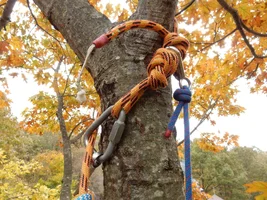
Secondary tie-in for spurring: choked split-tail climbing line -OR- running bowline -OR- ??

What knot it's that exactly? I was thinking it could be done with a bowline on a bight, forming two loops.

It'll work more smoothly than untying and retying a running bowline each time I'm passing a limb probably, correct?

Edit: Or maybe not. Need to practice tying one of those over and over.

The knot you pictured is most likely a figure 8 double loop. https://www.animatedknots.com/fig8loopdouble/ but there are other double loop knots that are similar. They work but are bulky.


Untying and retying your climbing line for every branch you need to pass, is a terrible idea.

For passing limbs, a compact knot that will grip a link, https://www.netknots.com/rope_knots/scaffold-knot be it a screw link or a carabiner is what I use and recommend.
 
Last edited:
The ONLY reason I had gone away from cinching with a carabiner is the side load issue, and the possible issue with it working open when in that sideways orientation (with respect to the direction of travel up the trunk).

Someone had suggested earlier in the thread using two carabiners oriented oppositely so that even if one was undone, the other would likely hold.

Will watch that video, BS, when I get to a WiFi connection. Thanks.
 
I see that the consensus seems to be that for a manually set TIP that can be visually inspected before committing to it, versus a remotely set TIP, a carabiner is fine (especially steel).

Never thought about the fact that I can just check and see if the biner is coming undone in the application I'm using it for (moving it with me up the trunk and back down again as a cinching connection to the trunk along with a steel core flipline).
 
The knot you pictured is most likely a figure 8 double loop. https://www.animatedknots.com/fig8loopdouble/ but there are other double loop knots that are similar. They work but are bulky.


Untying and retying your climbing line for every branch you need to pass, is a terrible idea.

For passing limbs, a compact knot that will grip a link, https://www.netknots.com/rope_knots/scaffold-knot be it a screw link or a carabiner is what I use and recommend.

Do you use a scaffold knot any time you are connecting to a carabiner in a life support context?
 
Yes. When tree climbing, you want to combine safe and simple as often as possible. The scaffold knot is both.

Thanks, man. Will give tying it a try tonight and see what it is.

Why is this knot mentioned very little in comparison (at least this is my perception at the moment) to the double fisherman's, anchor hitch, and buntline hitch for terminal attachment to carabiners? Am I reading dated material?
 
Hard to say. Both the anchor hitch and the buntline go back to the early days of tree work for attaching the rope to saddle, leaving enough tail to tie a friction hitch. I think that sometimes when you hear someone say double fisherman's they are actually referring to the scaffold knot.
 
This looks like a solution for being able to quickly unclip and reclip a choked TIP. Does anyone use this, or see a problem with using it in this manner? I'm asking since this was posted a while back. It looks like the biner isn't being cross-loaded, and this might actually be a good place to use a carabiner with one of the secondary wire gates in the bend to ensure it remains in the correct orientation.

WOW! That was almost six years ago. And yes, that was a "Double Figure 8 (Bunny Ears)" that I prefer to call an "88".

However, since then, for the past few years, I've progressed to using a Delta with a separate pull-down as my Fav TIP:

This is easy to set, advance & retrieve. It even cinches mid-stem. With the pull-down separate, both ends are available at the top. So, it's easier to move the TIP without having to "Yard-up" a lot of rope. You don't even have to be at the top to relocate the TIP. The pull-down can be lighter cordage but strong enough to allow escape if the work positioning rope is compromised. The Q-link is smooth enough to make a few redirects a little easier to pull out - similar to a "Texas-Tug". This method also makes "Double-Down" easy, since the end with a connector are at the top. The pull-down can be easily un-snapped and fastened to the harness during TIP relocation or Double-down.

44905856_1738859246223138_465015147065245696_o.webp
 
Last edited:
I think that sometimes when you hear someone say double fisherman's they are actually referring to the scaffold knot.

Yes exactly.. this makes things very conveluted.. they are tied very similar, where you form a couple wraps around the standing end.. & end up tucking the tail through the loop you just formed.

Sometimes the only difference between two knots can be as simple as an additional loop or wrap.. yet they have different designated names.. For example.. this Double Fisherman's you always hear about is actually a "Bend".. that's why you'll only find official illustrations it being shown as a bend. The Scaffold just incoperates a bite of rope.

If you actually look up the Double Fisherman's... you won't find it anywhere listed with a loop... not on the typical knot com's anyways.. you'll only see it referenced fisherman's loop in "non-official places". At the knot com's, its always referenced as a Scaffold.. & even if you search the term the double fisherman's loop is always shown as a "bend"
 
Yes. When tree climbing, you want to combine safe and simple as often as possible. The scaffold knot is both.

This blows my mind. I 100% believe you, but unless I'm pretty terrible at noticing patterns, this simple simple information you just gave me is difficult to find. Judging by the likes on your comment about the scaffold knot, it appears that there is a pretty good consensus that the scaffold knot is the one to use for attachment to biners/snaps.

Does state-of-the-art change that often, to where knot information from 5yrs ago would be stale already?
 
Thanks, ghost. It appears that, tied wrong as he illustrates in the video there is no way it would hold of bodyweight was applied to it (i.e., giving one the false perception that the unit was tied properly).

"Circle of death": just now reading some about this and accident reports. When you guys start cutting big stuff in the trees (limbs or blocking down the spar), do you discontinue use of the hip D's and attach solely to the central D (or D's), or use a webbing strap around the spar, etc.?
 
ArborPod kinda shows standard practice more or less:
https: //www.youtube.com/watch?v=qAwf7hqgRxc
If the trunk is dead dry or really iffy (did a conifer with spiral cracks one time) I personally will ratchet strap it not just cinch up. But that's a pretty iffy piece of trunk. The extra time that strapping takes over what's shown in the video is always going to be less time than a trip to the ER. When you've done it a while you get a feel for the tree type and the condition of the wood you're on. Some trees you'd never be on a 4-5" stem, sometimes it's OK.
 
ArborPod kinda shows standard practice more or less:
https: //www.youtube.com/watch?v=qAwf7hqgRxc
If the trunk is dead dry or really iffy (did a conifer with spiral cracks one time) I personally will ratchet strap it not just cinch up. But that's a pretty iffy piece of trunk. The extra time that strapping takes over what's shown in the video is always going to be less time than a trip to the ER. When you've done it a while you get a feel for the tree type and the condition of the wood you're on. Some trees you'd never be on a 4-5" stem, sometimes it's OK.

Cinch up? Wouldn't pressure outwards in a cinch simply open it up?
 
... It appears that, tied wrong as he illustrates in the video there is no way it would hold of bodyweight was applied to it (i.e., giving one the false perception that the unit was tied properly)...

Videos like that actually drive me nuts. I have seen similar 'warning" videos on other knots also and as far as I can tell all they do is freak out newbies who will then try some other knot thinking it will be safer. The problem is "any" knot can fail if you tie it wrong or clip into the wrong loop.

Take the time to learn how to tie the knots you will be using; learn when and how to use them.
 

Ah, I didn't watch the first video before I responded; the cinched climbing line - if the tree splits downwards - would only expand to the friction hitch anyway since he's hooked into the center D ring. Makes total sense.

Videos like that actually drive me nuts. I have seen similar 'warning" videos on other knots also and as far as I can tell all they do is freak out newbies who will then try some other knot thinking it will be safer. The problem is "any" knot can fail if you tie it wrong or clip into the wrong loop.

Click-bait. If it's not even a scaffold knot, then it's not the scaffold knot that's "failing".
 
I've seen that video before.. It took me a few times to actually realize it, but the difference between the two ways being tied are compleley different methods..

In other words, you'd really have to fuck up tying it to have it come out like that.. & it's just a coincidence that they look the same in the end..

Also.. you really wanna freak out a new climber..? Show em that Facebook video of that huge old tree completely collapsing below the climber.... That was fucking wild shit!!!
Actually.. here it is..
 
Last edited:

New threads New posts

Kask Stihl NORTHEASTERN Arborists Wesspur TreeStuff.com Teufelberger Westminster X-Rigging Teufelberger
Back
Top Bottom