
I can't remember having run the HH on 12 strand but something still sounds fishy. I have never experienced any significant let alone permanent rope deformation from using the HH. Others yes but not the HH. It has more of a cupped surface than many other devices. The dogbone and carabiner are only on one side of that curved surface and the finale grip of the hitch is significant and has a re-rounding effect as the rope passes through it.

Navigation
Install the app
How to install the app on iOS
Follow along with the video below to see how to install our site as a web app on your home screen.
Note: This feature may not be available in some browsers.
More options
You are using an out of date browser. It may not display this or other websites correctly.
You should upgrade or use an alternative browser.
You should upgrade or use an alternative browser.
Secondary tie-in for spurring: choked split-tail climbing line -OR- running bowline -OR- ??
- Thread starter LordFarkwad
- Start date

Jehinten
Been here much more than a while
- Location
- Evansville
That looks familiar.Another way.. mechanical one side, minimalistic on the tail..
 @LordFarkwad if you were to try the hitch system on the left the captive carabiner is nice. It's only a little more expensive than a regular carabiner but keeps everything inline. The bulk hitch cordage is a cost saver as well. Compact and smooth
Jehinten
Been here much more than a while
- Location
- Evansville
I can't remember having run the HH on 12 strand but something still sounds fishy. I have never experienced any significant let alone permanent rope deformation from using the HH. Others yes but not the HH. It has more of a cupped surface than many other devices. The dogbone and carabiner are only on one side of that curved surface and the finale grip of the hitch is significant and has a re-rounding effect as the rope passes through it.
I haven't tried the HH2 on a 12 strand, but I do remember my yale 16 strand would hold a square shape. I cannot remember if it caused any issues as I haven't climbed on it for a couple of years and did not have my HH2 dialed in at the time.

Jimmycrackcorn
Participating member
- Location
- Boston
Yes.. i agree & can see why this is happening.. it's the first thing i thought off.. but why it won't pop back into shape is odd..The dogbone and carabiner pressing the rope against the spine of the HH compressed it into a rectangular shape which doesn’t generate enough friction for the hitch to hold. There are only four corners for the hitch to rub against, instead of the full surface of a round rope.
I’ve run the section of rope through a Prusik hitch, a pulley, and a Munter hitch without success. Next will be a hole in a 2x4 just big enough to pull it though, hopefully squeezing it back into shape.
Because they can’t be used to descend, the cammer ascenders would only flatten small, isolated spots that probably are able to recover. The HH, that can descend, affects a larger area.
Is it possible the fibers became elongated getting pancaked in there? Or something along the lines of when your splicing a coated 12 strand, end up snagging a couple stands & can never work them back to where it originally were? What happens if you milk it from 20ft away to that flat spot? Can you even proficiently milk that 12 strand, there is something inside right?
Yes. As well. I need to grab some of those.. they look like they work perfect with that setup.. i think the oval is key to it too.. pear & hms biners allow too much room & if it were captive would be on wrong end, then of course a biner that's too small makes the rope ride on top of the prusik tails, but the captive O from Rock - O... its just right..That looks familiar.
I came up with a way I've never seen before, but I'm not sure if it's actual integrity in a 911.. the pic is with real flexible 12 strand & a bad uneven e2e x-over splice, yet it was pretty smooth.. Regardless, I'm pretty sure a mushy DB would work as well if that's all someone had...

... but I do remember my yale 16 strand would hold a square shape...
Many ropes will become square or misshapen when weighted, even when using just a hitch.

Just took these to try to better show the flat sided area.
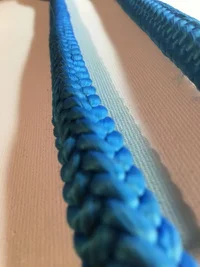
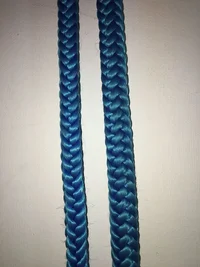
The carabiner being curved would force the rope into the groove more than the dogbone. One side is slightly concave and the other convex with aluminum oxide on that side from the HH spine.
The carabiner being curved would force the rope into the groove more than the dogbone. One side is slightly concave and the other convex with aluminum oxide on that side from the HH spine.

LordFarkwad
Branched out member
- Location
- Chatham Co.
I don't understand.. "it's not load bearing so it's a moot point"
What I meant was that I am not hanging on that snap at all. I just left it on there for absolutely no reason. I'm attached to the carabiner and the snap on the opposite end of the line.
I totally mucked that hitch on the lanyard that I initially tried to tie. I tried a distel on it just now and the distel won't catch on the rope - it freely slides both ways unless I make it catch by tightening down manually, then loading it. So that's a no-go.
The Prusik cord I'm using (again, on the lanyard, not the climbing line) becomes rock hard stiff approximately 3" from each sewn eye, and I don't know if that plays a part in the hitch not catching, but the pulley isn't able to reach the knot without those two stiff legs pushing upward towards the hitch itself.
LF, the tail of the rope coming out of the HH would normally go through the carabiner, which makes tending easier. Also, that is a lot of hitch wraps for that type and size of rope. You might want to play around with less and see if things work better.
Will do, DSM. It is tight.
Never seen hitchhiker or any new school multicender on 3 strand before. Does it twist and hockle the rope a lot when descending? Nothing really inherently wrong or dangerous with it though.
How are you retrieving the bowline after you descend?
Is some of this stuff making more sense now that you're putting theory into practice? See how the climbing line with the hitchhiker can double as your second lanyard until you reach your TIP? Have you tried a 540° wrap around the tree with the lanyard for some extra stability? It's a good idea when negative rigging tops and you're expecting a ride or anytime you want to make sure you'll stay put.
100% makes allot more sense. I am just spiking back down the tree. This was only supposed to be an emergency exit from the tree. Removals only. I imagine that if I wanted to descend on it and retrieve it, I'd just tie my throw line off to the loop and just bring it down from the ground. Sound reasonable?
Also, it isn't that much trouble moving the climbing RB up and down with me. I do like being tied in at least twice all the times. That was the original purpose of 3 connections to the tree (flipline, lanyard, and RB TIP).
That looks familiar.
I have a Pirate carabiner that has a wire gate that I can try that out with. Very minimalist. I like it. However, I'm unsure as to whether or not the stiff ends of the Prusik I'd mentioned before will preclude any type of hitch-tending arrangement working properly.
Thoughts?
Last edited:
The fixed length of your friction hitch cord is probably too long for the hitch you are trying to use. First try adding a wrap to the Distel, some hitches require an exact length of the eyes below the hitch to work properly. When a hitch is right the stiffness of the eyes become a bonus when tending slack.
LordFarkwad
Branched out member
- Location
- Chatham Co.
The fixed length of your friction hitch cord is probably too long for the hitch you are trying to use. First try adding a wrap to the Distel, some hitches require an exact length of the eyes below the hitch to work properly. When a hitch is right the stiffness of the eyes become a bonus when tending slack.
I might can squeeze one more in there. We'll see.
If that doesn't work, do you have any recommendations?
Also, got a solid recommendation on hitch cord and climbing line I should go with, having witnessed my ongoing saga via this thread?

Evo
Been here much more than a while
- Location
- My Island, WA
Can't go wrong with samson 16 strand, kinda sucks for SRT and mechanicals but its a damn solid rope with a good hand. Yale 11.7's are very popular, not as easy on the hands but also a very tough rope.
Dont forget to practice "ole school" blakes or taughtline, ESSENTIAL skills to have if climbing. I cannot stress this enough. When I teach someone who is serious about climbing, I send them up SRT first few go's. Afterwards they are grounded to a closed system blakes until they have it down pat. From there I start training..
Hitch cord is dependent on user, rope and weights. I'd start with some ice tail, it's a little slippery until broken in, but its super reliable.
Dont forget to practice "ole school" blakes or taughtline, ESSENTIAL skills to have if climbing. I cannot stress this enough. When I teach someone who is serious about climbing, I send them up SRT first few go's. Afterwards they are grounded to a closed system blakes until they have it down pat. From there I start training..
Hitch cord is dependent on user, rope and weights. I'd start with some ice tail, it's a little slippery until broken in, but its super reliable.
Also, got a solid recommendation on hitch cord and climbing line I should go with, having witnessed my ongoing saga via this thread?
You already have an HH so skip the 16 strand and go straight to 24 strand like one of the Yale 11.7. The hitch cord you have with it should work fine.
Jehinten
Been here much more than a while
- Location
- Evansville
Samson vortex works well in the HH2. It's a 12.7 mm so it's easy on the hands and holds knots well. I personally run my HH2 on vortex with 9.3 arbpro hitch cord
LordFarkwad
Branched out member
- Location
- Chatham Co.
Update on the lanyard hitch-slipping issue (change whatever that non-hitch was earlier to a distel, which wouldn't tighten up):
Added another wrap and it works perfectly. The long legs at the eyes don't negatively impact the performance. Tightens up with zero slippage.
I appreciate the feedback. Knots and rope are incredible.
Added another wrap and it works perfectly. The long legs at the eyes don't negatively impact the performance. Tightens up with zero slippage.
I appreciate the feedback. Knots and rope are incredible.
Samson vortex works well in the HH2. It's a 12.7 mm so it's easy on the hands and holds knots well. I personally run my HH2 on vortex with 9.3 arbpro hitch cord
It is a little heavier than the Yale 11.7s but it is an excellent rope with the HH.
Jimmycrackcorn
Participating member
- Location
- Boston
What kind of Cordage was that e2e anyhow?
Like someone else mentioned.. those stiff legs can help "self tend" the hitch.. especially in scenarios like the minimalistic setup where you just use the biner's bar stock as your pully... the stiff legs will not collapse & will force the rest of the hitch to advance.. same thing is possible with hand spliced eyes..
Do yourself a favor & learn a few different hitches by heart without having to reference anything.. you never know when you might have to redo one aloft & it sucks to not have the option of removing it if you need to because your not sure how to do it again.. Also, Play around with twisting the tails before threading them through the biner & see the differences within the hitch & how it reacts to the different taughtness of the cordage after (sometimes this is all that's wrong with a correctly tied hitch that isn't working right).
Also, I find larger diameter hitch cord more suitable for my lard ass. Not so much for DDRT on a flipline but when needing to SRT on a positioning lanyard.. 8mm can & has bound up tight on me with my full weight & no other friction points anywhere.
I'm not sure if everyone else will agree, but the opposite affect happens with using mechanical friction devices.. & by opposite i dont mean the the actual mechanical device replacing a hitch, i mean your rope.. Compatibility issues where a small guy will love his Unicender on 11mm whereas a tubby fella might want a larger nubbier 12mm using the same hardware.. Point is.. there isn't a Holy Grail & their decisions can be get pretty personalized.. So take you wight into consideration.. for example, i was running 11.8 in both my Uni & ZigZag.. then one day threw brand new 12.7 16 strand in there for the hell of it. It gave me a way more controlled feeling.. & that's with new Cordage too.. Had i known that combination whould have that affect when i was brandy new at this, i would have gone that route for sure, at least till i got used to the handling of the units.
Another example, but hardware specific, would be Gordon's B.O.L.A lanyard adjuster.. In talks with him he mentioned he designed it around 11mm KMIII & doesn't suggest it for ppl over a certain weight because it will slowly slip with different scenarios/methods..
Like someone else mentioned.. those stiff legs can help "self tend" the hitch.. especially in scenarios like the minimalistic setup where you just use the biner's bar stock as your pully... the stiff legs will not collapse & will force the rest of the hitch to advance.. same thing is possible with hand spliced eyes..
Do yourself a favor & learn a few different hitches by heart without having to reference anything.. you never know when you might have to redo one aloft & it sucks to not have the option of removing it if you need to because your not sure how to do it again.. Also, Play around with twisting the tails before threading them through the biner & see the differences within the hitch & how it reacts to the different taughtness of the cordage after (sometimes this is all that's wrong with a correctly tied hitch that isn't working right).
Also, I find larger diameter hitch cord more suitable for my lard ass. Not so much for DDRT on a flipline but when needing to SRT on a positioning lanyard.. 8mm can & has bound up tight on me with my full weight & no other friction points anywhere.
I'm not sure if everyone else will agree, but the opposite affect happens with using mechanical friction devices.. & by opposite i dont mean the the actual mechanical device replacing a hitch, i mean your rope.. Compatibility issues where a small guy will love his Unicender on 11mm whereas a tubby fella might want a larger nubbier 12mm using the same hardware.. Point is.. there isn't a Holy Grail & their decisions can be get pretty personalized.. So take you wight into consideration.. for example, i was running 11.8 in both my Uni & ZigZag.. then one day threw brand new 12.7 16 strand in there for the hell of it. It gave me a way more controlled feeling.. & that's with new Cordage too.. Had i known that combination whould have that affect when i was brandy new at this, i would have gone that route for sure, at least till i got used to the handling of the units.
Another example, but hardware specific, would be Gordon's B.O.L.A lanyard adjuster.. In talks with him he mentioned he designed it around 11mm KMIII & doesn't suggest it for ppl over a certain weight because it will slowly slip with different scenarios/methods..
Last edited:
LordFarkwad
Branched out member
- Location
- Chatham Co.
What kind of Cordage was that e2e anyhow?
The e2e on the hitchhiker? Sterling RIT 9mm, I think.
The other Prusik cordage on the lanyard...unsure.
I ended up going with Vortex and more 9mm Sterling RIT. I'm a bigger fellow - 6'2" 220lbs, relatively muscular. Hope that conbo works! :|
I've been thinking, I may just carry the extra lanyard (the one above, with the mucked up friction hitch and the stiff-ended e2e hitch cord) coiled up until I reach a branch, then clip it on above branch, and move the other two connections (choked TIP and steel core flipline) above the branch, then remove the extra lanyard and continue on. Sound like overkill?
... I ended up going with Vortex and more 9mm Sterling RIT. I'm a bigger fellow - 6'2" 220lbs, relatively muscular. Hope that conbo works! :|
I've been thinking, I may just carry the extra lanyard (the one above, with the mucked up friction hitch and the stiff-ended e2e hitch cord) coiled up until I reach a branch, then clip it on above branch, and move the other two connections (choked TIP and steel core flipline) above the branch, then remove the extra lanyard and continue on. Sound like overkill?
For your size and weight, the Vortex and Serling RIT should work great.
Do what you must to feel comfortable, but a steel core flipline and a choked SRS is way safe and will do just about anything you might need. Keeping it simple is good.
LordFarkwad
Branched out member
- Location
- Chatham Co.
Does anyone have a resource on undoing a splice? I've done some googling and haven't seen anywhere explaining removing one.

New threads New posts
-
test
-
 Alternatives to standard asphalt around roots
- Started by southsoundtree
- Replies: 5
-
-

-

-
 For Sale: 2018 Vermeer BC1000XL Chipper | 918 Run Hours | Deutz Diesel
- Started by Blue Ribbon Tree
- Replies: 2
-

