Saw technique???

Sure Rico, Ive seen on the tv American loggers climbing with spikes to knock out the tops, we dont do that over here. Its the same job done diferently and i like that its good to see the ways of the world. Another example is I see cutters with nylon or plastic wedges and a small hand axe tucked into the belt. Never seen that over here. I use steel wedges and an 8 pound sledge hammer. Steel wedges are fround on in some circles but it works for me. I would have love to go into the woods while in America to work with a gang, but I think Davey would have had a fit if I did. Ha too old now, would look foolish.
 
Evidently this is controversial, but I always angle cut first. It’s much easier to gun the angle and then cut perpendicular to the grain from corner to corner, humbolt or conventional. I’m all about simplicity and consistency. This is also why I usually add a blockout to a conventional notch rather than creating an open face (for ground falling cuts) to create the same effect. Trying to cut twice on a floating plane is hard. Cutting to something relative like the grain is not. I was trained the traditional way and it took a lot of experimentation to finally question why one wouldn’t angle cut first. Now it is standard procedure for me. I get consistent results and rely heavily on my skills as a faller.

Good post. By the way what is blockout in a conventional notch?
 
Good post. By the way what is blockout in a conventional notch?
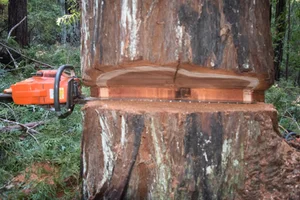
To add a blockout to a conventional notch, you make a plunge cut parallel with the hinge and directly below where the angle and level cut intersect, so that the top of the plunge intersects with the other two cuts at the back of the face cut. You then make another level cut to intersect the bottom of the plunge cut, creating a "block" that is removed from the face. This opens up the face cut for more extension of the hinge before the geometry closes and forces failure. You can plunge in for your block, and rip down the grain as far as you want- the further down, the more "open" the face becomes, so fibers still attached to the stem are a possible option.
The bottom of the blockout can be sniped to the same effect as a conventional notch, so a blockout conventional can have characteristics of both a sniped stump with the hinge extension of an open-face.
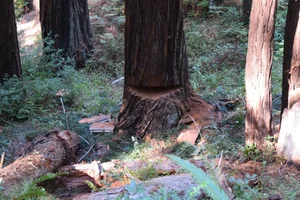
This technique is best suited for cutting with a saw bar that will extend beyond the diameter of the tree at your cut height (or you can shave like the pics in the beginning of this thread). You can pull it off with a shorter bar, but it usually requires some chainsaw carving to get rid of mismatch/bypass.
When making the plunge cut, I look directly at the profile of the face with the intersect at eye level.

 
59758

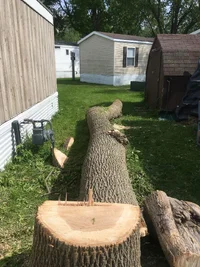
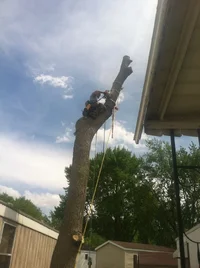
Just to show, the top of that stem was not cut and shifted, I had to fit that elbow in the fall. That's why I had the face gunned slightly left, and the snipe slightly right. I needed space to fit the morphology away from the shed, but I needed the stem to come off the stump in the middle of the structures in case there was a slight roll.
 
Good stuff Mitch, thanks.
So the purpose of it though, is what? A gentler release once the hinge does come apart, making for less chance of crazy bounce for a kinda twisted stem like that?
 
One reason to use block cuts is that they are one of the easiest ways to put undercuts in larger wood. And yes they do allow your hinge to hang on a little longer. A good cut to use when taking big tops where you are worried about a nasty barber chair. I often use a slightly different method for making my block cuts but the end result is the same.

One on a 4 footer and one on a 6 footer.

DSC_0215 copy 2.webpDSC_0055 copy.webp
 
Exactly!
I wanted the hinge to break after the stem had committed more than 45d to the fall. I'm sure you've seen a peg like this go a little to one side because the hinge ripped from one side to another. The blockout or an open face limits the degree the stem can side travel if this occurs, if at all. The reason that I gunned to the left is because those type of hinge failures pull towards top weight, which in this case was towards the shed.
This picture is a great example of how snipe can function. With a snipe gunned not far off from the face, I was able to shift the log off the stump to about equidistant between the structures. That was in case the 'bow wanted to take a half roll.
 
To add a blockout to a conventional notch, you make a plunge cut parallel with the hinge and directly below where the angle and level cut intersect, so that the top of the plunge intersects with the other two cuts at the back of the face cut. You then make another level cut to intersect the bottom of the plunge cut, creating a "block" that is removed from the face. This opens up the face cut for more extension of the hinge before the geometry closes and forces failure. You can plunge in for your block, and rip down the grain as far as you want- the further down, the more "open" the face becomes, so fibers still attached to the stem are a possible option.
The bottom of the blockout can be sniped to the same effect as a conventional notch, so a blockout conventional can have characteristics of both a sniped stump with the hinge extension of an open-face.
This technique is best suited for cutting with a saw bar that will extend beyond the diameter of the tree at your cut height (or you can shave like the pics in the beginning of this thread). You can pull it off with a shorter bar, but it usually requires some chainsaw carving to get rid of mismatch/bypass.
When making the plunge cut, I look directly at the profile of the face with the intersect at eye level.

Good posts and pic. Learned by different name as stepped face. Thanks for answering.
 

New threads New posts

Back
Top Bottom