SAKA (Self Advancing Knee Ascender) One of many steps the making.

Thank you,
Until I am able to get my own site, ClimbingInnovations.com up and running,
the SAKA is available via PayPal, price is 139.00 USD, including free shipping. Send money via PayPal to richard@mumford.org, all black or red and black. Extra bungee is 5.00 and extra footloop is 15.00. Small and large footloops are also available. The stock SAKA comes with everything you need, encluding regular size footloop and all carabiniers.

Thank you,

Richard Mumford
 
I SHOULD HAVE GOTTEN A SAKA INSTEAD OF A HAAAAAAAAAAS! if only i knew then what i know now...


(For tinkering climbers, old school Singer(and other brands) industrial machines from the 50s and 60s CAN handle the work load if you can find one and aren't sewing/splicing for production... i inherited one machine capable of sewing through several layers of LEATHER and/or CANVAS/WOOL all day long, which is pretty impressive given the quality of the AVERAGE sewing machine your mom uses. i also have a "newer" industrial singer from the 60s or 70s that would probably handle any webbing or other heavy materials with no problem. Not sure if either one has enough clearance for actual rope to fit under their feet, but they could both be set up to use heavy gauge needle and the appropriate thread for sewn splices.

i have a third machine, as well, that i think does triple stitching, or at least double, that would be excellent for reinforced seams on harnesses, but i'd use one of the singers for any heavy sewing, especially bar-tacking on harness belts, straps, and webbing... if no better option was available. Ideally i would have at least two machines just for rope and harness work, and a third with a post bed for those really weird pieces, and another one with a felling arm for those long, awkward pieces, but i'm a sewing nerd... can't wait to prototype some stuff this spring!)
 
I've got an old White machine from the 70's that can power through 4 layers of heavy webbing, but the stitch width maxes out around 7mm which is just too narrow for splicing. I have tested with removing the pressure foot for clearance and doing a kind of basting whip by hand before sewing, to decrease the width of the rope being spliced. The result was strong but way too inconsistent to ever take up a tree. I am good waiting for an industrial tool to happen by on Craigslist or ebay.
 
not sure if two out of my three singers can zig-zag at all, now i'm thinking about it. The oldest one is a straight lock stitch machine... the other two probably max out around 6-8mm width, which should be fine for any webbing and harness work, but not enough for ropework... i'm sure i could modify the machines to do it, but wouldn't be worth my time or effort with the little amount of work i'd be doing... not sure i'd want sewn eyes on anything i'd use regularly, anyway... big, doubled, stiff hunks of rope with heavy heat shrink on top just seem too bulky to me... so far, i prefer spliced eyes.
 
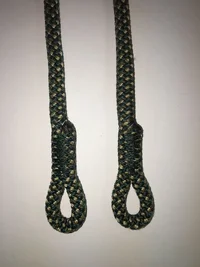
These eyes are a combination of bury and sewing. Not too bulky and unlike splices the cord is flexible shortly after the splice.

Those look slick, I don't trust my skill set off the sewing machine but I love how compact the connection area is, I have seen some machine sewn eyes with short leads that kind of twist sideways under load and hang off the sitches, as much as I like the short connection, the sideways thing worries me from an engineering standpoint, but I have no data to back that assumption up.
 
The few standard, just cord on cord with no bury, hand sewn eyes I had tested show signs of the end of the short tail trying to pull up. I can see where the top of the cord that doesn't have any stitches would still get pulled when loaded causing that short end to move.
There is a lengthy discussion of hand sewn eyes in the Splicing section that Moss started.
 
Ya I followed that thread, interesting read, I don't think most people have the background to sew their own and can see the danger in any climber hanging their life on something untested, but I do think there is value in discussing these techniques, and if not in a forum like this, then where?
 
One cheap old machine is a Paff 130 or greater... Commonly used by sailors for mending things... Only issue is that they used a cloth belt, and if there is sewing machine oil on them they wont last. Forward, reverse, and zigzag with plenty of oomph. I'm still looking for a good hand crank for mine, so much easier to handle webbing stitches.
 
... the top of the cord that doesn't have any stitches would still get pulled when loaded causing that short end to move.

Out of curiosity, have you tried putting 4kn+ on a sewn line WITH the bury? I am thinking with the extra fiber woven in as an anchor for the stitching, plus the added stiffness just before the stitching starts it would help to keep the force of the pull more inline with the rope and not do that 45° tilt. In an in line pull there is an added rope on rope friction boost from the stitches pulling the 2 sides tighter together, I think this would decrease if the stitched area tilts under load.
 

New threads New posts

Back
Top Bottom