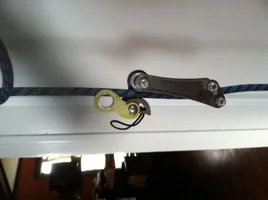
Rope Wrench Feedback?

[ QUOTE ]
Has spar work been discussed already? Anyone using the Wrench on spar removals, and if so, how?

I haven't tried, and only idea I can come up with is tying a tether to the knotted side of the line to release the running bowline left at the top when you descend for your next cut.

Old hat? Anyone?

[/ QUOTE ]

Or a running bowling with a long tail? Same thing I guess.
 
Odis at the NATS booth was demonstrating a technique that would work well for spar work. I'll try my best to describe it.

Choke off with a running bowline at the top, leaving a long enough tail to attach a carabiner (with a knot or ideally a spliced eye), attach your friction hitch and rope wrench, clip the tail of your rope into the carabiner so it will run through the carabiner as you descend on the rope wrench. You can now use this as a mechanical advantage to ascend by pulling on only the tail or you can safety in and retrieve the anchor point by pulling on both legs of the loop created from your tail running through the carabiner at the anchor point.
 
Running bowline with a long tail works for me. I've been doing it that way even before I got the wrench, on spikes you can take some of the weight off the knot. When it is ready to flop I'll send my working end to the ground for my crew to tie off, provided there are any crotches left.
 
Treebing I promised you this info back at Hartford.

Hope this gives you inspiration and clarity, to carry on with this roller coaster of inventiveness, prototyping, marketing etc.

http://www.spirittreecider.com/index.php?page=spirit_tree
http://en.wikipedia.org/wiki/Wassailing


Singing Tree and singing to trees, the metaphysics of this is very interesting. Projecting and listening and one with out the other is nothing shared.

RopeWrench is a valuable addition.

Thanks!
smile.gif
 
[ QUOTE ]
Has spar work been discussed already? Anyone using the Wrench on spar removals, and if so, how?

I haven't tried, and only idea I can come up with is tying a tether to the knotted side of the line to release the running bowline left at the top when you descend for your next cut.

Old hat? Anyone?

[/ QUOTE ]

I just put a vid up that features some spar removal work on the wrench.

Simply a choked running bowline with at least as long of a tail as the length of the sections you plan to fell out.

I've done it like that forever just fighting a binding up prusik on the single line pre-wrench. With the wrench it just runs superb.

Treegear TV | 65m Mountain Ash Tree Removal
 
Didn't get to try the spar technique yet, but this morning I had a chance to do the over-the-shoulder slack-tending technique.

That has changed everything, again.

I used to ascend with the pantin, prussik, and croll. With the RW, I had to ditch the croll, the two seemed incompatible - all clanging and banging - plus the croll is a toothed ascender, which I'm a little worried about these days.

I heard about some people using a slack-tending device with the wrench, and I tried a daisy chain tethered to my back suspenders, with each end connected to my Hitch Climber. Now all three holes are filled on my HC, which is a quite fulfilling.

Also, this makes me climb like a rocket. Thanks for all the input, this wrench rocks.
 
I love the lanyard over shoulder system and used since Kevin first posted about it. However I just switched to a petzl voltige chest harness and it's way quicker. I just clip the wrench tether to it and up I go. You'll find it on treestuff, they started carrying them the day I got mine in from karstsports
 
[ QUOTE ]
Cary,

90% of the time, I will use the Pantin. I find it very fast and efficient. Many people have trouble keeping the Pantin engaged until things fall into place technique and adjustment-wise. If it is a very short rise, I will footlock the tail. If it is a very awkward position, I will use the 3:1 with my modified Petzl hand ascender that I can click on and use with one hand and remove and place back on my saddle with one hand.

There are always ways to overcome obstacles in movement.

Dave

298585-RADSPetzlhandascender.jpg


[/ QUOTE ]

This photo shows a 2:1 system. You can call it a 3:1 rigged to disadvantage if you want to, but the MOVING end of the system only has two parts of rope. Thus, it provides a (theoretical) 2:1 advantage. The tail is only redirected through the sheave in the Ascension, which does not move while the MA system is working. This is simply a change in direction, not an increase in MA. In fact, redirecting like this actually decreases the MA by some amount based on the efficiency of the parts in the system. Now, in this example, pulling in this direction is obviously easier and more bio-mechanically sound than pulling away from your body. However, even if you use high efficiency pulleys (i.e. 95%), you are still dealing with a slightly-less-than-2:1-system.
 
[ QUOTE ]
This photo shows a 2:1 system. You can call it a 3:1 rigged to disadvantage if you want to...

[/ QUOTE ]

In climbing, we refer to a 2:1 system as one that requires the pulling of two feet of rope to advance one foot. It does not matter if it is run through a super efficient pulley or just thrown over a rough branch with so much friction that true 2:1 leverage is never achieved. You pull 2 to get 1.
Taken in context, what I showed, takes the pulling of three feet of rope to advance one foot. You pull 3 to get 1. This is a typical description of a RADS system. I will continue to call it a 3:1 for that reason and not lose any sleep over it.

Dave
 
[ QUOTE ]
[ QUOTE ]
This photo shows a 2:1 system. You can call it a 3:1 rigged to disadvantage if you want to...

[/ QUOTE ]

...

Taken in context, what I showed, takes the pulling of three feet of rope to advance one foot. You pull 3 to get 1. This is a typical description of a RADS system. I will continue to call it a 3:1 for that reason and not lose any sleep over it.

Dave

[/ QUOTE ]

+1 Dave.
icon14.gif


Can you imagine after all these years ... still voting on the RADS 3:1 thing?
shakinghead.gif
 
Just wanted to shout out to Kevin for the RW idea yet again! Been climbing in Central Park in NYC, and I'm loving SRT and the RW. Most of the climbs are just straight up, avg 40', get a few limbs/hangers, come down and move on. The RW and SRT is awesome in this application. No time wasted isolating a line, etc.
 
Adrian I believe thats what ispired Kevin to make the fate revolver setup,when kevins was doing the same thing in Texas.Chasing hangers after Ike.Kevin correct me if I wrong.
 
[ QUOTE ]
[ QUOTE ]
[ QUOTE ]
This photo shows a 2:1 system. You can call it a 3:1 rigged to disadvantage if you want to...

[/ QUOTE ]

...

Taken in context, what I showed, takes the pulling of three feet of rope to advance one foot. You pull 3 to get 1. This is a typical description of a RADS system. I will continue to call it a 3:1 for that reason and not lose any sleep over it.

Dave

[/ QUOTE ]

+1 Dave.
icon14.gif


Can you imagine after all these years ... still voting on the RADS 3:1 thing?
shakinghead.gif


[/ QUOTE ]

I must have been absent the day the voting took place.

Dave, point taken. However, I feel there is a general lack of understanding regarding mechanical advantage. Now throw in rope pull vs. distance traveled and use the familiar X:Y to express that relationship, and it adds to the confusion, IMO. I thought y'all were talking mechanical advantage and here, it seems, I should have known this was not the case based on the context of the conversation. The RADS setup in your photo may be used in rescue/haul MA systems. Labeling it as 3:1 in this case would be incorrect; context or no.

My apologies for misunderstanding the spirit of your post. In the future, I will prefix any mechanical advantage ratios with "MA", or will take the time to write out the words "mechanical advantage". The same with any pull/get ratios and I suggest everyone do the same. This will eliminate any confusion.
 
[ QUOTE ]
...The tail is only redirected through the sheave in the Ascension, which does not move while the MA system is working. This is simply a change in direction, not an increase in MA....

[/ QUOTE ]

Question: when is a fixed overhead pulley not just a change in direction?
Answer: when the load and lifting force are combined.

This is what makes our 2:1 climbing systems work. The same principles make the RADS a 3:1 for the climber. Hand the haul end to a ground man and it will be a redirected 2:1.

Dave
 
Are you talking pull/get or mechanical advantage? What do you mean by "load and lifting force combined"? The load aiding the lift by moving toward the fixed pulley under its own power while the lift is in progress? (i.e. a climber body thrusting?)

Still not an increase in mechanical advantage. A decrease in the amount of weight that's being moved while the pull is happening, maybe. You can't simply add a "1" to the ratio just because you are in the system. How about adding 1.5... or 2? What if a climber is really heavy but has really weak arms? What if a climber is super light but has super strong arms? What if I jump really high for each pull? What if I'm rescuing my friend and we're both hanging in my system but he's unconscious and I'm the only one doing the pulling? What if I rig a jet pack to the log I'm lifting so it moves toward the fixed pulley during the lift? Have I now changed the MA somehow? The jet pack log takes less input to move, but the MA ratio of the system stays the same.

Does anyone have the formula that shows how a 2:1 MA (RADS) becomes a 3:1 MA when the climber is hauling themselves? It may very well be easier to haul myself up a RADS versus someone hauling me, but it is not because of an increase in mechanical advantage.

I am not trying to come across as confrontational. I want to know the facts. If my take on this is incorrect, that's fine by me; I'll eat crow.
 
a ddrt system is a 1:1 system if someone else is doing the lifting but when you are part of the system it becomes 2:1. you move 1 foot for every two feet of rope you pull. The same happens in a RADS. you move 1 foot for every three feet of rope you pull thus it is a 3:1. someboedoy else pulling it is 2;1. Measure it out.

Think of you being the tree getting pulled over as 0pposed to you pulling the tree over. You yourself are the subject of your force so you get to count yourself twice.
 

New threads New posts

Kask Stihl NORTHEASTERN Arborists Wesspur TreeStuff.com Teufelberger Westminster X-Rigging Teufelberger
Back
Top Bottom