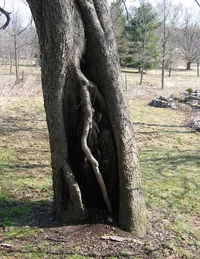
Roots in the Trunk?

One day this past week we took down a red maple. It had split on one side, about to fall on an electrical service and the pole that takes the service underground. The maple had signs of decline possible due to a former lightning strike. Anyways, it was approximately 36" DBH, and had a hollow cavity all the way up the trunk that was roughly 6" in diameter. Now, I didn't have a camera with me, so I have no pics. What sparked my post here is what this thing was doing on the inside. It had soil and roots inside the cavity that were almost all the way up the trunk. I've never seen this before and thought I would seek some insight and others experiences related to this.
 
I've seen it in a big ol' hollow Mullberry also, advantitious roots coming all the way down from about 15 feet up inside the thing.

Trees are so much smarter than us.
 
Ive seen this on Black locust as well. I just looked at a red maple last night that had these same roots you are talking about on the outside growing down from a croch about 6 feet up. They looked really funny.the roots were probably anywhere from 2-3 inches in dia. I guess a tree will do what it needs to do to survive.
 
Common on maple and others. Trees naturally shed their taproots, and digest their heartwood via adv roots. Is this hollow a "defect"? I am not sure. 6" is not a big cavity, and most splits can be mitigated and supported by cable or brace or pruning.
 
Here's one on Aesculus hippocastanum. The root is over 5' tall. The tree is also a lightning strike.

277130-Aesculushippocastanum_aerialroots.jpg
 

Attachments

  • 277130-Aesculushippocastanum_aerialroots.webp
    277130-Aesculushippocastanum_aerialroots.webp
    142.9 KB · Views: 34
Very cool image!
And interesting phenomenon.
I've been trying to find the reference in "The Tree" by Colin Tudge where he relates how when extremem winds knocked over oaks, that the really ancient oaks survived because they had grown hollow, and had grown adventitious roots down inside their hollow cores.
So, like Guy points out - is hollowness a defect?
I'm sure it can be, but I also think hollowing and adventitious roots are strategies in a trees 'toolbox' for moving on strong into a new life stage.
And all part of the evolutionary dance that trees and fungi have been engaged in for millenia.
 
Ascending the Giants, have documented adventitious roots that have begun life in decayed wood well up in the canopy (100 feet + if I recall right) and have been able to reach all the way to the forest floor and establish in the ground.

Oops, I just realized I had it wrong, the tree with roots in the decay was an epiphyitic hemlock growing on a cedar. So the epiphyte became a hemiphyte.

In any case, the development of roots into internal tree structure is quite well documented in almost all species and all over the world.
 
[ QUOTE ]
Is this hollow a "defect"?

[/ QUOTE ]

Many are starting to refer to things like this as "condition" and avoiding the negative connotation that words like defect and hazard, and pest have.

Defect = condition
Pest and pathogen = colonizer
Hazard = risk
 
This is one of those things that make trees so cool. Its makes perfect sense to me that they (the roots) will feed on the decaying matter inside a trunk, just something that I never have thought of, nor encountered. Learn something everyday, I hope anyway, RIGHT?

Guy, unfortunately in my line of work we aren't able to try to rememdy many problems. The maple was split from the top of the trunk down to about 5' from the ground. It was determined to be a threat to our equipment, so it had to go. Of course, the homeowner was worried about her home, so she called us because it was near a pole and line. I would like to be more oriented towards saving trees instead of getting rid of them. Oh well, one day!
 

New threads New posts

Back
Top Bottom