ripped off

[ QUOTE ]
Terminating both ends of the lanyard to the same D (front one) will keep your body out of the loop.

[/ QUOTE ]

But if using a fixed length and the force is enough to break the rope or d-ring you'll have nothing to hold you. 2 biners pulling oppisite directions will cross load the d-ring, cuasing it to fail first.?
 
I had a close one when an ash tree split on me while I was blowing out a big top, I just couldnt cut fast enough... Luckily I didnt get hurt because it broke loose just in time. I think it just scared the crap out of me instead of squeze it out of me (although I did get squezed.) I think that is better. Another valuable lesson from the school of hard knocks!
 
[ QUOTE ]
[ QUOTE ]
Terminating both ends of the lanyard to the same D (front one) will keep your body out of the loop.

[/ QUOTE ]

But if using a fixed length and the force is enough to break the rope or d-ring you'll have nothing to hold you. 2 biners pulling oppisite directions will cross load the d-ring, cuasing it to fail first.?

[/ QUOTE ]

Possibly yes, but I dont think that would happen in most cases. And you still would not have broken ribs and internal injuries. Your also making the assumption I meant without a second tie in.
 
[ QUOTE ]
Your also making the assumption I meant without a second tie in.

[/ QUOTE ]

so you'll have 4 biners into one d-ring? and when the rope or d-ring fail you'll be sling shot off.
 
Possibly. Or 3. It is possible to terminate the climb line to one biner.

Its recommended practice to terminate a lanyard to one connection when working a spar to avoid injury in this situation.
 
Thank you for sharing. That is horrible! Wish you a healthy recovery. FWIW, I always use a notch, kerf cuts, and take smaller pieces if unsure of the barberchair/splitting potential. Terminating your climbing line to a single connection point and then both ends of your lanyard to a seperate single connection point would yield maximum saftey factor in this situation.
 
An adjustable friction saver or friction saver prussic with a friction friction saver would solve the problem of you getting sucked in. Here is how it would work, Your problem solver

I use this for all trees. I've become much more confident working a spar using this technique. I had a hard time finding a technique that i felt was safe, but also didn't take to long to set up and take down, that i felt like removals were taking me a lot longer. This is what i found was best, and fastest. Very easy not hard to learn, and if you don't use a friction saver already it's something that you can use with all tree's, removals and prunings.

Make sure you use the appropriate cut for the appropriate situation. I was always told to use a notch when taking a top.

Good luck and quick recovery.
 
bigeyes.gif
I think the suggestions have covered the subject well.

Fireman: You seem to be humble and have a sense of humor with the accident. It is good to learn from a mistake and avoid the temptation to think, "Hmmm... That was just a fluke! I have been doing this _____ years and that has never happened to me before."
thinking.gif


I hope you make a 100% come back!
 
"if anyone has any input on how to prevent this let me know. i am very open to all types criticism."

holy crap man!

If you continue to do tree work, I bet 5 years from now, you'll look back and say, I can't believe I used to make a cut that way.

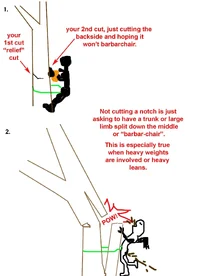
You're telling me you made no notch what so ever, just a saw cut, then proceeded to cut the back?

(See my diagram to clarify please and correct me if I'm not getting the picture)

No need to even get into bore cutting and other things, the first thing to talk about is simply cutting a notch.

Oh, yeah, and don't blame the knots in the wood, it had nothing to do with knots.
 

Attachments

  • 155267-notcuttinganotch.webp
    155267-notcuttinganotch.webp
    132.6 KB · Views: 193
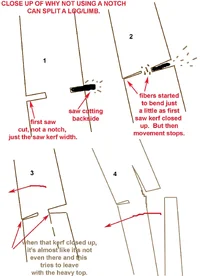
a close up diagram to try to show why this happens.
 

Attachments

  • 155268-closeupofnonotch.webp
    155268-closeupofnonotch.webp
    155.6 KB · Views: 188
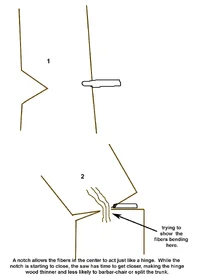
a quick diagram of a notch and why it generally is more controled and not violent.

now, on real big diameters and heavy leans, it would be good to use a back-strap to hold things until you get your hinge wood thin enough to your liking. then release the strap (i do with a chainsaw).

also, i like to see a climber nick that side sapwood so nothing peels down and pulls on the lanyard.

but lets keep things simple here......
 

Attachments

  • 155270-notchdiagram.webp
    155270-notchdiagram.webp
    75.4 KB · Views: 146
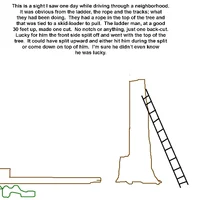
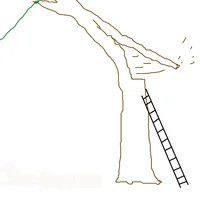
here is something i saw in a neighborhood a year ago or so.

I didn't have a camera (wish i did), but check out my diagram.

This was very scary looking.

I asked a neighbor if someone got hurt, because everything was just laying in the front yard and no one around.

the neighbor said, "not that I know of".

It was a rock oak, about 30 foot trunk standing, ladder still on trunk. top on the ground with rope under it. big split and peel all the way to the ground.
 

Attachments

  • 155273-onecutfrombacksidecopy.webp
    155273-onecutfrombacksidecopy.webp
    110.3 KB · Views: 201
this is what could have happened. and actually, what could have happened to Fireman also.

fireman could have been squeezed during the splitting, then if the split happened above him, could have come down on him smashing him.
 

Attachments

  • 155274-onecutladderonecut2.webp
    155274-onecutladderonecut2.webp
    40.7 KB · Views: 170
Fireman, thank you very much for sharing this. Really, you don't know how many people you might have just saved by posting this mistake.

My first year of climbing, I was climbing some big oaks in the woods, taking the tops out of them for a logger that didn't want the big tops busting up the valuble logs in the trunk.

One big red oak, i spiked to the top, tied in with my climbing line (thank goodness!) repelled some, cutting off limbs. I would just do a bottom cut and top cut, letting them pop off.

(similar to what you did on the trunk cut)

there was one particular large heavy limb, I went out on it maybe 6 feet and put my rope lanyard around it.

PUTTING A LANYARD ON FOR A SECOND TIE IN POINT ISN'T ALWAYS SAFER!

anyway, i proceeded to do it just like a regular limb, bottom cut up maybe 1/4 or 1/3rd. then top cut. Well, as we learned here.... yup it split and started to pull me into the limb, I luckily thought fast, pulled the saw out of the cut and swiped my lanyard on purpose relieving me from the pull. I recieved no injury, just a scare. Thank goodness i wasn't just working off of a lanyard. And I was also glad it wasn't a steel core lanyard.

a notch below would have allowed me to cut more of the backwood as it bent downward. or if the limb was large enough in diameter, could have bored in to make my backcut (but still kind of violent).

(I did post this old story on treebuzz way back when I first became a member, sorry you didn't read it.)

oh, and yeah, your humor is good. hope you like mine!
 
[ QUOTE ]
Norm,
When I use a strap cut I set it parallel with the notch and back cut.

Your illustration shows that strap at an angle, is there a reason for this?

[/ QUOTE ]

The illustration is of a tree removal from the ground. The reason for the side strap is to utilize the "escape route". The side opposite the strap is the "good" side. The strap side is the "bad" side.
 

New threads New posts

Back
Top Bottom