
Navigation
Install the app
How to install the app on iOS
Follow along with the video below to see how to install our site as a web app on your home screen.
Note: This feature may not be available in some browsers.
More options
You are using an out of date browser. It may not display this or other websites correctly.
You should upgrade or use an alternative browser.
You should upgrade or use an alternative browser.
ripped off
- Thread starter fireman
- Start date


- Location
- sunny Madison, WI
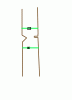
Thanks for the diagrams X...
Big wood gets a face notch and bore cut and maybe a pull line ddepending on the situation.
Smaller stems usually notch and back cut.
Fireman - Hope you get well! Thanks for sharing.
Big wood gets a face notch and bore cut and maybe a pull line ddepending on the situation.
Smaller stems usually notch and back cut.
Fireman - Hope you get well! Thanks for sharing.

- Location
- under grace
THis happened to an old climber i used to work with about 20yrs ago!! the piece sucked him in hard and then finally broke loose. Big old Sycamore scared the crap out of me back then!! never forgot it!!!
i will be praying for your recovery!!!!!!! please get well Thanks for sharing and I am soooo glad you are still with us!!!!!
i will be praying for your recovery!!!!!!! please get well Thanks for sharing and I am soooo glad you are still with us!!!!!

Roger_Barnett
Participating member
- Location
- Seattle, in the PNWet
So, fireman, I'm not sure I follow exactly what cuts you made. Did you make a face cut, or just one kerf cut? If face cuts, how open was the notch made?
I understand, that even with a proper face cut, with the presence of the grown over knots, that the wood fibers could still have caused the catastrophic split.
Usually, their presence can be sensed by observing the surfaces of the cut face, and looking for abnormalities in the shape of the area to be backcut.
May I also assume that you don't climb professionally, but are a fireman? As has been said above, it is often safest to take smaller pieces when working aloft.
Wishing you a full recovery.
This should be a lesson for all, to observe where you're cutting. Stay as far away from knots and grain abnormalities as possible. If in doubt, use ratchet straps, both above and below...and use both a choked lifeline and lanyard. And bore cut.
I understand, that even with a proper face cut, with the presence of the grown over knots, that the wood fibers could still have caused the catastrophic split.
Usually, their presence can be sensed by observing the surfaces of the cut face, and looking for abnormalities in the shape of the area to be backcut.
May I also assume that you don't climb professionally, but are a fireman? As has been said above, it is often safest to take smaller pieces when working aloft.
Wishing you a full recovery.
This should be a lesson for all, to observe where you're cutting. Stay as far away from knots and grain abnormalities as possible. If in doubt, use ratchet straps, both above and below...and use both a choked lifeline and lanyard. And bore cut.

"If in doubt, use ratchet straps, both above and below..."
good point. This came to my mind yesterday when I was thinking about this accident.
I do this when felling something from the ground that has multiple leaders and might have included bark that travels close to my felling cut. Well, not a strap, but chain and a binder usually. I've snapped a chain when the tree hits the ground and splits apart though.
good point. This came to my mind yesterday when I was thinking about this accident.
I do this when felling something from the ground that has multiple leaders and might have included bark that travels close to my felling cut. Well, not a strap, but chain and a binder usually. I've snapped a chain when the tree hits the ground and splits apart though.
- Location
- Fairhaven,Massachusettes
one of the guys that work for me and i have been thinking that maybe simular to what your saying about using the front d-ring is if you take some really strong webbing about 4" (it would have to be able to acomadate a carabiner on both ends )conect it to the side d ring(one on each side) then use another piece to connect them together in front then attach your flip line to them . This will make a loop around the tree but it would be approximitly 4" from your body not alowing it to consume all the flip lines valuable space
Fireman,
There's a ton a people on here asking questions and you haven't responded to any.
If you don't have the time; how about just responding to Roger's question?:
[ QUOTE ]
So, fireman, I'm not sure I follow exactly what cuts you made. Did you make a face cut, or just one kerf cut? If face cuts, how open was the notch made?
Wishing you a full recovery.
[/ QUOTE ]
Since you weren't responding, I was afraid you got an infection and was in real bad shape.
Glad to hear your still kickin'.
Hey, you did the right thing by posting this accident. You're a fireman, you like to help people.
A clear report of how this happened will help save... who knows how many people.
thanks again,
There's a ton a people on here asking questions and you haven't responded to any.
If you don't have the time; how about just responding to Roger's question?:
[ QUOTE ]
So, fireman, I'm not sure I follow exactly what cuts you made. Did you make a face cut, or just one kerf cut? If face cuts, how open was the notch made?
Wishing you a full recovery.
[/ QUOTE ]
Since you weren't responding, I was afraid you got an infection and was in real bad shape.
Glad to hear your still kickin'.
Hey, you did the right thing by posting this accident. You're a fireman, you like to help people.
A clear report of how this happened will help save... who knows how many people.
thanks again,
- Location
- Fairhaven,Massachusettes
sorry i have not got back but was having a tough week and i had to go and get my staples pulled out and was having a tough week. the top of the oak tree at approx. 30' curved and ran almost 90 degrees so it started to become horizontal.
thats where i put a single back cut unernieth because i could no longer stand on the trunk (i wauld have had to sit on the top of the trunk if i had gone any higher).then i started my top cut approx. 2" below the my under cut. i was only 3"away from completing the cut when it statrted to rip appart i hope that helps to clearify if you need more let me know
thats where i put a single back cut unernieth because i could no longer stand on the trunk (i wauld have had to sit on the top of the trunk if i had gone any higher).then i started my top cut approx. 2" below the my under cut. i was only 3"away from completing the cut when it statrted to rip appart i hope that helps to clearify if you need more let me know
- Location
- Fairhaven,Massachusettes
you asked how long ive been doing this .Im going on 12 years and was licenced from the state of R.I.back in 1998.
I'v got the report from OSHA and they are stating that the grain from a limb aprox. 15" above and some knots was the reason for the wood to split
I'v got the report from OSHA and they are stating that the grain from a limb aprox. 15" above and some knots was the reason for the wood to split
Roger_Barnett
Participating member
- Location
- Seattle, in the PNWet
I sure hope you're getting along better, fireman.
Ahh, so no face cut. Part of the problem.
Anyhow, here's various ways to prevent what happened.
Make a small face cut, but open. Then bore cut to establish a hinge if there was room. Next, cut out the back.
Or, instead of making a backcut parallel to the hinge wood, make 45 degree cuts, with the apex directly behind the hinge, and cutting out the corner wood, ,first one side, then the other.
Those methods might have worked, but with all that lateral weight, the tree should have been ratchet strapped or chained, both above and below the cut.
Alternatively, perhaps this would have been a situation where the Coos Bay cut would have worked. Having never used it, I can't speak from experience. But, it entails making two kerf cuts, 90 degrees to the intended fall, then cutting from the back, with no face cut at all.
Methods for choking off a lanyard and lifeline can be simple. One on each side d-ring could have worked. Each line would have needed to have a friction knot that would give if the tree split and lengthened the loop.
Ahh, so no face cut. Part of the problem.
Anyhow, here's various ways to prevent what happened.
Make a small face cut, but open. Then bore cut to establish a hinge if there was room. Next, cut out the back.
Or, instead of making a backcut parallel to the hinge wood, make 45 degree cuts, with the apex directly behind the hinge, and cutting out the corner wood, ,first one side, then the other.
Those methods might have worked, but with all that lateral weight, the tree should have been ratchet strapped or chained, both above and below the cut.
Alternatively, perhaps this would have been a situation where the Coos Bay cut would have worked. Having never used it, I can't speak from experience. But, it entails making two kerf cuts, 90 degrees to the intended fall, then cutting from the back, with no face cut at all.
Methods for choking off a lanyard and lifeline can be simple. One on each side d-ring could have worked. Each line would have needed to have a friction knot that would give if the tree split and lengthened the loop.

- Location
- Longmont, CO
I thought my illustrations were pretty good. LMOAO!
 This one even has the poop coming out the rear!
jim454
Participating member
- Location
- The land of Utopia
yup, that's poop alright.
jim454
Participating member
- Location
- The land of Utopia
Something brown is coming out of the mouth.
Did you do that on purpose?
Did you do that on purpose?
- Location
- Longmont, CO
[ QUOTE ]
Something brown is coming out of the mouth.
Did you do that on purpose?
[/ QUOTE ]
I missed that detail...

Something brown is coming out of the mouth.
Did you do that on purpose?
[/ QUOTE ]
I missed that detail...
- Location
- Longmont, CO
[ QUOTE ]
what do you mean, your illistrations. I guess that was a type-o?
[/ QUOTE ]
Yep. The "i" and the "u" are next to each other on the keyboard. Type-o. But, who's nit pick'n anyway?

what do you mean, your illistrations. I guess that was a type-o?
[/ QUOTE ]
Yep. The "i" and the "u" are next to each other on the keyboard. Type-o. But, who's nit pick'n anyway?
- Location
- Fairhaven,Massachusettes
what is the coos bay cut? can you send me a picture and how would a ratchet strap prevent this
New threads New posts
-
test
-
 Alternatives to standard asphalt around roots
- Started by southsoundtree
- Replies: 1
-
-

-

-
 For Sale: 2018 Vermeer BC1000XL Chipper | 918 Run Hours | Deutz Diesel
- Started by Blue Ribbon Tree
- Replies: 2
-


