
Navigation
Install the app
How to install the app on iOS
Follow along with the video below to see how to install our site as a web app on your home screen.
Note: This feature may not be available in some browsers.
More options
You are using an out of date browser. It may not display this or other websites correctly.
You should upgrade or use an alternative browser.
You should upgrade or use an alternative browser.
ripped off
- Thread starter fireman
- Start date


- Location
- Massachusetts
Glad to hear that you are OK. Man that is a scary story... Did your dept have to respond to the accident???? I am a jake up here in Danvers Ma...
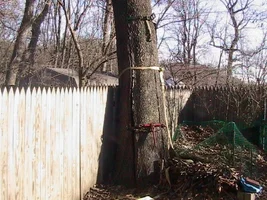
Norm, I would challenge your placement of your strap. Placing a strap off to the side is an excellent way to combine the bore cut with the use of wedges(felling situation)as well as having the strap FACING your primary escape route i.e. the good side off the tree. If you were to place the strap on the bad side of the tree you will be working under the bad sidewhen the strap is severed and the tree begins its fall.
- Location
- Fairhaven,Massachusettes
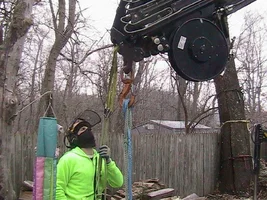
I was on that fire dept in the past for about 15 years and then moved so i had to go to another. I went back yesterday to finish the job I was up all night thinking about the rest of the job. I took it slow but got the job done.I will say that I was pretty nervous. Due to the deep cold we were having here I was able to get the bucket truck in the back yard(i broke my own policy, our rule is that the bucket truck does not go on lawns)
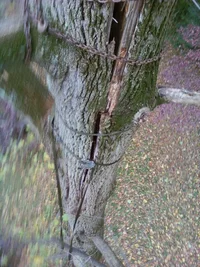
I like the use of the chain and binders. I got to speak to someone who had encounterd the same accedent,was not so fortunate he broke his spine and has a colostomy bag for the rest of his life.In his case there was acluded bark were two leaders came together. The more I chat with other climbers the more I realize how many arborist get cought up in this type of incident. I hope more people read these post.
I like the use of the chain and binders. I got to speak to someone who had encounterd the same accedent,was not so fortunate he broke his spine and has a colostomy bag for the rest of his life.In his case there was acluded bark were two leaders came together. The more I chat with other climbers the more I realize how many arborist get cought up in this type of incident. I hope more people read these post.

- Location
- Charlotte, NC
Glad you made it back to finish the job Bro.
Scotty
PS thanks again for your post
Scotty
PS thanks again for your post

- Location
- South Carolina
fireman good luck with your recovery... takes a strong man to come into especially this website and throw yourself to the wolves. These suggestions are good just make sure you practice them on the ground. I'd hate to hear someone went into a tree and tried a bore cut and cut themselves out or it went really wrong.
I've known guys to lug a chain to the top of Euc's and padlock the chain tightly just below the cuts and above a flipline (after a very similar accident that busted a cable core flipline resulting in a groundfall, to add to the already crushed innards).
This chain keeps the tree from splitting at all. In a less threatening situation using a friction saver and traditional friction hitch climbing set up can keep you outside the loop, and in the event of a split the friction hitch would slide.
I like the plunge cut too, I've only used it on the ground for heavy leans though, and it works great.
This chain keeps the tree from splitting at all. In a less threatening situation using a friction saver and traditional friction hitch climbing set up can keep you outside the loop, and in the event of a split the friction hitch would slide.
I like the plunge cut too, I've only used it on the ground for heavy leans though, and it works great.

southsoundtree
Been here much more than a while
- Location
- Olympia, WA
Coos bay cut is explained in Berenek's Fundementals of General Treework. The why and how.
With the Coos Bay, you lose directional felling control, which was somewhat predetermined to be lost/ unavailable as it is meant to be used on heavy leaners, which will want to go with the lean and not be so steerable. There is no face cut, only back cuts.
It is like a very, very, very exaggerated kerf/relief cut, with a back cut. The kerf/relief cuts normally put under the face/back cut combo are performed such that the length of the bar and tip point to the fall, with only a shallow cut.
With the bar tip pointing toward the lean, cut deeply toward the center. Maybe good to load it up with wedges, not for forcing it over, just to fill the kerf and reduce any lateral force. Do the same on the other side.
This will result in a strip that is oriented from the direction of the lean, to the opposite direction of the lean. Kinda like a mohawk would look with the direction of the lean being where the mohawk-ed person would be facing.
This mohawk strip is then cut quickly, with a strong and sharp saw from back of the head toward the face.
Berenek also discusses the technique where the back cut wood is shaped into a triangle with one side as the hinge wood, and the other two sides coming to point at the side opposite of the lean. Those two sides are cut though the sides of the hinge a bit, making the hinge narrower.
I believe that this allows the strong and sharp saw to cut through the back cut in less time, leaving the tree with less built up forces within the trunk for a shorter amount of time, resulting in less probability of a barber chair.
Best to see some diagrams, as I'm sure that this explanation is not crystal clear, and a picture speaks a thousand words.
With the Coos Bay, you lose directional felling control, which was somewhat predetermined to be lost/ unavailable as it is meant to be used on heavy leaners, which will want to go with the lean and not be so steerable. There is no face cut, only back cuts.
It is like a very, very, very exaggerated kerf/relief cut, with a back cut. The kerf/relief cuts normally put under the face/back cut combo are performed such that the length of the bar and tip point to the fall, with only a shallow cut.
With the bar tip pointing toward the lean, cut deeply toward the center. Maybe good to load it up with wedges, not for forcing it over, just to fill the kerf and reduce any lateral force. Do the same on the other side.
This will result in a strip that is oriented from the direction of the lean, to the opposite direction of the lean. Kinda like a mohawk would look with the direction of the lean being where the mohawk-ed person would be facing.
This mohawk strip is then cut quickly, with a strong and sharp saw from back of the head toward the face.
Berenek also discusses the technique where the back cut wood is shaped into a triangle with one side as the hinge wood, and the other two sides coming to point at the side opposite of the lean. Those two sides are cut though the sides of the hinge a bit, making the hinge narrower.
I believe that this allows the strong and sharp saw to cut through the back cut in less time, leaving the tree with less built up forces within the trunk for a shorter amount of time, resulting in less probability of a barber chair.
Best to see some diagrams, as I'm sure that this explanation is not crystal clear, and a picture speaks a thousand words.
[ QUOTE ]
Coos bay cut is explained in Berenek's Fundementals of General Treework. The why and how.
Best to see some diagrams, as I'm sure that this explanation is not crystal clear, and a picture speaks a thousand words.
[/ QUOTE ]
Well that's easy to do:
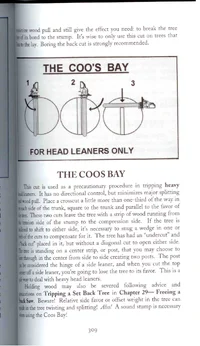
here's the page from the book.
Coos bay cut is explained in Berenek's Fundementals of General Treework. The why and how.
Best to see some diagrams, as I'm sure that this explanation is not crystal clear, and a picture speaks a thousand words.
[/ QUOTE ]
Well that's easy to do:
here's the page from the book.
Attachments

- Location
- Tha Dirty Bean
coos bay could work, but it seems just a decent notch would have done the trick in this situation.
Fairhaven huh? I've got a summer place in Marion, maybe we can hook up this summer for a rec climb?
Fairhaven huh? I've got a summer place in Marion, maybe we can hook up this summer for a rec climb?
- Location
- Fairhaven,Massachusettes
we will have to get together.do some talking.marion is a nice little town but it has it share of strange people. I almost got shot out of tree by this woman who was just relaesed from prison for shooting fisherman about 150 miles at sea in the grand banks,( in a 16' inflatable zodiak)she had only been out for 3 months when I was doing a removal of some pines a few houses away. she said she was the representaive of all trees and that she did not want any trees cut down. I found out later after 3 different police departments showed up to have her arrested,that she was the new england chapter leader of green peace corp. they busted my a## for years after that,but we will save that for coffee.let me know when your in town.Im in the phone book listed under Nicks Tree Service
New threads New posts
-
test
-
 Alternatives to standard asphalt around roots
- Started by southsoundtree
- Replies: 1
-
-

-

-
 For Sale: 2018 Vermeer BC1000XL Chipper | 918 Run Hours | Deutz Diesel
- Started by Blue Ribbon Tree
- Replies: 2
-


