This has been a great subject to follow and see what develops.
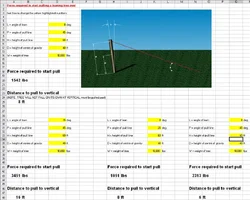
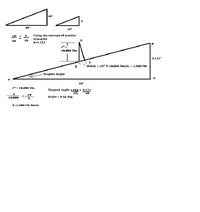
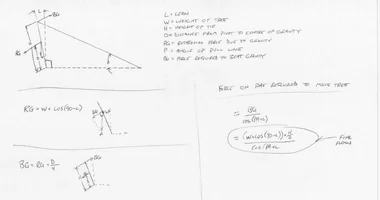
Through Chris's and Dave's illustrations and calculations I can see a basis for a more comprehensive work on the subject of vector forces, factors and calculation.
Rigging and pulling trees has always been a most intriguing part of our work and over the years I've seen it draw some of the largest crowds of spectators. Most of whom, I always felt in their subconscious, want to see you lose it.
Some aspects of keeping control of the tree while pulling it require as much gut feeling as correct calculations. Especially when dealing with side leaners. Using a holding line to swing the tree and another line to pull it.
Shape/form of the tree. Is there sweep in the lean? And are all the limbs on the lowside also? And are the limbs down low or way up high. As such, these factors in combination can double the force required to pull the tree. An increase in bulk and height will can add another 200-400% required force. 100' tall vs. 200' tall. That 200' tree can require more than twice the froce needed to pull the 100' tree. It comes to the point where you ask yourself, "can I handle it?" And how about your anchor? Yeah, you may have it all figured out correctly, but can the anchor handle it?
Condition of the tree. Is it rotten? In the stump? In the top? When I was rigging pull trees in the 70's and 80's, all old growth, it was an exception to have perfectly sound trees. Some were so scary I got the hell out of there when the fallers started cutting on them.
An old logger once told me, "Jer, you got to keep the weight of the tree under the rigging." How true. It's a good rule to stick by.
The rigging, in the woods weighed hundreds of pounds. We had to set rigging in the tree just to pull the rigging up. Setting at heights to 200 feet. Yeah, steel sucks, cuz it's so darn heavey and the splinters in it will rip you terribly, but it has abrasion resistance rope can never even come close to. However, I've seen it break to! No problem with the heavy logging equipment and winches we had. You had to be real gental to keep from breaking that inch and quarter cable.
In the urban environment "rope" is the choice of the trade. It's user friendly. And with the new synthetics the strength is right up there with steel. It's really amazing.
I pulled a tree a couple of months ago. Old growth Bishop pine, only about 90' tall and 30 inch on the stump. Not tall, but it had size. Trunk was straight for about 30' and then swept back 10' over the county road, power, telephone, cable, two homes. All the limbs where in the top, all on the back side and reached well over the county road. I rigged the tree with 5/8 Stable braid, 80'. The stem was about 12". It divided there into several wind blown spars. Oh, I had a good anchor, a large redwood stump right in lead with the lean. Though it was quite the reach, nearly 200 feet. I put a 3 block purchase on the Stable braid about 40' from the anchor. Using 3 rope comealongs gave me about 6,000 lbs on the top. If I really needed it.
After tightening up the system to a fine tune I went and cut the tree. With all the tension and stretch in the ropes the tree picked up to nearly plumb, but not quite. Went to the anchor and used two comealongs to tighten the system back up and then one comealong finished it.
Actual time on the stump was but a few minutes. Setting it up then tearing it down and packing it up took a few hours.
I've rigged and pulled lots bigger trees in the woods using shear brute force, but that Bishop pine was a pull tree that will always stick in my mind. Because, before taking it on, I walked around it for some time looking at the angles and thinking about everything thats been said in this discussion. I felt confident with it and went ahead. All on eyeball and gut feeling.
Hope to see more posts and follow ups like this one. It's been great.
Roger Barnett, send me your address so I can send you a DVD of the Tree House Project. Yeah, finally got it done.
Jerry B