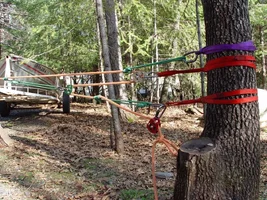
Rigging Pull Tree

Brian,
I have to disagree we you on this one. Yes common sense goes a long way but let me quote you something that I read:

"In the rigging trade there is no substitute for years of experience. but when working by rule of thumb alone, many times ropes and other load bearing-parts [ of the system } are stressed to a point dangerously close to the breaking point without the rigger realizing it. The author has no intention of attempting to make professional engineers out of riggers, but they should be able to make simple calculations to check their loads and the strength of their equipment. The element of chance will then be reduced to a minimum. Decisions, especially where life and property are involved, should not be made from sketchy information."

(W.E. Rossnagal, Handbook of Rigging (3rd edition), 1964.

If a calculator can be developed that will help us accomplish the above, I think it is a great idea.

If we did not use our imaginations more, than we would still be climbing with manila line.

Chris
 
Brian;
I don't disagree with you on good gut feeling and experience but on the other hand most of the tools we buy to execute the work safely like the bull rope are rated for our safety so I cant help but wonder why we would calculate the swl for a rope and not know within reason what we are attaching it to.
It would add to the safety factor I would think and remove some of the guess work.
There's little doubt that someone somewhere would make a mistake with it but that's already happening in this industry.
There are lots of guys doing tree work that are breaking slings and rope because they think the system is safe but if they could check their estimates quickly it might serve to prevent at least some of these accidents.
Maybe I'm just off on another tangent!
grin.gif
 
Like I said before, buy a PDA, input the spreadsheets and even keep a client list and calendar on it for under $200.00. No one needs a special one purpose calculator.
By the way, I better not get sued because someone didn't understand the purpose of these calcs and dropped a tree on their head.

Dave
 
Dave: I put a disclaimer at the bottom of a few of my posts "in the beginning". I was assured the good samaritans laws applied to the posts.

Since I'm thinking about it, I have no good stories of difficult pull trees.

Joe
 
Dave: I disagree. Figuring arc length is trig. The tree moves through an arc. The line is attached to the tree. That point of the line attached to the tree must move with the arc of the tree as the tree moves. I'm thinking it's not just the distance across which needs to be measured, but also the distance up and down. I'm not afraid of being proven wrong. I prefer it.

Joe
 
O.K Dave you're correct about me being wrong. I deleted that mess. I had to play with it from a different perspective. You still didn't prove me wrong, you just stated I was wrong. :)

Joe
 
Try this out ...
Calculator


Distance From Ground to Center of Gravity (feet) 45
Tree Weight(pounds) 10000
Angle of Tree to Ground 80
Height Rope is Tied(feet) 70
Angle of Tree to Rope 90

Result is 1118.0 lbs.
 
</font><blockquote><font class="small">In reply to:</font><hr />
Poster: Riggs
Subject: Re: Rigging Pull Tree

is this tree on the floor yet ? Somebody please cut that tree down .


[/ QUOTE ]

Sorry Riggs, are we boring you?
This is the best thread I have been on since "forces on a speedline"!

Dave
 
Kevin, that tension calculator spreadsheet looks great. I am going to try some numbers out by longhand using your formulas and the spreadsheet.

The tree is not on the ground yet because it is out on an island in the middle of a lake in N.H. AND I have to wait until the ice is thick enough to drive out on.

Chris
 
This thread slowed down a bit , so I thought I would throw in a question on the rigging. (SAFETY STOPS) Does anyone use them when using a MA&gt; ?

Thanks
Greg
 

Attachments

  • 7948-Safety #1.webp
    7948-Safety #1.webp
    302.8 KB · Views: 62
I'll use a stop in most critical situations or where I am unsure of the reliability of the person doing the pulling. I think your picture is a tad overboard though. 3 different stops on one setup, and the way you have them set they are likely to bind up the works and make your Z rig unworkable.

It looks like something a European government committee might impose on the industry though.
 
Rocky ,

I dont set it up that way when pulling a tree, although I have and the set up dosnt bind , not yet anyway .I usually only use one stop when pulling a tree. However, the amount of stops on there is for life rescue and and passing a knot through the pulleys.
Sorry this wasnt set up for the question, I just happen to have the pics for another reason .

Greg
 
/forum/images/graemlins/grin.gif

Heys guys, I was going through some of my old posts and realized that I never finished this thread to let you know the outcome of this takedown.

I did the removal last year and everything went well. I used Kevin's and Dave's Line pull calculator from The Forestry site and estimated that I would need between 6000lbs of tension on a straight pull, which I did not want to do.

What I did was use a tailhold and spar tree with a block set perpendicular with the angle of pull, ran it down to my rope come along and used a Samsom 1/2" 3-strand bull line to pull it over after the hinge was cut up. I ended up with plenty of MA.

Piece of cake. I got some pictures of the rigging setup which I'll try to post at a later date.

Chris
 

New threads New posts

Back
Top Bottom