TCtreeswinger
Branched out member
Daniel if you're loading 1/2" line like that, how often are you replacing ropes? Just curious

Follow along with the video below to see how to install our site as a web app on your home screen.
Note: This feature may not be available in some browsers.


X2 on CMI
Somehow we lost the snap ring out of a CMI 5/8" block that keeps the upper pin and bushing in place. I tried several times to find one locally, but it's an odd size, so contacted CMI to see if they could send me one. They said send the block back, they'd inspect it and fix it. Yesterday, I received a brand new block in the mail from them!! No note, no letter, no bill, just here you go. Now that's how you do customer service!Super in love with CMI blocks

So I'm looking to purchase my very first rigging setup in the near future. I would like to get the dmm impact block(5/8") and also the medium port a wrap(5/8"). I know by purchasing the 5/8" impact block, I will have to use a rigging line that's 5/8" or less, but what size can my whoppie, loopie, or dead eye sling be? I've searched online at treestuff and wesspur...if everything in this setup will be 5/8", then every piece of rope will be the color red, which is odd. I don't know why they would make all 5/8" rope/slings red. I'd rather have assorted colors to label which rope goes with the block and which one goes with the port a wrap(the color is not a big deal though). Also would you recommend a whoppie, loopie, or dead eye sling over the other? I was thinking about just purchasing 2 eye slings over the "oopies" being that you have to literally tie an cows/timber hitch to lock it down rather than girt hitching with the "oopies". Any thoughts?


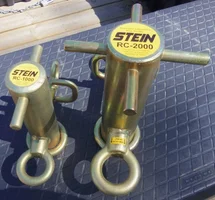
FYI, I've seen people do that with the lifting eye on a Port-o-wrap, using a small bungee or similar. Although I must confess I really don't see the need: Push the bight of the rigging line thru the eye and over the nub, pull down with the left hand and up with the right to tension the rigging line and stand the POW up, and take wraps. What's so difficult or time-consuming about that? I do it 100 times a day when I'm on the ground and really haven't seen the need to "improve" upon it.The big difference between the Stein bollard and the Port-a-Wrap design is that the Stein has a ring at the top that makes it possible to hang it up on the trunk of a tree, which allows it to maintain a vertical orientation.


plentyDaniel if you're loading 1/2" line like that, how often are you replacing ropes? Just curious

Definitely the biggest wood ive seen put on True blue. I wouldn't have hadt he nut to put it on that, but the I again I don't have 100 years of using it like you Daniel.that's an 1100 lb piece of oak..... I think the true blue should handle your side jobs just fine...
and here's a big tulip top coming over on true blue....
CMI or ISC doesn't matter much.. get something that is rated at 25,000 lbs and then just get some light shackles and put them on short pieces of old climbing or rigging line for redirects...
That said.. though we all have individual viewpoints.. I AM feeling the love here..

No worries..Definitely the biggest wood ive seen put on True blue. I wouldn't have hadt he nut to put it on that, but the I again I don't have 100 years of using it like you Daniel.
Just playin' ol'man

This is not good advice. 5/8 ropes are not that heavy. Are you carrying a rope bag around during your removal? Larger rope, larger safety margin. 1/2 in is not for everything. Rope should be the weakest part of the system? Why? If u never need any thing larger than 1/2 in then u are not doing large removals. Or u are taking tiny pieces or you are being reckless.If you don't have much rigging experience, I think you should start off with some 1/2in rigging line such as true blue, poly, or stable braid. The rope should always be the weakest link.
9/16 is pretty close to most 1/2 lines, just heavier and you don't need it most of the time.
5/8 is rarely necessary, unless you work on huge oaks a lot. And HEAVY
But IMO for you first purchase, I would go with Samson true blue, 200ft. A very forgiving and well wearing line for anything you come across.
This is not good advice. 5/8 ropes are not that heavy. Are you carrying a rope bag around during your removal? Larger rope, larger safety margin. 1/2 in is not for everything. Rope should be the weakest part of the system? Why? If u never need any thing larger than 1/2 in then u are not doing large removals. Or u are taking tiny pieces or you are being reckless.

It's not a misunderstanding, it's called a difference of opinion.THis is a perfect example of a major misunderstanding in the industry..


