Reg,
Nice video.. you leave nothing to chance and the helmet cam shows a lot of detail from which much can be learned... That said, I do have a few comments/suggestions/criticisms which can hopefully generate some good discussion.
Thanks man, you're welcome
I don't like the placement of the pulley on the first cut, so far below the notch. If you were using that placement to make the second cut as well, from the same placement, and you weren't worried about the additional shock loading from the longer fall, then that is understandable, (and it looks like that is the case) then fine, though an inexperienced climber might look at your video and make the mistake of thinking its good to place the pulley so far below the notch on a regular basis...
Dan you are correct that another section followed from above the rigging point (not in the vid) so its placement was convenience. Consider also that neither log was heavy enough to cause a concern, relatively speaking that is. In the past I have dropped logs and branches from almost 15ft directly above a rigging point where it made more sense than to otherwise follow the book, guess you had to be there.
Cutting a narrow humboldt for the final fall, would have dropped the but uphill of the stump, before the tip hit, thus preventing the log from sliding or bouncing back into the wall, and precluding the need for a control line on the final cut. That is one of the rare times that a humboldt is a good cut in suburban arboriculture!
A humboldt generally needs some top-weight to break the hinge, unlike the relatively short log in the vid. I would however have used a humboldt had I wanted to close the notch without breaking the hinge and then cut some more to let it down gently….but I obviously didn’t want to do that.
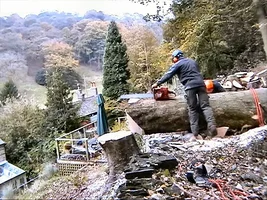
If you have enough top-weight to break a narrow, shallow notch then the butt can reach the ground first whether using a conventional or Humboldt….the difference in the two is how the opposing surfaces meet as the notch closes….because of this a humboldt can initiate a cleaner more instantaneous break, thus the tree (especially a tall one) is carried further clear of the stump because its momentum has only incurred the slightest delay. A wide Humboldt achieves almost nothing for the same reason….and without boring the middle of the one in the video or cutting the hinge to within a mm of its life then there was more to lose than what was to gain. The TreeHouse might be the better domain for Humboldt talk Dan. The log didn't move anyway, see photo.
I generally cut my notches shallower unless there is a need for a deep notch, both in falling and when aloft. Also making the top cuts first, is highly recommended for ease of matching the two facing cuts, especially when movement and therefore vision is limited, when standing in the hooks...
Dan I’ll cut them whichever way the moment takes me, I have a relatively good eye-sight - hand coordination.
And I personally don't like the double blocks, just cause it seems like it is a lot of needless extra work. A single block and line should be well within the safe working load limits of the your gear, for those sized pieces... Have you done the math? (that said I did just break my first rope on Wednesday)...
All things considered, probably about 2.5 tons hit the slings on the second log….sure a single rope and sling can take that, but how many times? I have scorched, melted and so shortened the life of so many in the past, and they are not cheap….but are still nothing compared to the potential damage of losing a heavy log if a rope fails. Yeah I do the maths Dan, but please don’t ask me to recite probably the most repeated, tediously over-stated equations that are so often spoken in such a topic. People have been doing that for many years now, same ole script but no further forward. I suppose yes, its new and relevant to folks coming into the job so that’s fair enough….but solve the problem, don’t just write about it for decade after decade….that’s all I’m trying to do here with this technique, get a little further forward.
That is my first impression, and it could be that we all just like what we are used to... Maybe using the two blocks and lines is a time saver, by allowing larger pieces to be rigged, and thus saving time by making fewer cuts, and having to move fewer times, while the double bollard device keeps the ground work simple.. Thus your point about "making the logs worth it"... Who knows for sure until they try it... thankfully we can usually either fall the spar or use a crane, or at least set up the rigging from a bucket truck...
Your attention to detail and precision in rigging is flawless and that is appreciated by many here. Thank you for taking the time and energy to make the videos. They are a lot of work and a gift to us all... I don't mean to sound ungrateful, I suppose I just lack the patience to set up riggin like that...
To live with my wife is to know patience, rigging is a breeze. Your alright Dan!