TheTreeSpyder
Branched out member
- Location
- Florida>>> USA
Kathy\'s Question
i was werking with some pulleys and the Dynamometer with some 10yr. old mens today (they help make me feel tall!). i was coming up with some simpler explanations, i think.
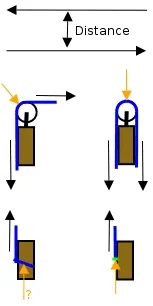
We had these pulley systems nested to compound/multiply their powers. They were pulling a hefty 1500#, each taking turns, few pix... There was a single line pulling on the dynamo registering 1500# when each took turn pulling, so we calculated it must be holding 1500# per line pretty quickly. A change in that came at a dropeye/becket pulley at the end of the single line; so we figured that was 1500/3 or 500# per line (3/1, easy to see, fer them as 1500# line was fedding into 3 lines most definitevely)after awhile. That fed into a 5/1 system, so 500#/5 per line etc. The lead 3:1, to move a load 1', you'd have to take 1' out of each of the 3 pull lines; or 3'input effort pull, to get 1'output work at 3x power. So, we are just funnelling 3' of work into 1'.
Also, If you had 300# sitting in a 3 square inch tiles; that would be likewise (as pulley systems) 100# per square inch. If we concentrated that into just 1 of the square inch tiles, that would be 300#per square inch(tile). In each case, no gain, no loss, just rearraingemeant; so that A always equals B. It is just factored different on each side; Like 300# lifted 1' (or into 1 square inch in tile example); is equal force/ work effort input, as to lift 100# 3'(0r 300 sitting on 3 square inch tiles etc.); which is equal to 20# lifted 15'. They all equal 300 foot pounds of work effort. Foot pounds right away telling you distance X power.
When, you turn a wrench, the longer it is the more easier power turning nut. The big circle of your turn of hand, is picking on, focusing/funneling into the little itty-bitty small nut, that in turn, takes advantage over the threads/real work. Just more distance, funneld into a smaller distance, so more power. Just like if 300# sits on 3 square inch tiles, or 1, determines how much pressure per square inch. We talked about how in some theif movies, they keep from setting off the pressure alarm in floor with some type of ski etc. spreading weight out to that of a dog etc.
If all the distance for turning the nut, was walked straight out, instead of in a circle, it could be several feet, taking you away from work. Like the recycle symbol, the circle allows us to stay in 1 location, turn nut 10x, and not be going back and forth or finish 20' away. The pedal crank on a bike, is a larger circle than the chain sprocket it drives, therefore concentrating /funneling power into smaller space/less tiles. So we have power increase. If sprocket arc was larger than pedal arc, that would be diluting, spreading your force over a bigger area, losing power faster. So, the smaller crank in front gives more concenttration of your power, while the larger sprocket covers more distance/speed but with less power for starting off, going up hill. But, each crank is driven by the same pedal push, so all equal/no magic, just L-earn your math!
Water pressure the same way, squeeze a forced pressure through a smaller hole, it has more power, everything equaling out keeps every act/force in balance. Every act and force bieg in balance, having an equal and opposite, means that the whole world stays in balance! Any changes in power speed/distance are jsut rearringements, not magic divine force. A car engine has a certain power output, transmission is leveraging circle gear system, that gives more power or speed etc. So, we talked about 2 speeding a screwdriver by turning either the handle or the shaft, to pwer the same screw. The shaft gives speed, the handle power in our little transmission. Then it was swim time.
Glens- the Flash animations are vector, not raster graphics; and can be strategized to lots of animation etc. in a very small filesize by use of symbols reperesenting repeated graphics, isntead of the graphics themselves each time. Such as in this BarberChair animation @ 55k. Which also illustrates at full screen size that the vector graphic can be enlarged many times with no loss to definition, or increase in filesize, like regular raster graphics. All your comments about filesize etc. are partially what kept me poking around till i came up with this.
i was werking with some pulleys and the Dynamometer with some 10yr. old mens today (they help make me feel tall!). i was coming up with some simpler explanations, i think.
We had these pulley systems nested to compound/multiply their powers. They were pulling a hefty 1500#, each taking turns, few pix... There was a single line pulling on the dynamo registering 1500# when each took turn pulling, so we calculated it must be holding 1500# per line pretty quickly. A change in that came at a dropeye/becket pulley at the end of the single line; so we figured that was 1500/3 or 500# per line (3/1, easy to see, fer them as 1500# line was fedding into 3 lines most definitevely)after awhile. That fed into a 5/1 system, so 500#/5 per line etc. The lead 3:1, to move a load 1', you'd have to take 1' out of each of the 3 pull lines; or 3'input effort pull, to get 1'output work at 3x power. So, we are just funnelling 3' of work into 1'.
Also, If you had 300# sitting in a 3 square inch tiles; that would be likewise (as pulley systems) 100# per square inch. If we concentrated that into just 1 of the square inch tiles, that would be 300#per square inch(tile). In each case, no gain, no loss, just rearraingemeant; so that A always equals B. It is just factored different on each side; Like 300# lifted 1' (or into 1 square inch in tile example); is equal force/ work effort input, as to lift 100# 3'(0r 300 sitting on 3 square inch tiles etc.); which is equal to 20# lifted 15'. They all equal 300 foot pounds of work effort. Foot pounds right away telling you distance X power.
When, you turn a wrench, the longer it is the more easier power turning nut. The big circle of your turn of hand, is picking on, focusing/funneling into the little itty-bitty small nut, that in turn, takes advantage over the threads/real work. Just more distance, funneld into a smaller distance, so more power. Just like if 300# sits on 3 square inch tiles, or 1, determines how much pressure per square inch. We talked about how in some theif movies, they keep from setting off the pressure alarm in floor with some type of ski etc. spreading weight out to that of a dog etc.
If all the distance for turning the nut, was walked straight out, instead of in a circle, it could be several feet, taking you away from work. Like the recycle symbol, the circle allows us to stay in 1 location, turn nut 10x, and not be going back and forth or finish 20' away. The pedal crank on a bike, is a larger circle than the chain sprocket it drives, therefore concentrating /funneling power into smaller space/less tiles. So we have power increase. If sprocket arc was larger than pedal arc, that would be diluting, spreading your force over a bigger area, losing power faster. So, the smaller crank in front gives more concenttration of your power, while the larger sprocket covers more distance/speed but with less power for starting off, going up hill. But, each crank is driven by the same pedal push, so all equal/no magic, just L-earn your math!
Water pressure the same way, squeeze a forced pressure through a smaller hole, it has more power, everything equaling out keeps every act/force in balance. Every act and force bieg in balance, having an equal and opposite, means that the whole world stays in balance! Any changes in power speed/distance are jsut rearringements, not magic divine force. A car engine has a certain power output, transmission is leveraging circle gear system, that gives more power or speed etc. So, we talked about 2 speeding a screwdriver by turning either the handle or the shaft, to pwer the same screw. The shaft gives speed, the handle power in our little transmission. Then it was swim time.
Glens- the Flash animations are vector, not raster graphics; and can be strategized to lots of animation etc. in a very small filesize by use of symbols reperesenting repeated graphics, isntead of the graphics themselves each time. Such as in this BarberChair animation @ 55k. Which also illustrates at full screen size that the vector graphic can be enlarged many times with no loss to definition, or increase in filesize, like regular raster graphics. All your comments about filesize etc. are partially what kept me poking around till i came up with this.