reverse MA

treebing

Been here much more than a while
Location
Detroit, Mi.
I work for a small company with no big log reemoval equipment, except a heavy duty root Ball Cart which takes pretty big logs. We had a large red Maple removal in a backyard today and it happened to be 150 feet down a 25 degree hill. While I was in the tree, the ground guys were wrestling with logs and brush up this slope and were about dead by lunch when we had the trunk on the ground, not even to the hard part yet.

My first instinct was to rig some pulleys to create a straight line and run the truck up the driveway to pull the ball cart up and an operator would only have to hold it steady. The problem was that we only had about 60 feet of driveway before a busy road.

Finally I realized that If I reversed some MA I could exchange force for speed and an F250 has way more force than needed to roll a ball cart.

I rigged a 1 to 2 system with the rope lined up at the front of the trailer (we have a three axle roll up). And went at it. Basically what it came down to was a pulley on the bumper of the truck, one end of the rope tied off on the trailer and a redirect off a tree using a Double pulley. this was just so the rope didn't run up a small tree, and the truck would have a straight angle up and down the driveway.

It went great except that the guy driving the truck at first didn't realize that the speed of the ball cart would be double his speed and nearly sent the ball cart operator flying out of control into a bush. Could have been bad but thankfully was just funny.

We were able to fill that trailer with big ole chunks of wood as fast as we could cut it and were out of there by 5 with healthy backs, and a new tool for future use.

I have always wanted to use reverse MA. When I was with another crew, I once set my pulley up in the tree, put a pulley on the trunk, a pulley on the bumper of an atv and tied the rope back to the tree. I tried to have it pull me 50 ft up a tree with 25 of space. The ATV was not strong enough and bogged down. That suprised me because when the ATV had a straight shot, it could pull me up the tree like it was nothing. With a truck it would work, a 1 to four sytem would even be easier, the truck goes 10 feet you shoot up 40. Whats cool too is that you arent limited as much by rope length as you are when you set MA for leverage.

I was thinking that it would be cool for the hell of it to rig it so extreme that the F250 diesel my boss is so proud of would just stall out.

When I first thought that, I thought, you would break the rope if you were to stall out truck. thats a lot of force. Thinking about it, I don't think you would, as all you are putting on a single line would still be my wieght only. What would it take? a 1 to 30? what would that look like, thats a lot of pulleys. Anyway now you all know what was on my mind last night when my girlfriend kept on bugging with that "what are you thinking about?"
Just stuff.

take care.
 
I'm surprised that the ATV bogged on just body weight. But I'm also confused about how you got 50' of lift with 25' of input using a simple system.

When you use vehicles for pulling anchor your system to the frame not the bumper or the ball on the hitch. The frame is the strongest anchor. I had some pieces of rigging ropes tied into loops using double fisherman's hitches that were used only for frame anchors. The ropes were large diameter and got junked when they got too greasy or got nicks from the frame. This is another way that old ropes got used up.

When I had my ATV I would load logs using a similar setup. Anchor the rope to the tongue of the trailer or to the truck. Choke a loop around the log and use a pulley there. Then another pulley at the front of the trailer and the rope terminated at the ATV. WE would load some hellacious logs onto the trailer with just this double whip tackle setup.

Good to use your head instead of your back.
 
[ QUOTE ]


When I first thought that, I thought, you would break the rope if you were to stall out truck. thats a lot of force. Thinking about it, I don't think you would, as all you are putting on a single line would still be my wieght only. What would it take? a 1 to 30? what would that look like, thats a lot of pulleys.

[/ QUOTE ]

Say you weigh 200 lbs, at a 1:30 MA, disregarding friction in the system it would take 6000 lbs of pull to lift you. (but 2 ft of pull would lift you 60 ft in the air (but 60 ft of air would require at least 1800 ft of rope)) great use of a mechanical disadvantage but be aware of the forces. Even with your 1:2 system getting a log moving could take up to 200 lbs of force, 400 at the truck, while this is not much, if the cart wheel falls in a hole and the driver is not aware, the truck will not feel the increase of force until there is a lot of pull on the rope. With a groundie standing at the cart, snapping a rope could be nasty.

One thing I do when using a block at a vehicle is to double tie it to the frame, one sling takes the load and the other is loose so that if a sling gets cut on the frame, the second sling catches the block. This happened to me once and I am sooooo thankful we were in an open area and no one was standing in line with the block. It flew about 60 ft and the only thing that stopped it was the rope going tight the other way. It would have killed a person for sure. Maybe get a tie in point welded to the frame?

Dave
 
Thanks for the cautions. We, in this case tied the block to the hoop which takes the trailer chains, are those frame attached? I said bumper because that was in the vicinity. On the front of the Vehicle their are tow hoops that we sometimes use. The biggest danger we found was if the driver were to back up with out someone hauling on the sope to keep it from getting run over. and that will screw up a rope.

I like the double sling idea for a back up. But I dont see why you would need 1800 ft of rope to get 60 ft in the air with the 1:30. All you would need is to have enough rope to go from you through the pulley 60 ft up in the tree back down to a block on the base of a tree and then through 30? pulleys in compressed formation with one half atached to a solid anchor and the other half atached to the frame of the truck. The truck hits the gas in 4 low, it goes 2.5 feet at one mile per hour, and you fly off into the tree at 30 miles an hour and get squeezed through the pulley if your brains were not already smashed on a branch. That is if the truck doesn't stall out.

Tom, the ATV bogged down when trying to haul two of me up the rope at one time. Without the 1:2 system it did fine. Try it, I think with a bigger atv or something it might work.

Before I thought to try the reverse MA, I tried doing what you mentioned and put a pulley on the ball cart, and tied one end of the rope to the trailer, the two operators would walk down the hill put the rope through the pulley and one person would hold the ball cart and the other would pull the rope. esentially a 3:2 system. It was lighter but way slow, so the person pulling found that it was only efficient if you ran. Cause in that way, the puller has to go twice the distance that the ball cart has to go. That would be good for much heavier loads, where speed could be tolerated at less than walking.

Mark, a tractor would be nice but how do people feel about what the tractors do to their yard not to mention the compaction on other tree roots in the area? Tractors tread heavy. On this job, we did not leave a dent, an no broken sprinkler heads.
sometimes its good to go light.
The one thing that I would like is to get one of those future forestry arches so I could get milling logs out of situations like that.
 
[ QUOTE ]
Mark, a tractor would be nice but how do people feel about what the tractors do to their yard not to mention the compaction on other tree roots in the area? Tractors tread heavy. On this job, we did not leave a dent, an no broken sprinkler heads.
sometimes its good to go light.


[/ QUOTE ]

You're right, sometimes going light is necessary. Most times a small tractor is perfect. We work in some very particular sites. These particular clients wouldn't allow us to leave their yard looking torn up. The tractor is relatively light and only does damage when it is very wet, the loads are too heavy and during a turn the front tires can cut in if loaded too much. Otherwise it works well. If there is a spot that will get damaged we pull out some alturnamats.

The log dolly is good for the spots where the truck or tractor don't go. But, sometimes you just have to do it the hard way.
 
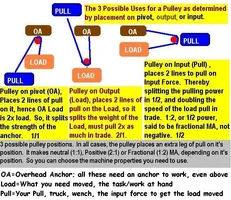
i've done this lots of times; especially like wanting to drag piles up a 50'hill with only a 25' run for truck. There are 3 basic pulley positions i think of input effort, output work, pivot/anchor. Pulley on pivot/anchor places 2x load on it, and gives 1:1 MA. Pulley on output work/load likewise places 2 legs of pull on the load; gives 2:1 MA. The 'final' positon to place pulley is on input effort/truck breaking it's pulll into 2 legs; so that 1 leg goes to an immovable anchor; other on output effort/load; there will be half as much power cuz pulling half of force on anchor and not all on load. So there will be 2x as much speed in trade or 1:2. i think better to say inverse MA to imply multiplication/division ratios; rather than reverse MA to imply additive/subtractive numbers.

1:30 X 60' = 1800' line machine etc.

If truck pulls forward to pull up, an extra low pulley can be employed to maintain traction. Without the pulley, as you pull forward lift is also placed on back of vehichle to lose traction. An extra pulley redirectiong the line to only pull at the hitch level of the vehichle, will allow all power and traction to be exerted forward without this loss of traction. At the expense of loading the chosen anchor to >Load, extra line and pulley. The ATV could have bogged down with 1:2 because the gain in speed, must be matched by a reciprocal lose of power, then less pulley friction for the Equal and Opposite/ Yin-Yangs to balance; as even the Theory of Relativity must have an Equal sign and be balanced. It is The Law!

This drawing was like my 2nd i ever drew; so is lil'rough might recognize from ISA forum.
 

Attachments

  • 27266-3pulleypositions.webp
    27266-3pulleypositions.webp
    98.6 KB · Views: 157
Good Point; but 1 for redirect to ground/ truck level to keep from losing traction should be equitable. If no impact can use a bearing$ pulley. i'm guessing 10% rope rubbin'and pulley friction per bushing redirect fer our experiment, and 5% per smooth bearing to see how conservative a guess on output that gives. Meaning if it was more efficinet than calculated need, cuz of over calcualted friction, is cool?

Also, that is part of reason for using hand hold tricks for more focused power on load, rather than add pulleys; raisng all the power potential to the same load, carrys less load on supports, as more is focussed on load, and it moves sooner/with less input power needed/ thereby less support load. In a dynamic drop, that positive can reverse on ya, in that the more lines of pull on load supporting, lowers load per same tensile line, thereby less usable elasticity in system. ie. A 3/1 at static hold has 1 1/3 x Load on support; a 1/1; simple pulley redirect has 2x load at static hold; so 3/1 has less support load. Differing elasticity of same line is determined by how much of the load is of the tensile strength; so the higher the SWL; the lower the elasticity. So, the 3/1 at static is less support load, but in a dynamic drop that can engage the dynamic/elastic response from line to buffer (that static can't use); the 3/1 has higher SWL; can hold more weigth; so will give more shock to support!

i think this is a big tradeoff to be aware of, in using linear MA with rope (not as present in angular levrage, use of line leverage near 180/flat bends)on load, rather than pretightening/compression jig. The increased support lines on load, decrease the elasticity of each, for the each bear less weight. And the elasticity response from the same line is given by how high the loadforce is in ration to the tensile strength; going lower takes elastic shock absorber away! In a 3/1 with not very much length of elasticity given on control leg and/or stiff line, the force of dropping the same log into 3/1 can be ~2.5 times on support than with a single line! Even though at a static hang,the 3/1 would load support less.

So, pretightening; high input line tension (ummmmmmmm that rigging calcualtor 1.0 doesn't allow variable for) with as much power focused in and out of device is best; like knowing the hand holds, then hingeing slowly over on overhead rigging so that motion pretightens line even more.

Or something like that;
Sorry fer the Sunday mourning preach;
and will be setting up Super Bob at some point;
and possibly doing requests
(know, that doesn't mean i'll shut up! /forum/images/graemlins/crazy.gif)
 
ok, you MA smartie guys. i have to admit, i keep reading and rereading these ma threads and getting more and more lost. anyone know of a SIMPLE book on the topic of mechanical advantage?

feeling stuhupid here..
k.
 
Kathy;

Try:

"Basic Machines and How They Work", Dover publications, chapter 2.

Or, much easier to find,the article 'Understanding Mechanical Advantage', in the book "Safe Work Practices", published by the ISA.

I'm sure that the latter will be available in Nashville.
 
Kathy,

No "stuhupid" people at the Treebuzz Cafe, just people who want to learn more :)

This thread might help a little:

http://tinyurl.com/d9npm

There is a page from a sailing website that has small, moving illustrations of a number of basic MA setups. I've posted it in the past but my bookmarks got poofed during a reformat job. Does anyone have that link? I'm googling like mad but can't find it.

This might have to do for now. The animated page is pretty cool.

http://www.pbenyon.plus.com/B_S_M/Purchases.html


Ken Casey/Spidey has some interesting MA stuff with graphics on his webpage.
 
[ QUOTE ]
Kathy,
Also, the ISA's little workbook on Practical Rigging has a very simple explanation.

[/ QUOTE ]

The text version of the article is included in the thread that I linked to in the above thread. Along with some great discussion too.
 
[ QUOTE ]
[ QUOTE ]
Kathy,
Also, the ISA's little workbook on Practical Rigging has a very simple explanation.

[/ QUOTE ]

The text version of the article is included in the thread that I linked to in the above thread. Along with some great discussion too.

[/ QUOTE ]

I assume CharlieB meant ASPR--The Art and Science of Practical Rigging. There is an 8 part video that can be purchased along with the book.

Tom;

ASPR is on the Sailing Smacks-Tackle link?
 

New threads New posts

Back
Top Bottom