- Location
- Springpatch, IL

Navigation
Install the app
How to install the app on iOS
Follow along with the video below to see how to install our site as a web app on your home screen.
Note: This feature may not be available in some browsers.
More options
You are using an out of date browser. It may not display this or other websites correctly.
You should upgrade or use an alternative browser.
You should upgrade or use an alternative browser.
Retrievable false crotch for long rappels
- Thread starter Tom Dunlap
- Start date

- Location
- Home of the New Jersey Devils
I agree. Or, tie the retieval line directly to the krab.
The problem with tying the retrieval line to the loop or carabiner is that sometimes it is difficult to overcome the friction of the knot which is cinched down around the branch. I think Whitinsville's idea has potential. Maybe tie a stopper knot on the end of the rap line that will pass through the biner but not through the quicklink, or use the retrieval ball from a Rope Guide. This way the quicklink will catch on the end of the climbing line and you can still pull it out of the tree.
If you could get this system to work smoothly it would require much less effort than fighting to "unlock" the cinched up rope. Of course, you would still have to worry about the biner getting hung up in stuff on the way down.
If you could get this system to work smoothly it would require much less effort than fighting to "unlock" the cinched up rope. Of course, you would still have to worry about the biner getting hung up in stuff on the way down.
- Location
- Springpatch, IL
Leon,
By attaching a retrieval ball or tying a stopper knot at the end of the access rope, I could only think of further problems that this might cause. If the concern is that the bight of the rope is cinched around the limb, then once the stopper knot reaches the bight/biner, it would seem that the knot/retrieval ball would jam against the bight/biner, and lock itself to the limb. Once this happens, you're SOL.
At least with the retrieval line being attached to the bight/biner side of the access rope, you have the option of manipulating both lines, in which you can easily loosen a cinched knot around a limb.
Mike
By attaching a retrieval ball or tying a stopper knot at the end of the access rope, I could only think of further problems that this might cause. If the concern is that the bight of the rope is cinched around the limb, then once the stopper knot reaches the bight/biner, it would seem that the knot/retrieval ball would jam against the bight/biner, and lock itself to the limb. Once this happens, you're SOL.
At least with the retrieval line being attached to the bight/biner side of the access rope, you have the option of manipulating both lines, in which you can easily loosen a cinched knot around a limb.
Mike

- Location
- Massachusetts
I think that someone hit the nail on the head when they said they just use a friction saver (I think someone said that?). That seems to make the most sense to me.
But, concerning the system we were discussing, I was operating under at least two presumptions:
1. The doubled rope will not reach the ground.
2. There is enough friction on the limb to prevent retrieval by pulling the krab or working end. If this is not so, I agree that one would simply tie the retrieval line to the krab or the bight.
I did not consider that the krab could get stuck in the crotch on it's way over. That's certainly a valid point. I don't think it would be a problem in most situations because the krab is smooth and round, but it leads us to the second problem that someone pointed out: a krab falling through the air among lots of brush is generally a bad thing (not to mention the bowline it's attached to.
Mike also pointed out that "the pull line would pull the standing part of the rope through the biner, the quick link/pull line would then fall to the ground . . .." But I think this is less of a problem than it would seem. The standing part will not "fall" from the krab until it's almost half-way down (until the part you're pulling weighs more than the end still hanging). But even then it will stay through the quick link until it's all the way down. The only instance in which this would not be true is if the retrieval line itself landed on a limb and got stuck there temporarily while the climbing line "fell" out of the link. If you run through the scenario in your mind, you realize it's not a probable one.
Still, for $45.00, it seems to me that the friction saver is the way to go.
But, concerning the system we were discussing, I was operating under at least two presumptions:
1. The doubled rope will not reach the ground.
2. There is enough friction on the limb to prevent retrieval by pulling the krab or working end. If this is not so, I agree that one would simply tie the retrieval line to the krab or the bight.
I did not consider that the krab could get stuck in the crotch on it's way over. That's certainly a valid point. I don't think it would be a problem in most situations because the krab is smooth and round, but it leads us to the second problem that someone pointed out: a krab falling through the air among lots of brush is generally a bad thing (not to mention the bowline it's attached to.
Mike also pointed out that "the pull line would pull the standing part of the rope through the biner, the quick link/pull line would then fall to the ground . . .." But I think this is less of a problem than it would seem. The standing part will not "fall" from the krab until it's almost half-way down (until the part you're pulling weighs more than the end still hanging). But even then it will stay through the quick link until it's all the way down. The only instance in which this would not be true is if the retrieval line itself landed on a limb and got stuck there temporarily while the climbing line "fell" out of the link. If you run through the scenario in your mind, you realize it's not a probable one.
Still, for $45.00, it seems to me that the friction saver is the way to go.

- Location
- Bloomington, Indiana
[ QUOTE ]
Still, for $45.00, it seems to me that the friction saver is the way to go.
[/ QUOTE ]
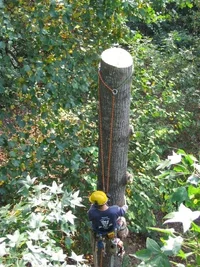
Or, make your own adjustable friction saver for less than $20.00. Easy to install, easy to retrieve, and the climber can both descend and ascend. (Photo credit: Tom D.)
Still, for $45.00, it seems to me that the friction saver is the way to go.
[/ QUOTE ]
Or, make your own adjustable friction saver for less than $20.00. Easy to install, easy to retrieve, and the climber can both descend and ascend. (Photo credit: Tom D.)
Attachments
- Location
- Massachusetts
$20 is good. Can you give a bit more direction?
Also, on a different note, how do others tie their throw line to the climbing line when setting up?
Also, on a different note, how do others tie their throw line to the climbing line when setting up?

- Location
- Retired in Minneapolis
A pile hitch is the best attachment for rope/throwline that I've found. It can be tied and untied with winter gloves on. The best selling point is that it is very secure and doesn't roll off the rope.
- Location
- Baltimore, MD.
Mahk, what keeps the friction saver from slipping... a nub?
Also, wouldn't there be a lot of extra friction due to the line being pressed between the trunk and the rings, as well as increased friction due to the tightness of the line against the trunk? At least that what I experienced one time when I used a friction saver that didn't fit completely around the trunk.
Thanks,
Jim
Also, wouldn't there be a lot of extra friction due to the line being pressed between the trunk and the rings, as well as increased friction due to the tightness of the line against the trunk? At least that what I experienced one time when I used a friction saver that didn't fit completely around the trunk.
Thanks,
Jim
- Location
- Retired in Minneapolis
Jim,
It's the rope/tree friction that makes this setup work. To keep the FC from slipping down it only takes the weight of the rope. When the climber gets to the next,lower station, lanyard in and pull the FC down to repeat.
It's the rope/tree friction that makes this setup work. To keep the FC from slipping down it only takes the weight of the rope. When the climber gets to the next,lower station, lanyard in and pull the FC down to repeat.

[ QUOTE ]
Jim,
It's the rope/tree friction that makes this setup work. To keep the FC from slipping down it only takes the weight of the rope.
[/ QUOTE ]
Would it hold in a wet sycamore or other smooth tree?
Jim,
It's the rope/tree friction that makes this setup work. To keep the FC from slipping down it only takes the weight of the rope.
[/ QUOTE ]
Would it hold in a wet sycamore or other smooth tree?
- Location
- Bloomington, Indiana
[ QUOTE ]
$20 is good. Can you give a bit more direction?
[/ QUOTE ]
You need to buy a small FS ring and a large FS ring--about $6.00 each from Sherrill. Splice the large ring to the end of your rope of choice, tie a split tail to the small ring and then attach the split tail to the rope with a Prusik.
[ QUOTE ]
Mahk, what keeps the friction saver from slipping... a nub?
[/ QUOTE ]
[ QUOTE ]
Jim,
It's the rope/tree friction that makes this setup work. To keep the FC from slipping down it only takes the weight of the rope. When the climber gets to the next,lower station, lanyard in and pull the FC down to repeat.
[/ QUOTE ]
Yea, what Tom said (he did take the picture).
[ QUOTE ]
Also, wouldn't there be a lot of extra friction...?
[/ QUOTE ]
There is obviously some friction, but when descending you don't even notice it. If you need to go back up, or pull some slack out of your line, the friction is just a little bit more than what you feel when climbing on a natural crotch.
[ QUOTE ]
Would it hold in a wet sycamore or other smooth tree?
[/ QUOTE ]
On small stems it might creep a little, but on trunk wood (which is where I use this setup) I think it would hold without any problem.
I like this setup because it is easy for the climber to move up or down, and because it is easy to retrieve. I have tried the SRT methods with a running bowline, but that system can be difficult or impossible to pull down if there are big crotches, flaky bark, or ivy on the tree.
$20 is good. Can you give a bit more direction?
[/ QUOTE ]
You need to buy a small FS ring and a large FS ring--about $6.00 each from Sherrill. Splice the large ring to the end of your rope of choice, tie a split tail to the small ring and then attach the split tail to the rope with a Prusik.
[ QUOTE ]
Mahk, what keeps the friction saver from slipping... a nub?
[/ QUOTE ]
[ QUOTE ]
Jim,
It's the rope/tree friction that makes this setup work. To keep the FC from slipping down it only takes the weight of the rope. When the climber gets to the next,lower station, lanyard in and pull the FC down to repeat.
[/ QUOTE ]
Yea, what Tom said (he did take the picture).
[ QUOTE ]
Also, wouldn't there be a lot of extra friction...?
[/ QUOTE ]
There is obviously some friction, but when descending you don't even notice it. If you need to go back up, or pull some slack out of your line, the friction is just a little bit more than what you feel when climbing on a natural crotch.
[ QUOTE ]
Would it hold in a wet sycamore or other smooth tree?
[/ QUOTE ]
On small stems it might creep a little, but on trunk wood (which is where I use this setup) I think it would hold without any problem.
I like this setup because it is easy for the climber to move up or down, and because it is easy to retrieve. I have tried the SRT methods with a running bowline, but that system can be difficult or impossible to pull down if there are big crotches, flaky bark, or ivy on the tree.

TreeCo
Carpal tunnel level member
[ QUOTE ]
On small stems it might creep a little, but on trunk wood (which is where I use this setup) I think it would hold without any problem.
[/ QUOTE ]
I like how this looks and works. I'm ordering the rings today.
On small stems it might creep a little, but on trunk wood (which is where I use this setup) I think it would hold without any problem.
[/ QUOTE ]
I like how this looks and works. I'm ordering the rings today.
- Location
- Retired in Minneapolis
Biners or screw links can be used instead of the rings. Screw links come in lots of configurations, round, triangle, half circle, square and oval. Super strong and tough too.
TreeCo
Carpal tunnel level member
[ QUOTE ]
Biners or screw links can be used instead of the rings. Screw links come in lots of configurations, round, triangle, half circle, square and oval. Super strong and tough too.
[/ QUOTE ]
Thanks for the info Tom. Am I correct is assuming that the hardware needs to be chosen so a knot in the rope catches in the small ring but passes easily through the large one?
Thanks,
Dan
Biners or screw links can be used instead of the rings. Screw links come in lots of configurations, round, triangle, half circle, square and oval. Super strong and tough too.
[/ QUOTE ]
Thanks for the info Tom. Am I correct is assuming that the hardware needs to be chosen so a knot in the rope catches in the small ring but passes easily through the large one?
Thanks,
Dan
- Location
- Bloomington, Indiana
[ QUOTE ]
Am I correct is assuming that the hardware needs to be chosen so a knot in the rope catches in the small ring but passes easily through the large one?
[/ QUOTE ]
If you use a knot to try to retrieve the system it will get stuck almost every time. Because the rope is pressed between the tree and the ring when the AFS is in use on a spar, the knot will run up to the ring and then become jammed against the ring. But, a screwlink (the same size that you would use to retrieve a standard FS from a tree) works every time.
If you don't have a rope with an eye on the end, just make a small (6-8 inch) loop with a piece of throwline and girth hitch the throwline to the screw link and to the rope.
Am I correct is assuming that the hardware needs to be chosen so a knot in the rope catches in the small ring but passes easily through the large one?
[/ QUOTE ]
If you use a knot to try to retrieve the system it will get stuck almost every time. Because the rope is pressed between the tree and the ring when the AFS is in use on a spar, the knot will run up to the ring and then become jammed against the ring. But, a screwlink (the same size that you would use to retrieve a standard FS from a tree) works every time.
If you don't have a rope with an eye on the end, just make a small (6-8 inch) loop with a piece of throwline and girth hitch the throwline to the screw link and to the rope.

- Location
- magalia california
I happen to run a one inch pulley on one side. if I'm using fly , splice want pull through . If I'm using Blaze or other smaller 11mm lines, I have found small screw link biners that catch perfectly in the pulley or ring.
Greg
Greg
- Location
- Bloomington, Indiana
[ QUOTE ]
I happen to run a one inch pulley on one side. if I'm using fly , splice want pull through .
[/ QUOTE ]
I am guessing that "want" is a typo for 'won't'.
I didn't think the Fly splice would fit through the small ring of a FS either. But, I was wrong.
Tom and I climbed the USS Constellation in Baltimore and went to the very top of one of the masts--about 180 feet above the water. I had my 150 foot Fly with me, so I set up my AFS as a regular FS (just hung it over something, although I can't remember what) rapelled down about 70 feet, put on my lanyard and just pulled my rope out. I had to tug on the rope to get the AFS off of whatever it was hanging on, and as the rope was falling around me I saw my AFS flipping end over end out past me towards the water. 'That's gone' I thought. Fortunately, however, the AFS landed on the very end of one of the lower yard arms--a great excuse to walk out on the yard arm on a rope slung just below the arm as sailors did when the ship was in use.
In the attachment I have just retrieved the AFS (it is hanging off of the back of my saddle) and am making my way back to the mast.
Thanks again to Tom for the pic!!
I happen to run a one inch pulley on one side. if I'm using fly , splice want pull through .
[/ QUOTE ]
I am guessing that "want" is a typo for 'won't'.
I didn't think the Fly splice would fit through the small ring of a FS either. But, I was wrong.
Tom and I climbed the USS Constellation in Baltimore and went to the very top of one of the masts--about 180 feet above the water. I had my 150 foot Fly with me, so I set up my AFS as a regular FS (just hung it over something, although I can't remember what) rapelled down about 70 feet, put on my lanyard and just pulled my rope out. I had to tug on the rope to get the AFS off of whatever it was hanging on, and as the rope was falling around me I saw my AFS flipping end over end out past me towards the water. 'That's gone' I thought. Fortunately, however, the AFS landed on the very end of one of the lower yard arms--a great excuse to walk out on the yard arm on a rope slung just below the arm as sailors did when the ship was in use.
In the attachment I have just retrieved the AFS (it is hanging off of the back of my saddle) and am making my way back to the mast.
Thanks again to Tom for the pic!!
Attachments
- Location
- magalia california
Mahk,
Typo ? lol....the way I type and spell, it probably wasnt , but since you said it was , I'll agree with you ...
By the way , I dont use a ring on one end. I use a locking biner. I had spliced a double braid single eye for rigging but, ended up using for a FC in conifers. Couldn't attach the ring after the fact . However , The next FC I make will have a alluminum ring. I have several of them in my bag and I would much rather use it than a biner .
Thanks
Greg
Typo ? lol....the way I type and spell, it probably wasnt , but since you said it was , I'll agree with you ...
By the way , I dont use a ring on one end. I use a locking biner. I had spliced a double braid single eye for rigging but, ended up using for a FC in conifers. Couldn't attach the ring after the fact . However , The next FC I make will have a alluminum ring. I have several of them in my bag and I would much rather use it than a biner .
Thanks
Greg
New threads New posts
-
test
-

-
Experienced Tree Service Sales Representative — Sell in Your Own Town (Nationwide)
- Started by BlossomExteriors
- Replies: 4
-

-
 Lyme disease is a man-made military biological weapon developed on Plum Island
- Started by Daniel
- Replies: 7
-

-


